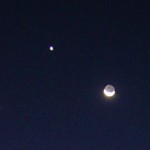
The Moon, Venus and Aldebaran join up for an evening conjunction
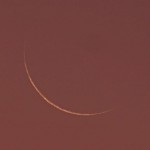
The year begins with a nice pairing of a 17% crescent Moon and a brilliant Venus just 2° apart before dawn tomorrow on New year’s Day. Jupiter and Mercury are also visible in the glow of sunrise below the pair.
The month of January will feature a clutch of bright planets in the dawn. Mercury will disappear into the sun’s glare to be replaced by Saturn emerging from superior conjunction mid-month, joining Venus and Jupiter.
The first meteor shower of 2019 is the annual Quadrantid meteor shower. The Quadrantids are a reliable shower, producing 60-120 ZHR, one to two meteors per minute. The Quadrantids are named for the obsolete constellation Quadrans Muralis, now part of the constellation Boötes.
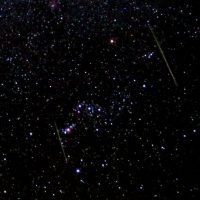
A pair of Leonid meteors streak through Orion
Unlike other showers where activity can occur for days or even weeks, the Quadrantids have a sharp peak, activity falls off rapidly on the preceding and following nights, or even a few hours away from the peak. Thus it is important to observe the Quadrantids quite near the peak prediction.
This year’s peak is calculated for January 4th at 02:20UT, this would be January 3rd at 16:20HST, well timed for observers in Europe, not favorable for observers in these islands. For northern observers the radiant is circumpolar, thus the shower is observable all night long. Given our 20° latitude here in Hawaii the radiant does not rise until 01:30HST, thus observations must wait until well into the morning hours.
New Moon on January 6 creates optimum viewing conditions for the expected Quadrantid maximum on January 4. For many northern hemisphere sites, the shower’s radiant is circumpolar, in northern Boötes, from where it first attains a useful elevation after local midnight, steadily improving through till dawn. The 02h UT timing for the peak will be favourable for European longitudes. The λ⊙ = 283 . ◦16 maximum timing is based on the best-observed return of the shower ever analysed, from IMO data collected in 1992, as confirmed by radio results in most years since 1996. It also coincides with the closest approach to the stream calculated by Jérémie Vaubaillon (λ⊙ = 283 . ◦17). The peak is short-lived with an average duration (full width at half maximum) of about four hours. Hence it can be easily missed if the observer is located outside the “main observing window” – IMO 2019 Meteor Shower Calendar
Watching meteors requires no more equipment than your eyes and a dark sky, and can be enjoyable for just about anyone. While most observers in the northern hemisphere must endure winter conditions to observe this shower, in the islands we have the option of observing from somewhat warmer locations. I think this year’s Quadrantids deserve an early wake-up and a trip into the dark!
It has been too long since I really got out with a telescope. The ‘scopes have been out, but usually doing public work like last weekend’s Winter Star Party at CFHT in Waimea. Time to get a good night for myself.
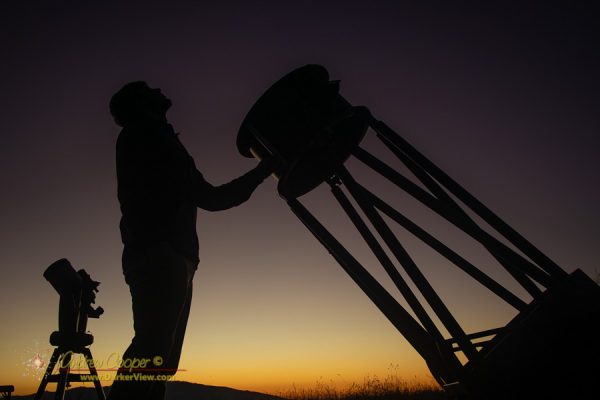
Andrew Unger beside the 20″ Obsession while waiting for properly dark skies at Kaʻohe
As president of our little club I make the schedule and choose the night. Last month was a bust, bad weather rolling in both weekends either side of new Moon. Thus I was pleasantly surprised when this particular Saturday I had chosen looked perfect, not a cloud in the sky over Mauna Kea.
It was the wind that was likely to spoil the night. In Waimea and Waikoloa strong trade winds roared and rushed. A pall of dust could be seen over the whole area from Waimea to the sea. The Kaʻohe site has a particular blessing, it is directly in the lee of the mountain when the trades come out of the nor’east.
It is odd working at a place that everyone wants to visit. To be expected working at the world’s best observatory, after a dozen years the novelty of the situation has never grown old.
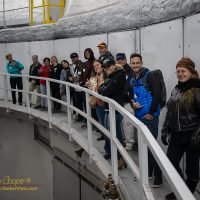
A Kama‘āina Observatory Experience Tour group visiting Keck 2I enjoy leading a tour through the building. Doing a tour gives me a chance to vicariously see the facility through my audience’s eyes, seeing this special place afresh, to renew the fascination and wonder.
I think I am a fairly good tour guide, everyone says so, they might be right. Certainly after a decade of tours I have heard most of the questions and have ready and well rehearsed answers.
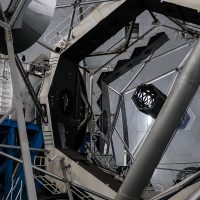
Looking at the primary mirror of the Keck 1 telescopeInside tours of Keck Observatory are currently only available two ways… Know someone who works at the observatory, or take one of the monthly Kama‘āina Observatory Experience tours offered through ‘Imiloa and supported by all of the Mauna Kea observatories.
The KOE tour is free, but open to Hawaii residents only, you have to have a Hawaii ID to go. Each month the tours visit two observatories, rotating through the various observatories on the summit. The tours are also immensely popular, filling up very quickly.
This coming Saturday the KOE tours will visit the James Clerk Maxwell Telescope and the W. M. Keck Observatory. If you are on one of the morning tours, yes, I will be there, leading a tour through our facility.
Today I learned of the passing of Steven Coe, an amateur observer well known and admired in the Arizona community and elsewhere. He had been having health issues on and off for the past few years, but would usually bounce right back and you could again find him out in the dark with a telescope somewhere.
Steven Coe set up at the 2004 All Arizona Star PartyI spent many nights observing with Steve and the rest of the usual gang at star parties in Southern Arizona. Nights at Sentinel or Farnsworth Ranch, he was nearly always there, one of the most dedicated visual observers in the community.
Go to the new moon events in southern AZ, wherever they were that month, and you would find Steve, AJ Crayon, Tom Polakis, and the rest. If everyone was there, it was going to be a good night. They were very memorable nights indeed.
If you saw Steve setting up at a star party you always wanted to setup nearby, you would learn so much just listening through the night. You were always welcome at his eyepiece, and what I saw there was so often something I had never seen before. A distant quasar, or some obscure gem of a nebula not found in the usual guides. Steve knew so much about the sky, and would cheerfully share that knowledge.
This last week we said goodbye to a truly pioneering space telescope. The Kepler mission was designed to find exoplanets, planets that orbit around other stars. The mission succeeded beyond everyone’s expectations.
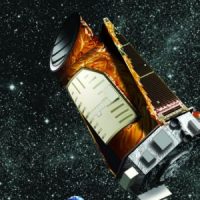
Artist’s rendition of the Kepler Spacecraft in orbit around the Sun peering at a distant solar system, press release image from the NASA Kepler websiteThis little space telescope monitored over 500,000 stars during it’s mission, watching for the minuscule dip in brightness as a panet passed in front of the star. For nine years Kepler stared at those thousands of stars, during that time it discovered over 2,600 exoplanets. Along with the planets came a long list of other discoveries such as binary stars, variable stars, and novae.
After nine productive years this engine of discovery has come to an end. With the spacecraft out of fuel NASA flight engineers sent the last commands, shutting the spacecraft down.
The Keck Observatory and the Kepler Spacecraft had a great partnership. It was not possible to confirm most Kepler’s possible exoplanets using only data from the spacecraft. A large telescope using a high resolution spectrograph, like HIRES on Keck 1, would allow astronomers to not only confirm Kepler’s discovery, but to learn more about each exoplanet.