The forecast looks promising. Not for observing, we lost most of the night last night to fog and clouds, the rest of the week looks worse. It does look like we may get some snow this week. Checking the cameras there are already a few flakes coming down, just a degree or so too warm to stick.
Winter is here… Snow for Christmas?
A few snowflakes in the camera… Snow for the holidays?
Update! Sticking now…
The first snowfall of the 2017-2018 winter season atop Mauna Kea.
Today Mercury will be at maximum eastern elongation, as high in the evening sky as it will appear for this current apparition. After today the planet will slide back into the sunset, passing through inferior conjunction on December 12th to reappear in the morning sky around the end of the year.
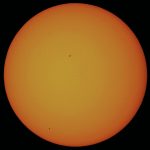
Mercury transiting the Sun on May 9, 2016. Celestron C8 and Canon 6D at f/10.Mercury typically completes three morning and three evening apparitions in each year. While the innermost planet never gets very far from the Sun, maximum elongation represents the best time to observe Mercury as high in the sky as possible.
There are no transits of Mercury in 2017, the next will be Nov 11, 2019.
An international team of astronomers led by Las Cumbres Observatory (LCO) has made a bizarre discovery; a star that refuses to stop shining.
Supernovae, the explosions of stars, have been observed in the thousands and in all cases they marked the death of a star.
Artists impression of a supernova. Credit NASA/ESA/G. Bacon (STSCI)But in a study published today in the journal Nature, the team discovered a remarkable exception; a star that exploded multiple times over a period of more than fifty years. Their observations, which include data from W. M. Keck Observatory on Maunakea, Hawaii, are challenging existing theories on these cosmic catastrophes.
“The spectra we obtained at Keck Observatory showed that this supernova looked like nothing we had ever seen before. This, after discovering nearly 5,000 supernovae in the last two decades,” said Peter Nugent, Senior Scientist and Division Deputy for Science Engagement in the Computational Research Division at Lawrence Berkeley National Laboratory who co-authored the study. “While the spectra bear a resemblance to normal hydrogen-rich core-collapse supernova explosions, they grew brighter and dimmer at least five times more slowly, stretching an event which normally lasts 100 days to over two years.”
Researchers used the Low Resolution Imaging Spectrometer (LRIS) on the Keck I telescope to obtain spectrum of the star’s host galaxy, and the Deep Imaging and Multi-Object Spectrograph (DEIMOS) on Keck II to obtain high-resolution spectra of the unusual star itself.
With the Keck Observatory open house approaching I am helping get one of the most popular activities ready. At the last two open houses we have made flasher pins, we will do so again this year.
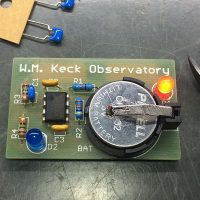
A simple electronics project… The Flasher PinFlashers? These are a simple circuit built on a PCB that flashes a pair of LED’s. Nothing serious, just a bit of electronics fun. The activity allows folks to learn a little electronics and soldering.
The PCB is configured as a pin or badge, with a brooch pin soldered to the back that also serves as a switch to turn on the LED’s.
The original design came from John Maute at SAO. The circuit is based around the venerable LM555 timer IC configured as an astable multivibrator. The LM555 timing circuit is simple enough to solder together in a few minutes, complex enough to look cool and provide a real introduction to an electronic circuit.
Today the planet Uranus will pass through opposition, directly opposite the Sun in our sky. The planet will be well placed for observation all night long, rising at sunset, transiting at midnight, and setting at sunrise. If you are looking to observe Uranus, it is currently shining at magnitude 5.7 in the center of the constellation Pisces.
The planet Uranus as it appears in a mid-sized telescopeAs the outer planets Uranus and Neptune move so slowly across the sky, the timing of oppositions is driven by the Earth’s orbit and occur each year at nearly the same time. The orbital period of Uranus is 84.1 years, taking the better part of a century to circle the celestial globe once.