Dual Laser Milky Way Photo Op

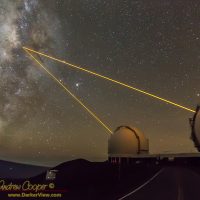
The island is home to a vibrant community of photographers, a mix of professionals and serious amateurs. There is one set of photos everyone, and I do mean everyone wants… Dual lasers on the Milky Way.
Dual Lasers on the Galactic Center
Both Keck lasers aimed at the center of the Milky Way galaxy
Just occasionally both of the keck telescopes, and both lasers, are focused on the center of the galaxy, both stabbing right at the heart of the Milky Way.

Opportunities to see and photograph this are few, and occur strictly during the summer months of June to August, when the Milky Way is high overhead. furthermore, these opportunities occur only when Andre Ghez and her UCLA Galactic Center Group have both telescopes scheduled.

July 25th was such a night, a good opportunity to get both lasers. Andrea’s group has the first half of the night, turning over the ‘scopes to other astronomers just after midnight. Actually there were a few nights this particular week, we just chose the 25th. After this galactic center season is over, at least until next year.

Continue reading “Dual Laser Milky Way Photo Op”

Total Solar Eclipse 2017

On August 21 this year a total solar eclipse will sweep cross the mainland United States, something that has not happened since 1979.

1999 Total Solar Eclipse
The 1999 Total Solar Eclipse, image credit Luc Viator
I have witnessed only one total solar eclipse in my lifetime, the February 1979 eclipse that crossed Oregon and Washington. Our family viewed the eclipse from near Maryhill, Washington, atop one of the high bluffs overlooking the Columbia river. We had a perfect view, a vivid memory that remains with me nearly four decades later. The 2017 event will be similar in some respects, sweeping into North America near the Washington-Oregon border.

Our plan for this eclipse? A little preliminary yet, but starting to shape up. Eastern Oregon should provide a good chance for a clear view in August. Stay in the LaGrande area with family, heading south on eclipse day to a good vantage point near the center-line. Most likely somewhere south of Baker, Oregon. There are a lot of high elevation meadows and mountain roads that should provide a memorable place from which to view this eclipse.

Shooting Sidereal Timelapse

Another night on the summit for photography, another night of dual lasers working the sky above the Keck telescopes.

Sidereal Drive Platform
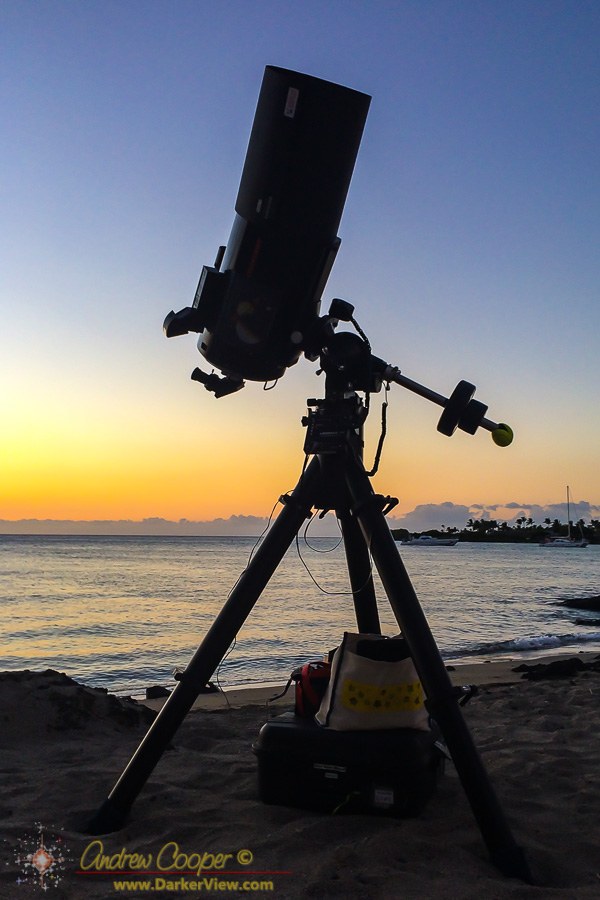
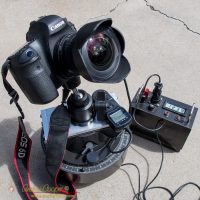
A Celestron telescope drive configured as a sidereal rate tracking camera platform
I have never really had a chance to properly use the old Celestron mount for photography after finishing it a few months back. Short tests, but nothing properly following the sky for hours on end as the equipment was meant to do.

It works, and it works very well indeed.

The video below contains 2.5 hours of time-lapse at 15 second for each exposure for 557 frames. Put that together and render at 24fps and you have the following result…

Mercury at Maximum Elongation

Today Mercury will be at maximum eastern elongation, as high in the evening sky as it will appear for this current apparition. After today the planet will slide back into the sunset, passing through inferior conjunction on August 26th to reappear in the morning sky in mid-September.

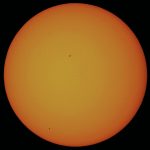
Mercury Transit 9May2016
Mercury transiting the Sun on May 9, 2016. Celestron C8 and Canon 6D at f/10.
Mercury typically completes three morning and three evening apparitions in each year. While the innermost planet never gets very far from the Sun, maximum elongation represents the best time to observe Mercury as high in the sky as possible.

There are no transits of Mercury in 2017, the next will be Nov 11, 2019.

Continue reading “Mercury at Maximum Elongation”

The Moon and Venus

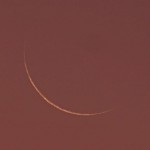
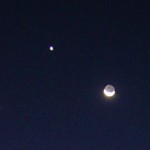
Tomorrow morning, July 20th, a pretty crescent Moon will be located close to a brilliant Venus. The Moon will be a slim 11% crescent a little over 4° from Venus shining at -4.0 magnitude. The pair will rise about three hours before sunrise a bit before 2am, look for the two above the brightening glow of dawn.

e Moon, Venus and Aldebaran
The Moon, Venus and Aldebaran join up for an evening conjunction

Service Call

It does not happen very often, but it does happen. Driving up to the summit in the night to fix the telescope. As an operations engineer it is part of the job, but I can think of only a handful of times in my decade on the summit I have actually done it.

The motor controllers for the Keck 2 top shutter
Considering it takes the better part of two hours to get to the summit there is no point in trying unless the issue occurs early. You have to consider the issue… Can you fix it in the middle of the night? Will there be any night left once you fix it? Do you just call the night and head up the next day with a full crew and a good night’s rest to fix it properly?

This particular problem was discovered first thing upon opening. Well? Lack of opening for the night. The top shutter on Keck 2 would not move, fault lights all over the place. Hard to look at the sky with the top shutter closed. I worked the issue over the phone for a while with Nick as far as we could.

The conclusion? I would have to work the problem in person to fix it, I have to go up.

Can I fix this? Probably. I found myself leaving the house before 9pm for a run to the summit.

Continue reading “Service Call”