4WD and Washboard on Mauna Kea

It has long been policy on the Mauna Kea summit road to use four wheel drive while ascending the mountain. One of the reasons given is to slow the formation of washboard, the annoying ripples that inevitably form on gravel roads.

Convoy
A convoy of observatory vehicles heads up the summit access road

On Mauna Kea an oft cited mantra is that the use of four wheel drive when ascending the mountain reduces the formation of washboard. I have always suspected this is a mountain myth with no substance. Where does this belief come from? Is there any real information on this?

The Manuals

There are a great many references that detail the practical details of maintaining gravel roads. Generations of highway engineers have spent a lot of time studying and writing about how to best maintain gravel roads at the least cost.

Washboard
Typical washboard on the Mauna Kea access road

The US Department of Transportation highway Administration has published a lengthy guide to the problems and solutions of gravel roads. This guide dedicates a dozen pages to the issue of corrugation or washboarding. While multiple factors in the formation and prevention of washboarding are discussed there is no mention of 4WD vehicles being a factor.
Continue reading “4WD and Washboard on Mauna Kea”

Apehelion

Today the Earth is furthest from the Sun, a point called apehelion. We will be about 152,096,000km (94,508,000miles) from the Sun. Compare this to the 147,099,000km (91,403,000miles) we were at perihelion on January 4th, a difference of about 4,996,000km (3,104,000miles) occurring throughout one orbit.

It may seem odd that we are actually at the furthest for the middle of northern summer, you just have to remember that proximity to the Sun is not the cause of the seasons. The seasons are caused by the axial tilt of the Earth, creating short and long days throughout the year, with a resulting change in the angle and intensity of the sunlight.

2017 Solstices and Equinoxes
  UT HST
Perihelion Jan 4 14:18UT Jan 4 04:18HST
Vernal Equinox Mar 20 10:29UT Mar 20 00:29HST
Summer Solstice Jun 21 04:24UT Jun 20 18:24HST
Apehelion Jul 3 20:11UT Jul 3 10:11HST
Autumnal Equinox Sep 22 20:02UT Sep 22 10:02HST
Winter Solstice Dec 21 16:28UT Dec 21 06:28HST
Source: USNO data Services


Old School Drive Corrector

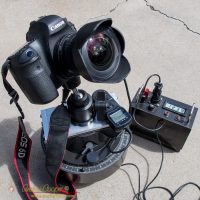
Telescope clock drives from the 1980’s or earlier often used AC synchronous motors. These commonly available AC motors are used to power timeclocks, record player turntables, and telescopes, anyplace a motor needed to run at a very accurate speed.

Sidereal Drive Platform
A Celestron telescope drive configured as a sidereal rate tracking camera platform

The speed of a synchronous motor is set by the frequency of the powerline, in North America and many other places this is 60Hz. As the frequency must be synchronized for every power station on the grid the frequency is quite accurate, a feature exploited by clockmakers and telescope builders. Once found everywhere these motors are less common, but are still around.

Drive Correctors

It was the common use of these motors in telescope drives that led to the invention of the drive corrector, a device that was once a required piece of kit for serious amateur astronomers. Drive correctors like this were needed when operating from a battery at some remote location, generating AC from a 12Vdc car battery.

You also needed a drive corrector for guiding while doing astrophotography. The corrector could speed up or slow down the telescope drive a bit to correct the telescope drive speed and stay on target, something not possible with the fixed 60Hz of the mains supply. Thus the term drive corrector.

Continue reading “Old School Drive Corrector”

Unexpected Classification of Exoplanets Discovered

W. M. Keck Observatory press release

Since the mid-1990s, when the first planet around another sun-like star was discovered, astronomers have amassed an ever-expanding collection of nearly 3,500 confirmed exoplanets.

Exoplanet Formation
Assembly Line of Planets: This diagram illustrates how planets are assembled and sorted into two distinct size classes. Image credit: NASA/Kepler/Caltech (R. Hurt)
In a new Caltech-led study, researchers have classified these exoplanets in much the same way that biologists identify new animal species and found the majority of exoplanets fall into two distinct groups: rocky Earth-like planets and larger mini-Neptunes. The team used data from W. M. Keck Observatory and NASA’s Kepler mission.

“This is a major new division in the family tree of planets, analogous to discovering that mammals and lizards are distinct branches on the tree of life,” says Andrew Howard, professor of astronomy at Caltech and a principal investigator of the new research.

The lead author of the new study, to be published in The Astronomical Journal, is Benjamin J. (B. J.) Fulton, a graduate student in Howard’s group.

In essence, their research shows that our galaxy has a strong preference for either rocky planets up to 1.75 times the size of Earth or gas-enshrouded mini-Neptune worlds, which are from 2 to 3.5 times the size of Earth (or somewhat smaller than Neptune). Our galaxy rarely makes planets with sizes in between these two groups.

“Astronomers like to put things in buckets,” says Fulton. “In this case, we have found two very distinct buckets for the majority of the Kepler planets.”

Continue reading “Unexpected Classification of Exoplanets Discovered”

Mercury at Superior Conjunction

Today Mercury will be at superior conjunction. After today the planet will reappear in the evening sky, rising high enough from the Sun’s glow to be seen early next month.

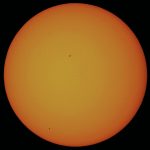
Mercury Transit 9May2016
Mercury transiting the Sun on May 9, 2016. Celestron C8 and Canon 6D at f/10.
Superior conjunction is when the planet passes around the far side of the Sun as seen from Earth. For a few weeks the planet will be lost in the Sun’s glare, hidden from view.

As Mercury is on an orbit inside that of Earth’s it will see both inferior and superior conjunctions as it passes from the evening sky to the dawn sky and back again.

Continue reading “Mercury at Superior Conjunction”