Summer Solstice

Summer solstice occurs today at 18:24HST. Today the Sun will occupy the most northerly position in the sky of the year. The term solstice comes from the latin terms Sol (the Sun) and sistere (to stand still). On this day the Sun seems to stand still as it stops moving northwards each day and begins move to the south. This is the first day of summer as marked by many cultures in the northern hemisphere. Alternately this is the first day of winter for those living south of the equator.

This year many calendars will mark September 21st as the summer solstice, and so it is for much of the world. Here in Hawaiʻi the solstice actually occurs on the 20th when considering the time zone differences.

2017 Solstices and Equinoxes
  UT HST
Perihelion Jan 4 14:18UT Jan 4 04:18HST
Vernal Equinox Mar 20 10:29UT Mar 20 00:29HST
Summer Solstice Jun 21 04:24UT Jun 20 18:24HST
Apehelion Jul 3 20:11UT Jul 3 10:11HST
Autumnal Equinox Sep 22 20:02UT Sep 22 10:02HST
Winter Solstice Dec 21 16:28UT Dec 21 06:28HST
Source: USNO data Services


The Moon and Venus

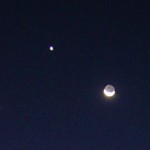
Tomorrow morning, June 20th, a pretty crescent Moon will be located close to a brilliant Venus. The Moon will be a slim 18% crescent a little under 6° from Venus shining at -4.2 magnitude. The pair will rise about three hours before sunrise at about 2am, look for the two above the brightening glow of dawn.

e Moon, Venus and Aldebaran
The Moon, Venus and Aldebaran join up for an evening conjunction

Astronomers Prove What Separates True Stars from Wannabes

W. M. Keck Observatory press release

Astronomers have shown what separates real stars from the wannabes. Not in Hollywood, but out in the universe.

“When we look up and see the stars shining at night, we are seeing only part of the story,” said Trent Dupuy of the University of Texas at Austin and a graduate of the Institute for Astronomy at the University of Hawaii at Manoa. “Not everything that could be a star ‘makes it,’ and figuring out why this process sometimes fails is just as important as understanding when it succeeds.”

Dupuy is the lead author of the study and is presenting his research today in a news conference at the semi-annual meeting of the American Astronomical Society in Austin.

He and co-author Michael Liu of the University of Hawaii have found that an object must weigh at least 70 times the mass of Jupiter in order to start hydrogen fusion and achieve star-status. If it weighs less, the star does not ignite and becomes a brown dwarf instead.

How did they reach that conclusion? The two studied 31 faint brown dwarf binaries (pairs of these objects that orbit each other) using W. M. Keck Observatory’s laser guide star adaptive optics system (LGS AO) to collect ultra-sharp images of them, and track their orbital motions using high-precision observations.

“We have been working on this since Keck Observatory’s LGS AO first revolutionized ground-based astronomy a decade ago,” said Dupuy. “Keck is the only observatory that has been doing this consistently for over 10 years. That long-running, high-quality data from the laser system is at the core of this project.”

Continue reading “Astronomers Prove What Separates True Stars from Wannabes”

Segments!!

Saturn at Opposition

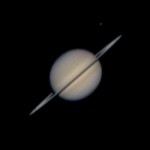
Today the planet Saturn will pass through opposition, directly opposite the Sun in our sky.

Saturn 22Apr2010
Saturn with Titan above
Saturn orbits the Sun once every 29.45 years. As the ringed planet continues on its way the Earth swings around much faster on our inside track. As a result we lap Saturn once every 378.1 days, passing between the planet and the Sun. During opposition Saturn will be well placed for observation all night long, rising at sunset, transiting at midnight, and setting at sunrise.

During opposition the planet and rings will be slightly brighter than normal, an effect known as the opposition effect. The effect is most notable in the rings where the apparent brightness can increase by 30%. The effect is a combination of two factors, shadow hiding and the retro-reflective properties of the ring particles.

Fly Over Jupiter

Take a series of photos from the Juno spacecraft and just project them in sequence to make a timelapse movie of the spacecraft swinging past Jupiter. Sounds easy… Right?

Not easy at all. As the spacecraft orbited past the planet the perspective changes rapidly. To make a natural seeming animation much more would have to be done. Mathematician Gerald Eichstaedt did just that… Taking 36 images he projected each image on a mathematically modeled sphere, then panned through each image using the orbital trajectory of the spacecraft to create a view to simulate actually being there.

Further work by filmmaker Seán Doran smoothed the resulting video into an even more natural view. This created the video posted below. You can see the original video at https://www.youtube.com/watch?v=AuOy-shbQuM&feature=youtu.be

The result is simply stunning, take look at what it would have been like to be there as Juno swung past the planet just a few thousand miles above the cloudtops.


Jupiter: Juno Perijove 06 from Sean Doran on Vimeo.

Venus at Maximum Elongation

Today Venus is at maximum elongation, as high in the dawn sky as it will get for this morning apparition, about 45.9°. After today the planet will begin its slide back into the glare of dawn. It will disappear from view around the end of the year and reach superior conjunction on January 8th, 2018.

As Earth and Venus race about the Sun, Venus will complete about one cycle of appearances each year. We can expect one evening apparition and one morning apparition to occur in 2017.

Continue reading “Venus at Maximum Elongation”