Moonset would not be until nearly 11pm, otherwise the weather looked quite promising for a night on the mauna. The plan… A late arrival and setup at the substation site across the street from the Mauna Kea VIS
Arriving late would mean most of the evening crowd at the visitor station would be gone, taking their headlights with them, hopefully leaving a dark and quiet night to enjoy. This early summer season places the center of the Milky Way high overhead for much of the night for excellent observing possibilities.
Deep Violet set up under Mauna Kea skies waiting for moonset and full darknessSometimes things work out exactly as planned.
Meeting me on the mountain would be David Kriege, owner of Obsession Telescopes. This trip marked his first opportunity for Hawaiian observing and to take advantage of that he brought along a 22″ ultra-compact model. Along with David came Mike, he brought a camera in place of a telescope, not a bad choice with the Milky Way high overhead all night.
A spectacular image taken by the Juno spacecraft just above the cloud tops of Jupiter. Waves of clouds at 37.8 degrees latitude dominate this three-dimensional Jovian cloudscape, courtesy of NASA’s Juno spacecraft. JunoCam obtained this enhanced-color picture on May 19, 2017, at 5:50 UTC from an altitude of 5,500 miles (8,900 kilometers). Image credit: NASA/SWRI/MSSS/Gerald Eichstadt/Sean Doran
Early science results from NASA’s Juno mission to Jupiter portray the largest planet in our solar system as a complex, gigantic, turbulent world, with Earth-sized polar cyclones, plunging storm systems that travel deep into the heart of the gas giant, and a mammoth, lumpy magnetic field that may indicate it was generated closer to the planet’s surface than previously thought.
This image shows Jupiter’s south pole, as seen by NASA’s Juno spacecraft from an altitude of 32,000 miles (52,000 kilometers). Credit: NASA/JPL-Caltech/SwRI/MSSS/Betsy Asher Hall/Gervasio Robles“We are excited to share these early discoveries, which help us better understand what makes Jupiter so fascinating,” said Diane Brown, Juno program executive at NASA Headquarters in Washington. “It was a long trip to get to Jupiter, but these first results already demonstrate it was well worth the journey.”
Juno launched on Aug. 5, 2011, entering Jupiter’s orbit on July 4, 2016. The findings from the first data-collection pass, which flew within about 2,600 miles (4,200 kilometers) of Jupiter’s swirling cloud tops on Aug. 27, are being published this week in two papers in the journal Science, as well as 44 papers in Geophysical Research Letters.
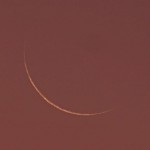
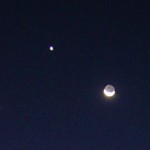
Tomorrow morning, May 22nd, a pretty crescent Moon will be located close to a brilliant Venus. The Moon will be a slim 15% crescent a little over 3° from Venus shining at -4.4 magnitude. The pair will rise about two hours before sunrise at about 3am, look for the two above the brightening glow of dawn.
The Moon, Venus and Aldebaran join up for an evening conjunction
Today Mercury will be at maximum western elongation, as high in the morning sky as it will appear for this current apparition. After today the planet will slide back into the dawn, passing through superior conjunction on June 21st to reappear in the evening in mid-July.
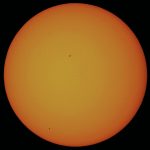
Mercury transiting the Sun on May 9, 2016. Celestron C8 and Canon 6D at f/10.This will be the best morning apparition of the inner planet for 2016. The best evening apparition of 2017 will be in July, with a maximum elongation of over 27°.
There are no transits of Mercury in 2017, the next will be Nov 11, 2019.
Among the tribes of the coastal northwest there is a ceremony that surrounds the first fish of the season. These ceremonies might vary from tribe to tribe, from family to family, but every tribe had such a ceremony.
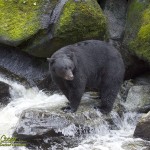
A black bear (Ursus americanus) fishing at the Anan Wildlife Observatory
Life once depended on the yearly return of salmon to the rivers and streams each summer. For bears, eagles, and humans the annual bounty of salmon provided the nourishment that would see them through the long winter. The forest itself benefits from the nutrients carried from distant seas into the trees where the salmon would spawn and die.
Upon catching the first salmon of the season the tribe will stop and celebrate. They celebrate the life of the fish, they celebrate the cycles of the natural world, they celebrate their connection with nature. Some protocols insist that the first fish be released, to continue upriver to spawn, to ensure the salmon continue to return each summer.
That one idea is the critical bit, our connection with nature. Any fisherman understands that he takes from the natural world. A good fisherman stops and considers what he takes. He takes only what he needs to feed his family. This is the entire point of the first fish ceremony, it serves to educate the community in the act of taking, to limit what you take to what the environment can provide.
I grew up in a hunting and fishing family, where a considerable portion of our food came from what my father caught or shot. Be it elk, deer, ducks, razor clams, or smelt, so many of my childhood memories center around the capture, preparation and storage of food… Chopping, packaging and freezing an elk was a serious amount of labor for the entire family.
In the ten years I have lived on island I have never missed an AstroDay. This year was no change to that streak, I volunteered to do the last shift on the Keck Observatory table, 2-4pm. Show up at lunchtime, enjoy the activities myself for a while, say hi to everyone I know there, then do my shift on the table… Good plan.
Thermal image of a young guest at AstroDayWe were using a thermal camera for our primary activity. Instead of borrowing the fancy, and very expensive, FLIR camera from the summit, our outreach group has bought one of the little iPad thermal cameras from Seek Thermal.
I was pleasantly surprised with this little thermal camera, it does a nice job costing only a few hundred dollars. Using the iPad linked to a large display using AirPlay the setup worked quite well in practice. I could handle the camera with no wires to tether me to one place.
It was a last minute request. OK, not actually the last minute, but two days is not much lead time to plan a public outreach event.
Fortunately there was not much to arrange, a single solar telescope and the standard table setup we keep packed and ready to go, all we had to do was show up. Drive up to the Pōhakuloa Training Area to join in their Earth Day events. There would be several hundred students from local schools, tables and displays from other organizations, a good outreach opportunity.
A solar telescope set up at Pōhakuloa Training Area for Earth Day.In ten years of driving past the front gates of PTA, I had never been inside. Why not, just an easy drive from Waikoloa, and I have a telescope that will do the job perfectly.
It seems odd that a military base would celebrate Earth Day. What do attack helicopters, live munitions, and troops have to do with the environment? The answer should not be that surprising… Military bases are often large effective nature reserves.
Large areas of land, much of which sits unused and undisturbed, are closed to public access. An active range needs huge safety and buffer zones around the firing ranges. Of the 133,000 acres that makes up PTA, only a small percentage is directly impacted by the training activities. The rest is home to a endemic and endangered species, closed to any activity that can disturb the land.