
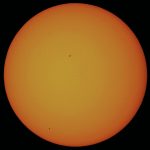
Sun!
When you want to see the stars, find someplace dark

Exploring the cosmos
Where do you go to show a bunch of students from Hawaii Preparatory Academy the stars? Located in Waimea the school has a very nice campus, that is usually under heavy clouds every afternoon and evening. After looking around we settled on Mauna Kea Recreation Area in the saddle between Mauna Loa and Mauna Kea. At 6,700ft elevation the site can offer very good skies for stargazing. This area in the saddle at Pōhakuloa is often cloud free, a curious hole in the clouds between the mauna that tower on either side.
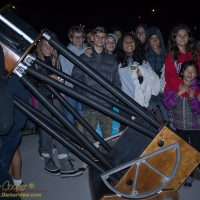
With the opportunity for a reasonably dark sky I brought the 20″ obsession. Tony and Maureen brought 12″ dobs. Tony’s friend Steve brough the 8″ he had just bought from Tony, a first night out with a new ‘scope. Cliff brought his 6″ imaging system set up to show objects on the screen. We had a lot of glass available, good telescopes, and surprisingly good skies.
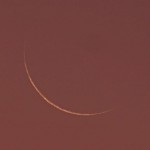
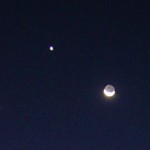
Tomorrow morning, April 23rd, a pretty crescent Moon will be located close to a brilliant Venus. The Moon will be a slim 12% crescent a little over 7° from Venus shining at -4.3 magnitude. The pair will rise about an hour before sunrise at about 4am, look for the two just above the brightening glow of dawn.
Today Mercury will be at inferior conjunction. After today the planet will reappear in the dawn, rising high enough from the Sun’s glow to be seen around the end of the month.
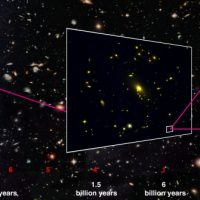
Seven years of meticulous observing have resulted in a cosmic discovery that comes from an era dating back 13.1 billion years, giving scientists a detailed glimpse of what may have happened just after the Big Bang.
Using the world-class W. M. Keck Observatory on Maunakea, Hawaii, an international team of astronomers from the United States, Australia, and Europe has confirmed the existence of one of the most distant galaxies in the universe.
To characterize the faint galaxy, the discovery team, led by Austin Hoag, a University of California, Davis physics graduate student, used MOSFIRE, the most in-demand instrument on the 10-meter Keck I telescope.
What makes this galaxy extraordinary is that it is ordinary. It is thought to be a common galaxy at that distance and age of the universe. However, such galaxies would normally be too faint to detect. The astronomers used a method called gravitational lensing to magnify the galaxy so they could study it.
“Most objects that we’ve seen at that distance are extremely bright, and probably rare compared to other galaxies,” said Hoag. “We think this galaxy is much more representative of other galaxies of its time.”
Continue reading “Primordial Galaxy Discovered, First of Its Kind”
W. M. Keck Observatory press release…
W. M. Keck Observatory overnight captured the very first successful science data from its newest, cutting-edge instrument, the Keck Cosmic Web Imager (KCWI).

“I’m thrilled to see this new instrument,” said Keck Observatory Director Hilton Lewis. “It takes years to design and build these very sophisticated instruments. KCWI is a superb example of the application of the most advanced technology to enable the hardest science. I believe it has the potential to transform the science that we do, and continue to keep Keck Observatory right at the forefront of astronomical research.”
KCWI is extremely sensitive, specifically designed to capture high-resolution spectra of ultra-faint celestial bodies with unprecedented detail. It is able to differentiate even the slightest changes in spectral color with a great degree of accuracy.
This powerful capability is key for astronomers because a highly-detailed spectral image allows them to identify a cosmic object’s characteristics, including its temperature, motion, density, mass, distance, chemical composition, and more.
Continue reading “W. M. Keck Observatory Achieves First Light with New Instrument”
W. M. Keck Observatory press release…
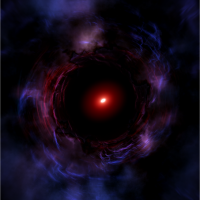
This research publishes today in the journal Nature, with Professor Karl Glazebrook, director of Swinburne’s Centre for Astrophysics and Supercomputing , as the lead author. To characterize the faint galaxy, the discovery team used MOSFIRE, the most in-demand instrument on the 10-meter Keck I telescope.
“This observation was only possible due to the extreme sensitivity of the new MOSFIRE spectrograph,” said Glazebrook. “It is the absolute best in the world for faint near-IR spectra by a wide margin. Our team is indebted to the accomplishment of Chuck Steidel, Ian McClean, and all the Keck Observatory staff for building and delivering this remarkable instrument.”
Astronomers expect most galaxies from this epoch to be low-mass minnows, busily forming stars. However, this galaxy is ‘a monster’ and inactive.
Jupiter will pass through opposition at 10:58HST today.

Look for a bright object rising in the eastern sky after sunset. It is difficult to mistake for anything else, shining at it’s brightest during opposition, a brilliant -2.7 magnitude. For the remainder of the spring and much of the summer, the planet will be quite prominent in the evening sky.