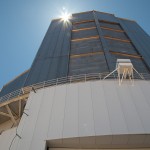
It is always a good day when I drive up the mountain to a broken telescope, then drive down leaving a working telescope. Easy to say, not always easy to accomplish, the simple statement obscuring a day of struggle to solve the problem and fix it.
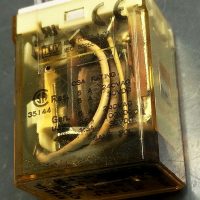
A relay with a blown out coil from the Keck 2 telescope driveSuch a day was Monday.
The Keck 2 telescope drive is a complex beast of dozens of relays, miles of cabling, servo amplifiers and power supplies, plus several circuit boards designed and built in the 1980’s holding a bewildering array of arcane logic.
While most states have yet to see any snow this winter, Hawaiʻi is not one of them. A light dusting of snow graced the summit of Mauna Kea this morning.
Interestingly recent forecasts have revisited the possibility of a La Niña event forming in the central Pacific this fall. If this does come to pass Hawaiʻi may be looking at a wetter than usual winter with the potential of significant snowfall on Mauna Kea. While this can wreak havoc with observatory operations, it can also be quite pretty.
A light dusting of snow on the summit of Mauna Kea on the morning of October 18, 2016A light dusting of snow on the summit of Mauna Kea on the morning of October 18, 2016
Obsession Telescopes are something of a standard in the astronomy community. David Kriege was one of the first to start building truss tube dobsonian telescopes commercially, bringing portable large aperture telescopes to the astronomy community. These telescopes were a bit of a revolution in the pursuit, with sizes unreachable only a decade before, when a 10″ or 12″ telescope was considered big. When I built my 18″ it is David Kriege’s book I used for much of the design, following in the footsteps of so many amateur astronomers.
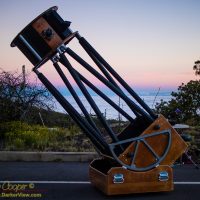
The restored 20″ Obsession telescope set up at hale Pohaku on the side of Mauna Kea
A 20″ f/4 Obsession donated to the observatory has presented a challenge and an opportunity. The telescope was the prized possession of Bob Michael having been ordered new directly from Obsession. The telescope is serial number 004 with a manufacturing date of June 1st, 1990. As David started Obsession Telescope in 1989, this is a very early example of his work. For many years Bob and his wife used this telescope to observe, completing the Herschel 400 and other observing projects. Unfortunately he was forced to give up astronomy due to age and glaucoma, donating his equipment to the observatory.
I have a pile of material that was donated to the observatory. While some of the gear will be used for outreach, a fair amount of the pile is not usable for this. With JoAnne reminding me about the stack in her warehouse it is time for me to sort it out and dispose of it. Among the pile was an entire crate of books… Astronomy textbooks, star charts, observing guides, and more.
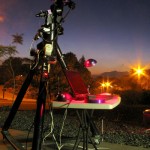
The Losmandy G11 mount setup in the driveway for an evening of astrophotography
This pile of books included a full set of the classic Burnham’s Celestial Handbook, both volumes of Uranometria, and other treasures. After determining the observatory had no need for these I brought them to the last astronomy club meeting and gave them away. It was nice to see these books go to those who would appreciate them.
At the bottom of the pile was something that caught my eye, several old catalogs and manuals. These were just fun to read through. There are both Losmandy and Takahashi catalogs from 1998 and 1999, as well as a manual for a Takahashi FS Series refractor.
The 1999 Losmandy catalog was particularly interesting. My old Losmandy G11 is a workhorse mount, one that has seen many adventures with me. The manual includes a price list, showing that it once sold for $3400, quite a bit more than the $1400 I paid for mine used in about the same era. Interestingly Losmandy still sells this mount and most of same accessories found in this catalog.
As I read I realized that this catalog may also be good to scan and post so that others may find this catalog a useful resource. I hope to scan and post some of the other items in the stack that might be good to save.
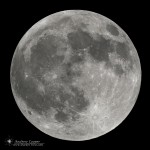
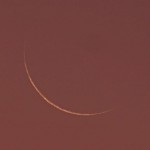
A very young moon over Waikoloa, this is only 26 hours after new, visible to the unaided eye as a sliver in the fading glow of sunsetNew Moon will occur today at 14:12HST.