Conjunction

Only once before have I seen Jupiter and Venus this close, many years ago. Being close enough to fit in the same eyepiece field is quite interesting, particularly with enough magnification to see the moons and planet details well.

If you have not been paying attention the evening planet dance is in full swing, Mercury, Venus and Jupiter all in close attendance.

This evening was the close approach of Jupiter and Venus. I set up a telescope briefly to capture the conjunction. More than a little overexposed, but you can see the moons of Jupiter this way…

Venus and Jupiter
Venus and Jupiter in conjunction on Aug 27, 2016. The star at lower right is Beta Virginis

Scientists Discover Massive Galaxy Made of 99.99 Percent Dark Matter

W. M. Keck Observatory press release

Using the world’s most powerful telescopes, an international team of astronomers has discovered a massive galaxy that consists almost entirely of Dark Matter. Using the W. M. Keck Observatory and the Gemini North telescope – both on Maunakea, Hawaii – the team found a galaxy whose mass is almost entirely Dark Matter. The findings are being published in The Astrophysical Journal Letters today.

Dragonfly 44
The dark galaxy Dragonfly 44. Credit: Pieter Van Dokkum, Roberto Abraham Gemini, Sloan Digital Sky Survey
Even though it is relatively nearby, the galaxy, named Dragonfly 44, had been missed by astronomers for decades because it is very dim. It was discovered just last year when the Dragonfly Telephoto Array observed a region of the sky in the constellation Coma. Upon further scrutiny, the team realized the galaxy had to have more than meets the eye: it has so few stars that it quickly would be ripped apart unless something was holding it together.

To determine the amount of Dark Matter in Dragonfly 44, astronomers used the DEIMOS instrument installed on Keck II to measure the velocities of stars for 33.5 hours over a period of six nights so they could determine the galaxy’s mass. The team then used the Gemini Multi-Object Spectrograph (GMOS) on the 8-meter Gemini North telescope on Maunakea in Hawaii to reveal a halo of spherical clusters of stars around the galaxy’s core, similar to the halo that surrounds our Milky Way Galaxy.

Continue reading “Scientists Discover Massive Galaxy Made of 99.99 Percent Dark Matter”

Cosmic Neighbors Inhibit Star Formation, Even in the Early-Universe

W. M. Keck Observatory press release

Galaxy cluster MACS J0416
Massive galaxy cluster MACS J0416 seen in X-rays (blue), visible light (red, green, and blue), and radio light (pink). Credit: NASA, CXC, SAO, G.Ogrean, STSCI, NRAO, AUI, NSF
The international University of California, Riverside-led SpARCS collaboration has discovered four of the most distant clusters of galaxies ever found, as they appeared when the Universe was only four billion years old. Clusters are rare regions of the Universe consisting of hundreds of galaxies containing trillions of stars, as well as hot gas and mysterious Dark Matter. Spectroscopic observations from the W. M. Keck Observatory on Maunakea, Hawaii and the Very Large Telescope in Chile confirmed the four candidates to be massive clusters. This sample is now providing the best measurement yet of when and how fast galaxy clusters stop forming stars in the early Universe.

“We looked at how the properties of galaxies in these clusters differed from galaxies found in more typical environments with fewer close neighbors,” said lead author Julie Nantais, an assistant professor at the Andres Bello University in Chile. “It has long been known that when a galaxy falls into a cluster, interactions with other cluster galaxies and with hot gas accelerate the shut off of its star formation relative to that of a similar galaxy in the field, in a process known as environmental quenching. The SpARCS team have developed new techniques using Spitzer Space Telescope infrared observations to identify hundreds of previously-undiscovered clusters of galaxies in the distant Universe.”

Continue reading “Cosmic Neighbors Inhibit Star Formation, Even in the Early-Universe”
Perseid Meteor Shower

Over the next few days the Perseid meteor shower will peak. As the most reliable shower each year this is also the most viewed meteor shower. Plentiful shooting stars combined with warm summer evenings makes this shower the easiest and most comfortable to view across much of the northern hemisphere.

The comfort of summer meteor observing marks quite a difference from the other reliable showers such as the Leonids and Quadrantids, that occur in November and January. Consider a warm summer night under a dark sky full of stars, a picnic blanket, relaxing while shooting stars streak across the sky. What could be better?
Leonids in Orion
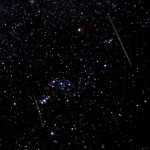
A pair of Leonid meteors streak through Orion
The Perseid meteor shower occurs when the Earth passes through a stream of debris along the orbit of Comet Swift-Tuttle. This shower has been consistent throughout recorded history, mentioned in Chinese, Japanese and Korean records as early as the 1st century.

Active from July 17th to August 24th, the shower will build slowly for weeks before the peak. A week before or after peak the shower can still be seen with around 20 meteors each hour. With a radiant high in the constellation of Perseus this is a northern hemisphere shower, for southern observers the radiant never rises above the horizon.

Continue reading “Perseid Meteor Shower”

The Moon and Jupiter

This evening at sunset a nice crescent Moon and the bright planet Jupiter will be quite close. As sunset around 19:00 the two will be separated by a mere 46′, just a little over the width of the full Moon. The two should make a very attractive pair as they sit above the glow of sunset.

Keep an eye out for Mercury and Venus closer to the horizon. At 19:00 Venus will be 9° above the horizon with Mercury a bit higher at 14°. The Moon and Jupiter will be higher yet around 25°. Since Mars and Saturn are also visible in the southern sky all five naked eye planets will be visible.

UCLA Astronomers Use Keck Observatory to Look Back 12 Billion Years and Measure Oxygen

W. M. Keck Observatory press release

UCLA astronomers have used the W. M. Keck Observatory on Maunakea, Hawaii to make the first accurate measurement of the abundance of oxygen in a distant galaxy. Oxygen, the third-most abundant chemical element in the Universe, is created inside stars and released into interstellar gas when stars die. Quantifying the amount of oxygen is key to understanding how matter cycles in and out of galaxies. This research is published online in the Astrophysical Journal Letters.

COSMOS-1908
Galaxy COSMOS-1908 is in the center of this Hubble Space Telescope image, indicated by the arrow. Nearly everything in the image is a galaxy.
Credit: Ryan Sandres and the CANDELS Team
“This is by far the most distant galaxy for which the oxygen abundance has actually been measured,” said Alice Shapley, a UCLA professor of astronomy, and co-author of the study. “We’re looking back in time at this galaxy as it appeared 12 billion years ago.”

Knowing the abundance of oxygen in the galaxy called COSMOS-1908 is an important stepping stone toward allowing astronomers to better understand the population of faint, distant galaxies observed when the Universe was only a few billion years old, Shapley said.

COSMOS-1908 contains approximately one billion stars. In contrast, the Milky Way contains approximately 100 billion stars. Furthermore, COSMOS-1908 contains approximately only 20 percent the abundance of oxygen that is observed in the Sun.

Continue reading “UCLA Astronomers Use Keck Observatory to Look Back 12 Billion Years and Measure Oxygen”

The Moon and Venus

A very thin crescent Moon will pair with Venus in the sunset this evening. The Moon will be about 3.5° from Venus, well above the glow of sunset, perfectly placed to create a nice view. With sunset occurring at 18:58 HST, the pair will be 10° above the horizon at 19:00 and will set almost an hour later at 19:48 HST. The Moon will be quite thin, only 1.9% illuminated and only 1.3 days old. Creating a triangle with the pair of solar system bodies, the bright star Regulus will be 2° above Venus, while Mercury will be 8° higher in the sky. Jupiter will also be visible higher in the evening sky making for a nice lineup of bright planets.

Earthshine
A young crescent Moon, overexposed to show the remainder lit by reflected light from the Earth.