This evening at sunset a nice crescent Moon and the bright planet Jupiter will be quite close. As sunset around 19:00 the two will be separated by a mere 46′, just a little over the width of the full Moon. The two should make a very attractive pair as they sit above the glow of sunset.
Keep an eye out for Mercury and Venus closer to the horizon. At 19:00 Venus will be 9° above the horizon with Mercury a bit higher at 14°. The Moon and Jupiter will be higher yet around 25°. Since Mars and Saturn are also visible in the southern sky all five naked eye planets will be visible.
UCLA astronomers have used the W. M. Keck Observatory on Maunakea, Hawaii to make the first accurate measurement of the abundance of oxygen in a distant galaxy. Oxygen, the third-most abundant chemical element in the Universe, is created inside stars and released into interstellar gas when stars die. Quantifying the amount of oxygen is key to understanding how matter cycles in and out of galaxies. This research is published online in the Astrophysical Journal Letters.
Galaxy COSMOS-1908 is in the center of this Hubble Space Telescope image, indicated by the arrow. Nearly everything in the image is a galaxy. Credit: Ryan Sandres and the CANDELS Team“This is by far the most distant galaxy for which the oxygen abundance has actually been measured,” said Alice Shapley, a UCLA professor of astronomy, and co-author of the study. “We’re looking back in time at this galaxy as it appeared 12 billion years ago.”
Knowing the abundance of oxygen in the galaxy called COSMOS-1908 is an important stepping stone toward allowing astronomers to better understand the population of faint, distant galaxies observed when the Universe was only a few billion years old, Shapley said.
COSMOS-1908 contains approximately one billion stars. In contrast, the Milky Way contains approximately 100 billion stars. Furthermore, COSMOS-1908 contains approximately only 20 percent the abundance of oxygen that is observed in the Sun.
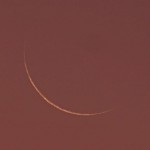
A very thin crescent Moon will pair with Venus in the sunset this evening. The Moon will be about 3.5° from Venus, well above the glow of sunset, perfectly placed to create a nice view. With sunset occurring at 18:58 HST, the pair will be 10° above the horizon at 19:00 and will set almost an hour later at 19:48 HST. The Moon will be quite thin, only 1.9% illuminated and only 1.3 days old. Creating a triangle with the pair of solar system bodies, the bright star Regulus will be 2° above Venus, while Mercury will be 8° higher in the sky. Jupiter will also be visible higher in the evening sky making for a nice lineup of bright planets.
A young crescent Moon, overexposed to show the remainder lit by reflected light from the Earth.
A very young moon over Waikoloa, this is only 26 hours after new, visible to the unaided eye as a sliver in the fading glow of sunsetNew Moon will occur today at 10:45HST.
For much of the month all five naked eye planets will be visible at sunset. Mercury, Venus, Mars, Saturn, and Jupiter can all be seen easily if one knows where to look. Indeed, four of the five are quite bright and quite hard to miss. Neptune and Uranus are generally too faint to be seen without optical aid.
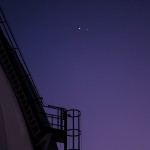
Venus and Jupiter over the Keck 1 domeTonight, August 1st, Venus is just rising high enough to be easily seen. It will be a mere 5° above the horizon at 19:30, probably bright enough to be seen against the glow. You can find Mercury a little higher, about 10° above the horizon. Jupiter is obvious well above the sunset as a bright object shining at -1.7 magnitude. Mars and Saturn are visible to the south on the top of Scorpio.
There will be a nice conjunction of the Moon and Jupiter, only 46′ apart, on the 5th of August. Mercury reaches eastern elongation on the 16th of the month. A beautiful triplet of Mercury, Venus, and Jupiter will gather in the days around the 22nd. Keep an eye to the sky for the month to be treated to some nice planetary views.
An international team of astronomers have discovered and confirmed a treasure trove of new worlds. The researchers achieved this extraordinary discovery of exoplanets by combining NASA’s K2 mission data with follow-up observations by Earth-based telescopes including the W. M. Keck Observatory on Maunakea, the twin Gemini telescopes on Maunakea and in Chile, the Automated Planet Finder of the University of California Observatories and the Large Binocular Telescope operated by the University of Arizona. The team confirmed more than 100 planets, including the first planetary system comprising four planets potentially similar to Earth. The discoveries are published online in The Astrophysical Journal Supplement Series.
Image montage showing the Maunakea Observatories, Kepler Space Telescope, and night sky with K2 Fields and discovered planetary systems (dots) overlaid. Credit: Karen Teramura/IFA , Miloslav Druckmüller, NASAIronically, the bounty was made possible when the Kepler space telescope’s pointing system broke.
In its initial mission, Kepler surveyed a specific patch of sky in the northern hemisphere, measuring the frequency with which planets whose sizes and temperatures are similar to Earth occur around stars like our sun. But when it lost its ability to precisely stare at its original target area in 2013, engineers created a second life for the telescope that is proving remarkably fruitful.
Not a call I want to get just a few hours before our astronomy club meeting… My presenter for the evening? Tooth extraction?
Andrea Ghez talking at the July WHAC meetingYeah, we have no main lecture for the evening.
The West Hawaii Astronomy Club is not a large club, more than a dozen folks is a big meeting. Still, these are dedicated amateur astronomers that can be relied upon to help out with school star parties and observatory events. They have driven all the way to Waimea because I promised them a lecture from an astronomer. A few folks come from Kona 45 minutes to an hour away. I really want to give them something worth the effort of getting here.
They will just have to settle for a talk with Andrea Ghez.
Yes, that Andrea, the closest thing we have to a superstar in astronomy. Discoverer of the black hole at the center of our galaxy, winner of the Crafoord Prize and the Bakerian Medal… That Andrea.
I ran into Andrea at dinner next door to the observatory, we know each other from other outreach events and swapping photos. She is a regular Keck observer with research that concentrates on the massive black hole at the core of our Milky Way galaxy. I asked her if she could come talk with the club, or rather I begged a bit. Being the gracious lady she is, she said yes. Thanks Andrea!!
It was so much better than the warmed over presentation I had thought I would be giving this evening. The small group allowed something closer to a conversation than a lecture. There were some good questions too! We moved past the basics pretty quickly with a group that knew more than a little about the subject. I found the evening very informative, I think everyone did.