
Keck in the Dawn
When you want to see the stars, find someplace dark

Exploring the cosmos

W. M. Keck Observatory press release…
An international team of scientists has detected and confirmed the faintest early-Universe galaxy ever using the W. M. Keck Observatory on the summit on Maunakea, Hawaii. In addition to using the world’s most powerful telescope, the team relied on gravitational lensing to see the incredibly faint object born just after the Big Bang. The results are being published in The Astrophysical Journal Letters today.

The detection was made using the DEIMOS instrument fitted on the ten-meter Keck II telescope, and was made possible through a phenomenon predicted by Einstein in which an object is magnified by the gravity of another object that is between it and the viewer. In this case, the detected galaxy was behind the galaxy cluster MACS2129.4-0741, which is massive enough to create three different images of the object.
“Keck Observatory’s telescopes are simply the best in the world for this work,” said Marusa Bradac, a proefssor at University of California, Davis who led the team. “Their power, paired with the gravitational force of a massive cluster of galaxies, allows us to truly see where no human has seen before.”
Continue reading “Faintest Early-Universe Galaxy Ever, Detected and Confirmed”

I have been trying to get some good photos of both Keck lasers on the galactic center for some years. Other photographers have produced spectacular photos that have me seething with envy. Why can I not get equivalent photos? It is not like I have a lack of access. The answer is mostly bad luck and circumstance. I do work, this limits the nights I can make the attempt. On those times I have ascended the mountain to photograph I have been plagued by bad weather.

This year looked to be much the same. The night was set, I had volunteered to host several local photographers, we had film permits on-hand, an observatory vehicle reserved, all the arrangements made. The only issue? The Mauna Kea Weather Center forecast promised high clouds and fog for the night. I was bracing for yet another disappointment.
W. M. Keck Observatory press release…
An International team led by scientists at ETH Zurich in Switzerland used the W. M. Keck Observatory to study the role of star formation rates in metal contents of distant galaxies. What they discovered is the amount of metals are very similar, irrespective of galaxies’ star formation activity, raising new questions about star-forming theory. Their findings were recently published in the Astrophysical Journal.

The team found typical galaxies forming stars in the Universe two billion years after the Big Bang have only twenty percent of metals (elements heavier than Helium) compared with those in the present day Universe. They also discovered the metal content is independent of the strength of the star-formation activity – in stark contrast with what is known for recently formed, or nearby galaxies.
Continue reading “Metal Content in Early Galaxies Challenges Star Forming Theory”
W. M. Keck Observatory press release…
The search for planets orbiting other stars in our galaxy has revealed an extraordinary family of planets whose orbits are so carefully timed that they provide long-term stability for their planetary system. The data came from observations from the Kepler Space Telescope and the W. M. Keck Observatory on Maunakea, Hawaii. A paper describing the formation of this planetary system by a research team was published in the journal Nature today.

Continue reading “Four Synchronized Planets Reveal Clues to How Planets Form”
It was a beautiful morning! Alarm set for 4:30am, out of the house at 5am, setup just at sunrise on the old Saddle Road. The sun rose through low clouds over the grasslands of Parker Ranch with Waimea to one side and Mauna Kea on the other.
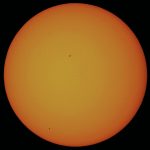
The seeing was pretty horrible at sunrise but rapidly improved as the Sun rose. As the transit ended the seeing was quite sharp and the photos not all that bad. At least as long as I kept the shutter speeds high. Visually the view was quite nice, a sharp black dot against the Sun, a far cry from the dancing blur you usually see when trying to view Mercury in the glow of Sunset.
Just a quick reminder that mercury will transit the face of the Sun tomorrow morning. You can read full details in my earlier post or check out a decent transit calculator. For observer in Hawaii the transit will already be well underway at sunrise, making this a set-the-alarm-early exercise. My telescope and solar filter are already loaded… Are yours?
