Mercury Transit

Both of the planets that orbit closer to the Sun, Mercury and Venus, can be seen to cross the face of the Sun if everything lines up just right. The last transit of Venus was in 2012. It has been much longer since a transit of Mercury, that last occurred in 2006.

Transit of Mercury
The 2006 transit of Mercury, photographed with a 90mm telescope and a Canon 20Da

In comparison the the rare transits of Venus, transits of Mercury are fairly common. There are 13 or 14 transits of Mercury each century, meaning there is a transit on average every seven years. On May 9th this year we have another chance to observe a Mercury Transit.

Photographing the Transit
Photographing the 2006 transit of Mercury from Tucson
Back in 2006 I took the day off work and photographed the transit from my backyard in Tucson. As a transit is a five hour event the effort to observe the entire thing takes a while.

Mercury is quite small with respect to the Sun. During the transit the planet will be a mere 12-13 arcsec across. Considering the Sun is about 1920 arcsec across, the planet will be a fairly small dot on the face of the Sun.

In some respects a transit is the clearest view of Mercury small telescope users are able to view. Normally observed low on the horizon, the innermost planet never gets far from the Sun. During transit a fairly sharp disk can be seen, far better then the mushy view offered near the horizon at sunset and dawn.

First Contact 11:12 UT 1:12 HST
Second Contact 11:15 UT 1:15 HST
Mid-Transit 14:57 UT 4:57 HST
Third Contact 18:39 UT 8:39 HST
Last Contact 18:42 UT 8:42 HST

2016 May 09 Mercury Transit
Unfortunately for observers in the middle of the Pacific the 2016 transit will begin well before dawn. It is only the last hour or so of transit that will be easily visible as the morning Sun rises into the sky. Viewers in eastern North America and Europe will have a better vantage point for this transit.

Please exercise caution when viewing the Sun! Use appropriate eye protection or indirect observing techniques to project an image of the Sun. The link at the start of this paragraph leads to a great discussion on viewing the Sun safely. As always the single best source on the web (or anywhere) for eclipse and transit information is Fred Espenak’s eclipse website at NASA. Stop by whenever you have a question on upcoming events as well as viewing and photography tips.

The next Mercury transit will occur November 11, 2019. This next transit also favors Europe as mid transit occurs at 15:20UT. For the next Venus transit? You are out of luck as it occurs in 2117, over a century away.

New Hypervelocity Binary Star Challenges Dark Matter, Stellar Acceleration Models

W. M. Keck Observatory press release

A team of astronomers at the Friedrich Alexander University led by Péter Németh has discovered a binary star moving nearly at the escape velocity of our galaxy. There are about two dozen so-called hypervelocity stars known to be escaping the galaxy. While all of them are single stars, PB3877 is the first wide binary star found to travel at such a high speed. Additionally, the results of the new study challenge the commonly accepted scenario that hypervelocity stars are accelerated by the supermassive black hole at the galactic center. The findings are being published in the Astrophysical Journal Letters today.

PB3877 Binary
PB3877 is a hyper-velocity wide binary star zooming through the outskirts of the Milky Way galaxy. This image shows its current location as well as our Sun.
The team, in collaboration with researchers from the California Institute of Technology, showed the binary cannot originate from the Galactic Center, and no other mechanism is known that is able to accelerate a wide binary to such a high velocity without disrupting it. They therefore hypothesized there must be a lot of dark matter to keep the star bound to the Milky Way galaxy; or the binary star, PB3877, could be an intruder that has been born in another galaxy and may or may not leave the Milky Way again.

PB3877 was first reported to be a hyper-velocity, hot compact star, when it was discovered form the Sloan Digital Sky-Survey (SDSS) data in 2011. New spectroscopic observations were done with the 10 meter Keck II telescope at W. M. Keck Observatory on Maunakea, Hawaii and with the 8.2 meter Very Large Telescope (VLT) of the European Southern Observatory (ESO) in Chile.Caltech astronomers Thomas Kupfer and Felix Fürst observed PB3877 with the ESI Instrument fitted on the Keck II telescope.

“When we looked at the new data, much to our surprise, we found weak absorption lines that could not come from the hot star,” Kupfer said. “The cool companion, just like the hot primary, shows a high radial velocity. Hence, the two stars form a binary system, which is the first hyper-velocity wide binary candidate.”

Continue reading “New Hypervelocity Binary Star Challenges Dark Matter, Stellar Acceleration Models”

Spot a Young Moon

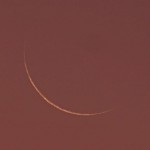
At sunset this evening the Moon will be less than a day past new, about 20 hours old and only 0.7% illuminated. It is possible, if somewhat challenging, to spot this very thin crescent in the evening sky deep in the bright glow of sunset.

Young Moon
A very young moon over Waikoloa, this is only 26 hours after new, visible to the unaided eye as a sliver in the fading glow of sunset

This evening the Sun will set at 18:39 and the Moon will set at 19:21, about ten degrees behind the Sun. Thus a low and clear western horizon is a necessity for locating the Moon tonight. Optical aid will also be very useful, once the correct area is located the Moon can often easily be found by sweeping the area with binoculars. A small, rich field telescope with a field of several degrees across can also be used.

The effort is aided a bit by the presence of the bright planet Mercury in the sunset this evening. The planet will be seven degrees higher in the sky and just a bit north of the Moon. If you find Mercury at 19:00HST, the Moon will be 5 degrees below the planet and four degrees to the south in azimuth.

In several cultures with lunar calendars the spotting of a young crescent Moon like this marks the beginning of the month. Often Moon sightings are used to determine religious holidays and other important events of the year. It is also an good challenge to practice your observational skills. have fun!

Jupiter 27 March 2016

Another pass on Jupiter this evening, the string of decent seeing nights has continued. I am working on improving the setup and my technique. I had been using a diagonal to mount the camera… That is gone. I futzed with the collimation a bit, but it really is quite close. I need to figure out how to get a barlow into this arrangement, do they make a rear cell thread barlow like the focal reducer?

The seeing really does appear to be my greatest limitation. Planning a trip to better seeing in the next couple weeks.

It is not an Easter egg, but this will have to do, the closest I have for the day…

Jove 20160327
Jupiter on March 27th, 2016. Celestron 11″ and a Canon 60D @ f/10

Jupiter Again

After a stormy Friday night we had clear skies and decent seeing over Waikoloa again last night. Again I set up the telescope for a little planetary photography. The seeing was marginally better, and so is the resulting image.

The night also featured three moons in close to the planet. Io can be seen alone to one side of the Planet while Europa and Ganymede form a close pair. Ganymede is the larger moon and slightly closer to the planet

I really need to do this from the summit under good seeing some time.

Jove 26Mar2016
Jupiter under moderately good seeing from Waikoloa

Ceres Up Close

Dawn has been in orbit around Ceres for over a year now, having entered orbit back on March 6th, 2015. Most of the dwarf planet has been photographed and mapped in high resolution now, creating beautiful imagery that reveals a great deal of interesting terrian. As we have seen with other dwarf planets like Pluto, these little worlds are surprisingly dynamic places, hardly the dead rocks one might have expected.

The bright features in Occator crater have been revealed to be some sort of cryovolcano. While not certain, the bright is likely to be water ice, or perhaps a briny, salt and water mixture. There has even been some evidence of vapor observed over the crater, possibly from sublimating ices.

I am sure this is a large disappointment to those who claimed it was some sort of alien base. Not that this has stopped the claims, they are just more modest in size. You can find YouTube videos of folks combing through the high resolution images and claiming any little feature that is slightly regular looking is some alien artifact.

More enjoyable to watch is a JPL video pointing out the highlights of Ceres…

Jupiter High

Jupiter passed through opposition back on March 7th. Thus the giant planet is high in the sky through much of the night, well placed for observations.

Jove 20160324
Jupiter on March 24th from Waikoloa
I was thinking of going to bed, but it was a hot windless evening in Waikoloa, not much point in trying to sleep before it cooled off a bit. The dead calm conditions made me think… What is the seeing like? A question only an amateur astronomer would ask.

Turns out the seeing was pretty good. The typical horrible seeing in Waikoloa is 2 to 3 arcseconds or worse, when the trades are blowing it can be quite bad. I suspect the seeing was 1 arcsecond or better last night, the view of Jupiter in the eyepiece was quite pleasing. Putting a camera in place of the eyepiece yielded video worth the effort in processing.