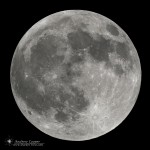
Full Moon taken 27Aug2007, 90mm f/12 APO and Canon 20DaFull Moon will occur today at 02:01HST.
This full moon will feature a penumbral lunar eclipse visible across the Pacific region. It will be well placed for observers in the Hawaiian Islands where the entire eclipse from beginning to end will be visible. Do not expect much, penumbral lunar eclipses involve only a slight dimming of the Moon, it is unlikely to be noticeable without instrumentation.
The vernal or spring equinox occurs today at 18:30HST. Today there will be little difference between the length of the night when counted against the number of daylight hours. This is the first day of spring as marked by many cultures in the northern hemisphere.
Yeah, I did another Messier marathon, You know, that crazy exercise where you attempt to find all 110 Messier objects in a single night. A bit crazy, but also rather addicting. I am a somewhat of a purist, I use no computerized telescope, just a chart, a Telrad, and my knowledge of the night sky. This makes a Messier marathon a real challenge.
A few clouds wandering across the western horizon, some near, some far. At least there is some blue sky!I had invited a few other folks to join me at the Kaʻohe observing site on the side of Mauna Kea. A few other observers had indicated they would be there, I even had a DLNR permit for a small group to join me and a few extra checklists printed out. It was the clouds that convinced the others not to make the attempt. Thus, in the end I had the night to myself. Mostly.
Even if the clouds spoiled the event there was not much to risk. May as well pack up and drive to the site, as the organizer I pretty much had to be there in case any of the others responded to my invitation. This outing would not take much preparation, a cooler packed with munchies and drinks to get me through the night and one of my smaller telescopes. There is not much question as to which telescope I will use… Primero, my 6″ RFT and the veteran of many Messier marathons. it is this instrument with which I achieved my one perfect 110 score at the All Arizona Messier Marathon many years ago.
My first attempt at a proper Milky Way arch photograph. Not easy to stitch properly, but worth the effort! Click on the image for a file size large enough to properly enjoy…
The winter Milky Way arches over Hualālai with Orion and the setting Moon at the center, taken from the Kaʻohe observing site, panorama of five images taken with a Canon 6D and a Rokinon 14mm lens with over 300 degrees of horizon
The seeing was terrible, but at least we could see the Sun while much of the island was overcast and raining. I had hoped to set up in the parking lot for Puʻukohala Heiau but arrived a few minutes after they closed the gate. Instead I set up just below at Spencer Beach park.
Of course the telescope drew a crowd of folks who wanted a look. No matter, an eclipse is a slow motion affair with plenty of time to share the eyepiece. I showed my guests how to take photos with their cell phones at the eyepiece, so everyone got a photo or three of the event.
The solar eclipse of March 8th, 2016 taken from Spencer Beach State Park. Celestron C8 with a Canon 6D at cassegrain focus, 2000mm focal length
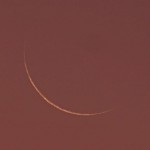
A very young moon over Waikoloa, this is only 26 hours after new, visible to the unaided eye as a sliver in the fading glow of sunsetNew Moon will occur today at 15:45HST.
A partial solar eclipse from Kawaihae, 9 May 2013Just a reminder that later today there will be a solar eclipse. This is a total with the path of totality passing north of the main Hawaiian Islands near Midway. For the Big Island this will be a deep partial, about 55%.
The tropical environment of Hawaiʻi is not kind to optical instruments. Tropical humidity can cause a host of issues ranging from corrosion of metal parts to decay of wooden and cardboard telescope structures. For those of us who build and use small telescopes the issues of tropical heat and humidity are rather concerning.
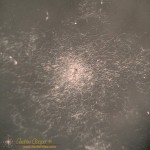
Fungus colony on a small achromatic lens surfaceWorst of all is the fungus. Impressively there are species of fungus that can grow and thrive on clean optical surfaces. It is hard to imaging a more hostile place to grow, seemingly devoid of nutrients and the moisture necessary for life.
I have seen camera lenses lost to the white fungus. A friend once showed me a Canon 70-200 f/2.8 L, a $2000 lens, with fungus covering internal elements. Even on the “dry side” of Waimea the humidity was high enough to allow fungus to destroy this lens.
The problem is not an issue on the summit of Mauna Kea. The high altitude air typically exhibits a relative humidity of less than 10%. Several references note that a humidity of above 70% is needed to promote fungal growth on optics. We see no issues with fungal damage to the mirrors or instruments on the big ‘scopes.
Below the tropical inversion layer (about 6-7k feet) it is another issue entirely. Near sea level, where most of us live, humidity can remain above 80% much of the year. The warm and humid conditions of these islands are idea for growing anything, including the omnipresent fungal gardens that create the smells of a tropical landscape. Fungus is inescapable in this world, the spores drift on the wind and an stay dormant for decades, anywhere conditions are suitable fungus will grow.
The possibility of equipment damage was a major element in our buying a house. Waikoloa is located within one of the driest areas of the island. The humidity typically hovers in the 50’s, dry enough that I have had no issues with the multiple telescopes stored in the garage. Still, I do inspect stored equipment periodically, looking for the dreaded white fungus or other damage wrought by this tropical climate.
It is not a single species of fungus responsible for the problem. Apparently quite a few species are able to colonize an optical surface. Looking through the literature I find referenced to multiple species that can grow on optical glass…
The fungi which grow in optical instruments belong to the groups Phycomycetes, Ascomycetes and Fungi Imperfecti. The following species were frequently isolated from instruments which had been in New Guinea: Penicillium spinulosum, Thom.; P. commune, Thom.; P. citrinum, Thom.; Aspergillus niger, Van Tiegh.; Trichoderma viride, Pers. ex-Fr.; Mucor racemosus, Fres.; and M. ramannianus, A. Moeller. So far, Monilia crassa has not been isolated from Australian instruments, although Dr. W. G. Hutchinson (5) of the United States, found this to be a common species in the Panama zone, and it has also been recorded as frequent in West Africa by Major I. G. Campbell. – J.S. Turner, et al.1
I admit that the fungus can be pretty, in an odd sort of way considering the damage. Under a microscope it appears lacy, the mycelium fibrils growing across the glass in search of more nutrients to support the colony. In the center small round fruiting bodies are the launching point for new fungal spores.
I recently had another round of battle with fungus while restoring a collection of instruments that had been stored in a garage on the side of Hualalai. The high humidity had wrought impressive damage on both the optics and metal components of the telescopes. And there is fungus! Found in the eyepieces and on the telescope mirrors. During the cleaning and restoration of the instruments I found it necessary to completely dismantle many optical assemblies just to remove and kill the fungus. I some cases I was in time, but not completely, it is not without regret that I throw a $400 eyepiece into the trash.
Dealing with the fungus is imperative, cleaning and killing the growth before severe damage can be done may save the equipment. If the growth is severe enough the glass surface and the coatings can be damaged. Apparently the fungi can excrete hydrochloric acid, etching the surface and creating permanent damage.
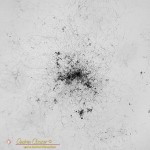
Fungus colony on a small achromatic lens surfaceMinor damage may not be enough to ruin the device. It actually takes a great deal of damage to appreciably affect the performance of most optics. A few small specks of damage remaining on the surface after cleaning may not be noticeable. Inspection of each spot of damage with a microscope can be useful, Sometimes it is clearly damage of the surface and irrepairable. I have also found hard deposits that at first glance appeared to be damage under the core of fungal colonies that remained after cleaning. These may be removed using a soft wooden tool like a toothpick or chopstick.
Killing the fungi requires a solvent that will both kill the fungus while not damaging the optical surface. I find references to both alcohol as well as other solvents. A mix of 50/50 hydrogen peroxide and ammonia is recommended by some references. Along with cleaning the glass I am careful to soak all of the structural elements as well. The tube, the spacers and lock-rings can all harbor minuscule colonies or spores awaiting suitable conditions to grow again.
Optical fungicide solutions tend to be expensive and hard to obtain, but they are available from some optical equipment manufacturers. Alternatively, you can use a 50/50 mix of hydrogen peroxide (H2O2) and ammonia (NH3). Usually, 5 ml of each is adequate (10 cc in total). Mix just prior to use and do not store the mixed product. – Ismael Cordero, Community Eye Health Journal2
Living in a warm humid environment one must be vigilant and ready to deal with issues when found. Examine optics regularly, keep a can of WD-40 next to the tool box (and use it), store optics and electronics with plenty of ventilation and reduce the humidity to well below 70% if needed. Extra vigilance to preserve valuable equipment is the price of living in paradise.
Today is February 29th, that odd date that only occurs every four years.
The reason for a leap day inserted into the calendar, the existence of February 29th, is ultimately astronomical. Perhaps a little explanation is in order…
We originally defined days as the time it takes the Earth to rotate. While we define years as the time it takes the Earth to orbit once around the Sun. The problem is that these values do not divide evenly into one another.
Sunrise seen from the summit of Mauna Kea
The Earth takes about 365.24219 days to obit the Sun, when measured by the Sun’s position in the sky, what is called a tropical year. There are different ways to measure a year, but if one is concerned with keeping the seasons in sync with your calendar, then you are interested in tropical years.
It is that bunch of decimals, the 0.24219 etc., that is the problem, every four years the count drifts out of sync by roughly one day. The insertion of an extra day every four years helps bring the calendar back into synchronization with the orbit of the Earth and with the seasons.
Even leap years do not quite fix the problem as 0.24219 is close, but not quite 0.25 or one quarter of a day. Thus additional corrections are needed… Enter leap centuries.
Our current calendar was instituted by Pope Gregory XIII in 1582, setting up a standard set of corrections for the fractional difference between the length of a year and the length of a day. Scholars knew that errors had been accumulating in the calendar for centuries, resulting in a drift of several days. Religious authorities were concerned that this drift had displaced important celebration in the church calendar, in particular the celebration of Easter. After much argument it was decided to reform the calendar. The current solution was devised by a number of astronomers, including Aloysius Lilius, the primary author of the new system.
The Gregorian Calendar uses an extra day in February every four years, unless the year is divisible by 100, then there is no leap leap day that year. However, if the year is divisible by 400, then it is a leap year. While this may sound odd, it does create a correction much closer to the ideal value of 365.24219 days per year.
I am a geek, so let us put that into code…
1
2
3
4
5
6
7
8
9
10
if(year modulo4=0)then
if(year modulo100=0)then
if(year modulo400=0)then
leap=True
else
leap=False
else
leap=True
else
leap=False
Even this is not perfectly precise. The correction is close but will drift given enough time. The length of a tropical year also changes slowly over time. We will eventually have to add another correction to keep the calendar and the seasons in sync. But not for a few millennia, good enough, for now.
As 2016 is divisible by four and not divisible by 100, there will be a leap day added to the end of this February… Today.