
Category: Astronomy
Exploring the cosmos
Cherry Blossom Festival Sidewalk Astronomy
It was a perfect day to do an astronomy outreach event. Of course as it was a daytime event, only one star is available for viewing in the telescopes… The Sun. Set up a few solar telescopes for an astro outreach event.

The festival guarantees a huge crowd of people for an outreach event, no advertising needed. The main part of the festival takes place along church row where the cherry trees are, next door to Keck headquarters. Much of the available parking is at the shopping centers on the other side of headquarters. There is a steady stream of hundreds of people right through our lawn. All we needed to do was to set up and be ready for a crowd.
A few friendly looking telescopes, a couple signs with the prominent word “free”… We had a crowd! As one would expect they came in surges, for four hours it varied between a few people at each telescope to a good sized line at every telescope, with up to fifty people gathered around at at time. We had three telescopes operating, two eight inch telescopes with white light filters and the Coronado PST providing a hydrogen alpha view.
Continue reading “Cherry Blossom Festival Sidewalk Astronomy”
Icy Morning

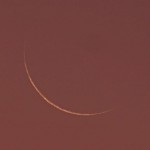
The Moon, Mercury, and Venus
Tomorrow morning a beautiful trio of two planets and the Moon will rise in the dawn. Venus will rise first at 5:02HST, followed shortly thereafter by the Moon and Mercury nearly together. The trio will form a neat triangle about 6° across. The planets will rise an hour before the light of dawn spreads across the sky and nearly two hours before sunrise.
Keck Panorama

Dear Keck Staff
We have a lot of fun when the kids come to visit. We regularly offer tours of Keck to local school groups. When they come we lay in a schedule of activities… Solar telescopes, an IR camera demonstration, tours of our remote operations, the activities can vary depending on the grade level.
After the last tour we got a packet of thank you letters from one of the classes. These are just fun to read, it is great to see what the kids remember from their visit. A drawing of telescopes set up in the lawn caught my eye, I was responsible for running the solar telescope activity!

The Moon and Jupiter
The Moon and Jupiter will rise together this evening of January 26th. The Moon will rise first, around 20:40HST, followed by Jupiter half an hour later at 21:25HST. Over the course of the night the Moon will slowly approach Jupiter, closing to about 4° by dawn.
The following evening, January 27th, the order will be reversed, with Jupiter rising first at 21:21HST and the Moon rising twenty minutes later at 21:40HST, with about the same separation of 4°.
Afocal Luna
With a few public outreach events this last week I had a few opportunities to hold my phone up to the eyepiece and shoot a few shots of a waxing Moon. The iPhone 5S does have a notably better camera than my old 3S. The afocal method does provide some nice snapshots of the Moon.
As usual I demonstrated the technique to our viewers, showing them how to use their phone to shoot the Moon. The result? Big smiles and happy folks, thrilled to have some great Moon photos of their own.

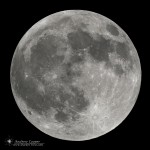
Full Moon
Five Bright Planets in the Dawn
All five planets that are visible to the unaided eye can be found in the dawn for the next few weeks. Jupiter, Saturn, Venus and Mars have been visible in the dawn for some time now. Arriving late to the party is Mercury, just rising out of the glow of dawn. Mercury is headed for maximum elongation on February 7th, rising to 24° ahead of the rising Sun. The line of planets will persist for a week or two after that as Mercury drops back into the glow of dawn after elongation.
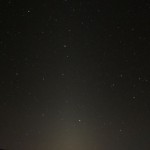
Together the five planets neatly outline the ecliptic, the plane of our solar system revealed by simply connecting the dots across the sky. As dawn approaches, but before the start of twilight around 6am, look for the zodiacal light, the bright glow of interplanetary dust also seen along the ecliptic.