Caltech researchers have found evidence of a giant planet tracing a bizarre, highly elongated orbit in the outer solar system. The object, which the researchers have nicknamed Planet Nine, has a mass about 10 times that of Earth and orbits about 20 times farther from the sun on average than does Neptune (which orbits the sun at an average distance of 2.8 billion miles). In fact, it would take this new planet between 10,000 and 20,000 years to make just one full orbit around the sun.
This artistic rendering shows the distant view from Planet Nine back towards the sun. The planet is thought to be gaseous, similar to Uranus and Neptune. Hypothetical lightning lights up the night side. Credit: Caltech/R. Hurt (IPAC)The researchers, Konstantin Batygin and Mike Brown, discovered the planet’s existence through mathematical modeling and computer simulations but have not yet observed the object directly.
“This would be a real ninth planet,” says Brown, the Richard and Barbara Rosenberg Professor of Planetary Astronomy. “There have only been two true planets discovered since ancient times, and this would be a third. It’s a pretty substantial chunk of our solar system that’s still out there to be found, which is pretty exciting.”
Brown notes that the putative ninth planet—at 5,000 times the mass of Pluto—is sufficiently large that there should be no debate about whether it is a true planet. Unlike the class of smaller objects now known as dwarf planets, Planet Nine gravitationally dominates its neighborhood of the solar system. In fact, it dominates a region larger than any of the other known planets—a fact that Brown says makes it “the most planet-y of the planets in the whole solar system.”
Batygin and Brown describe their work in the current issue of the Astronomical Journal and show how Planet Nine helps explain a number of mysterious features of the field of icy objects and debris beyond Neptune known as the Kuiper Belt.
“Although we were initially quite skeptical that this planet could exist, as we continued to investigate its orbit and what it would mean for the outer solar system, we become increasingly convinced that it is out there,” says Batygin, an assistant professor of planetary science. “For the first time in over 150 years, there is solid evidence that the solar system’s planetary census is incomplete.”
Preparing for the crowd at Laupāhoehoe Charter SchoolI worry a bit about helping out with a school star party sometimes. When I drum up a few volunteers and telescopes for an event I wonder if we will have clear skies and a good audience. These great guys are coming because I asked them. Will it be worth the effort of the volunteers to pack a ‘scope and drive across the island?
Nothing is more frustrating than a crowd of kids wanting to see through the telescope and all you can show them is the bottom of a cloud. I was worrying again as I left Waimea under a solid overcast. Maybe it will be better on the other side of the island? My fear is justified by past experience, the windward side is often cloudy or even rainy in the evening. Arriving at Honokaʻa it was still overcast, maybe down the coast? Over Laupāhoehoe it was clear! How can this be? We got really lucky.
The next worry was the crowd. While setting up there were a dozen telescopes but only a handful of folks waiting for us. But as it got dark the people kept arriving, a steady stream of students and families. A large area of blankets appeared, covering the playing field. William and the other organizers had done a great job of putting out the message to the community, we had a great crowd.
With a quarter Moon we had a good target even before it got dark. Better yet, there were no lights on the field and only a small town below us. After the light faded it was pretty dark on the field, dark enough to show nebulae and star clusters in all their glory.
I spent much of the evening on the Orion Nebula. It looked great in the ‘scope and I could tell the tale of star formation occurring in the clouds of gas visible in the eyepiece. I took a few iPhone photos of the Moon, demonstrating how it was done. The quarter phase was revealing great topography along the terminator.
In the end my worries were for naught. Everything went very well. A lot of happy kids and parents, presented with a good view of our endlessly fascinating universe.
Preparing for the crowd at Laupāhoehoe Charter School
Cliff performing and alignment on his outreach telescope
Josh setting up his ‘scope set up very low for the kids.
Vaugn set up ahead of everyone else with a 12″ dobsonian
The telescopes are nearly ready, now to wait for dark!
Blankets appear as everyone prepares to enjoy the evening
Getting a look at the moon before it gets dark.
iPhone 5S photo of the Moon through a NexStar 11″, afocal method with a 35mm eyepiece
iPhone 5S photo of the Moon through a 6″ dob, afocal method
Looking for a site that is a bit closer to home than driving all the way to the Mauna Kea VIS? Maybe not quite as high up the mountain, not as cold or windy? There is not a lot to choose from on Mauna Kea, much of the land is controlled access, either DLNR or private ranch land. Locked gates are the standard solution around the island.
Looking towards Hualālai from Kilohana, a heavy layer of vog sits just below
There is a gate that is generally not locked. The hunter check-in station at Kilohana that provides access to the Kaʻohe game Management Area. Starting at 5,700 feet from the Old Saddle Road the R-1 road climbs the mountain from here.
The actual spot I use is a staging area used by DLNR crews, hunters and the ATV riders who normally frequent the area. From the neat lines of pine trees it looks like the site was once a homestead or ranch house of some sort built high on the side of the mountain. It is about 1/4mile above Old Saddle Road and the Kilohana hunter check in station and directly adjacent to the R-1 road.
As usual you need to obey DLNR rules for access to the site. The R-1 road is designated a public access trail under the Nā Ala Hele trail system, so a permit should not be required. You must not be “camping”, this is defined by the DLNR as being in possession of “camping paraphenalia”, like sleeping bags, tent, etc., during the hours of darkness.
There is a sign in and out form at the hunter check-in station. The DLNR states that 4WD is required to use the R-1 road, but in reality the old homestead could be reached by any vehicle, the first part of this road is quite nice, basic gravel, the rough stuff is far higher up the mountain.
The site has many advantages. It is just far enough off the Old Saddle Road as to avoid vehicle headlights. Not that there is much traffic on the old road, the new road has accommodated most of the across island traffic and it is miles below the site.
One of the best features of the site is shelter from the strong trade winds that sweep across the island. The trades are generally from the northeast, while the site is on the southwest flank, sheltered in the lee of a 14,000ft mountain. I have seen days when the trades were howling in Waimea and Waikoloa, while it was dead calm at Kaʻohe.
You can get some fog and dew here in the evening. At 5,800 feet elevation you are just at the top of the inversion cloud level, sometimes just below. When it is clear it is glorious here, but you can get evening fog until the cooling night allows the sea breeze to wane and the cloud level to subside. You can always pass the site up and head on to the VIS if the cloud tops are higher.
The 20″ Obsession telescope being set up at Kaʻohe, on the side of Mauna Kea
As with any site on the slopes of Mauna Kea, air currents around the mountain can cause some seeing issues. The site should be less susceptible to cold down slope flows than the VIS area as it sits upon a ridge line, not a depression.
The game management area can occasionally be closed to access by the DLNR for one reason or another. You can check the DLNR website or the Nā Ala Hele trail system webpage. Closures should also be marked at the hunter check-in station.
The site is most easily reached from the new Saddle Road (Daniel K. Inouye Highway) in the valley below. Turning up the old road near milepost 42 and driving one mile up to Kilohana. If you see the girl scout camp you missed the turn by a bit.
I have used the site many times, and have also observed from the nearby Kilohana Girl Scout Camp, and been very pleased with the observing. I suspect I will use the site again in the near future.
Directions from Waimea
The gate into the Kaʻohe Game Management Area and the start of the R-1 road at Kilohana
Drive south on the Mamalahoa Highway towards Kona
6.2 miles from the Lindsey road light you will reach the old Saddle Road intersection, turn left uphill
Proceed 10.2 miles to the Kaʻohe GMA entrance with a sign and yellow gate, the signs also say Kilohana Hunter Check-In Station
Proceed 0.2 miles on the dirt road to the site, the site is on the left in front of the pine trees
Directions from Kona
Drive 24 miles north from Kona on the Mamalahoa Highway (upper road)
Turn right on Saddle Road (Daniel K. Inouye Hwy.)
Proceed 9.6 miles on Saddle to the Old Saddle intersection
Turn left onto the Old Saddle Road
Proceed 1.1 miles to the Kaʻohe GMA entrance with a sign and yellow gate, the signs also say Kilohana Hunter Check-In Station Proceed 0.2 miles on the dirt road to the site, the site is on the left in front of the pine trees
Directions from Hilo
Drive across island on Saddle Road (Daniel K. Inouye Hwy.) to near milepost 42
Turn left up the old Saddle Road
Proceed 1.1 miles to the Kaʻohe GMA entrance with a sign and yellow gate, the signs also say Kilohana Hunter Check-In Station
Proceed 0.2 miles on the dirt road to the site, the site is on the left in front of the pine trees
Using the world’s largest telescopes, researchers discovered ancient cold gas clouds larger than galaxies in the early Universe. The discovery was announced today at a press conference at the 227th meeting of the American Astronomical Society in Orlando, Florida.
Artists impression of the power of background galaxies to measure the size of gas clouds as compared to the conventional method of using quasars. Credit: Adrian Malec (Swinburne University) and Marie Martig (Max Plank Institute)The discovery, led by Associate Professor Jeff Cooke, Swinburne University of Technology, and Associate Professor John O’Meara, St. Michael’s College, has helped solve a decades-old puzzle on the nature of gas clouds, known as damped Lyman alpha systems, or DLAs.
Cooke and O’Meara realized that finding DLA gas clouds in the line of sight to background galaxies would enable measurements of their size by determining how much of the galaxy they cover.
“Our new method first identifies galaxies that are more likely to have intervening DLA gas clouds and then searches for them using long, deep exposures on the powerful Keck Observatory 10m telescopes on Maunakea and deep data from the VLT 8m telescopes in Chile,” Cooke said. “The technique is timely as the next generation of giant 30m telescopes will be online in several years and are ideal to take advantage of this method to routinely gather large numbers of DLAs for study.”
DLA clouds contain most of the cool gas in the Universe and are predicted to contain enough gas to form most of the stars we see in galaxies around us today, like the Milky Way. However, this prediction has yet to be confirmed.
DLAs currently have little ongoing star formation, making them too dim to observe directly from their emitted light alone. Instead, they are detected when they happen to fall in the line of sight to a more distant bright object and leave an unmistakeable absorption signature in the background object’s light.
Previously, researchers used quasars as the background objects to search for DLAs. Although quasars can be very bright, they are rare and are comparatively small, only a fraction of a light year across, whereas galaxies are quite common and provide a 100 million-fold increase in area to probe DLAs.
“Using the galaxy technique, DLAs can be studied in large numbers to provide a 3-D tomographic picture of distribution of gas clouds in the early Universe and help complete our understanding of how galaxies formed and evolved over cosmic time,” O’Meara said.
Today Mercury will pass through inferior conjunction. The planet will reappear in the dawn during the last week of January.
There will be a lovely conjunction with Venus starting in early February with Mercury and Venus staying fairly close, less than 5° most of the month. On the morning of February 6th the pair will be joined by a crescent Moon for a lovely trio. As this occurs around maximum elongation for Mercury the conjunction will be about 25° from the Sun and well up in the dawn sky.
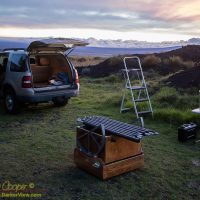
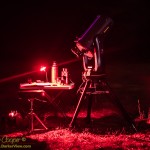
The 11″ NexStar GPS telescope, GyPSy set up at Ka’OheI have been observing from the driveway quite a bit lately. But I really wanted to escape the neighborhood lights and get some real dark time. Add the vog factor, a thick layer was dimming the stars as seen from lower elevations. A few thousand feet of altitude would solve a lot of problems.
I needed some altitude! But I did not want to go to the VIS, it was cold and windy up there. A compromise was decided upon, if the clouds proved low enough I would go to the Ka’ohe site on the old Saddle Road. Only 5’800 feet elevation is a compromise between getting above the clouds, it is usually just high enough, and staying warm. On the west face of the mountain the winds are usually mild. This is only the second time I have used the site. Not that the site is new, I had noted this place as a possible observing site many years ago, it is only recently I have begun using it.
I have also been working on the ‘scope a bit. Now over a decade old the 11″ NexStar is in need of some TLC. A replaced GPS battery, a new power connector in the base, a little lube in the slip rings, a repaired solder connection also in the slip rings, etc., etc. She is working pretty well now, the GOTO system hitting target after target with precision. Thus I was looking to use the 11″ instead of the 18″, though this limited my magnitude a bit. I set up my observing lists for a maximum magnitude of 13.
What to observe? Just query my observing list generator for a list of whatever I have not observed in the area. I usually work in 30° x 2 hour section of the sky. This evening would see me south of Orion in Lepus, Eridanus, and Columba. What I did not expect is that everything I had not observed down there was a small, dim 12-13 magnitude galaxy! Everything!
NGC1993 Small, very faint, round 1′ in diameter, stellar core
NGC2089 Small, faint, round 1′ in diameter, stellar core
So it went, galaxy after galaxy, the variation was usually some version of faint… “Faint”, “Very faint”, “Quite faint”, to the limit of my vision “Averted vision required with the 28cm”. A bright star or another galaxy in the same field was exciting!
Normally when working a region of the sky I find quite a few plain objects, the usual slew of dim galaxies when off the galactic plane, open clusters in the plane. Usually there is the occasional gem sprinkled in to liven the observing session. Not tonight!
Still, it was very nice to be out under the stars. It was a completely dark night, the sky brilliant with Orion and Canis Major high overhead. I was sitting just at the top of the cloud deck, the cars far below me on Saddle Road creating a dim glow in the clouds. Across the top of the clouds I could see Mauna Loa and Hualalai lit by starlight and skyglow.
A solid three hours at the eyepiece, three pages of notes, and I was out of hot tea. I put down the unending list of dim galaxies and just spent a bit looking up some old favorites. The Orion nebula was stunning in the eyepeice, R Lep is still very, very red. Finally breaking down and heading home, I was in bed about midnight.
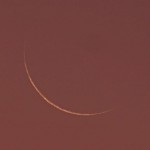
A very young moon over Waikoloa, this is only 26 hours after new, visible to the unaided eye as a sliver in the fading glow of sunsetNew Moon will occur today at 15:30HST.
Getting rain or snow on the primary mirrors is bad.
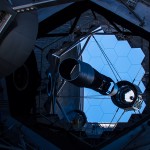
The Keck 2 primary mirrorThe normal method of detecting conditions that might lead to rain or snow is by monitoring the humidity or dew point. If the dew point approaches the current temperature, to within a few degrees the operators must close the domes. This is much the same thing as the humidity approaching 100%. Thus I have installed several new humidity/dew point/temperature sensors over the last few years. These replaced some old and troublesome equipment that had been in place for over a decade.
The problem… You can have both rain and snow occur with low humidity. Moist air above the telescope can produce rain or snow which falls into drier air at the summit level. This can catch the operators by surprise, a situation we have observed on a number of occasions.
To help detect this you can deploy a precipitation sensor, something some of the neighboring telescopes have done. The engineers over at CFHT were kind enough to show me the units they had installed during their remote operation project.
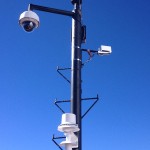
Various instruments atop the Keck Observatory weather mastYes, I just went out and bought one. Not just any old unit either… The best precipitation sensor I could locate on the market, a Vaisala DRD11A. The sensor uses a capacitive detection method. Moisture on the top of a plate will change the capacitance and trigger the sensor. The plate is tilted to allow rain to run off and heated to melt snowflakes and sleet. testing on my work bench showed this to be pretty effective and quite sensitive. Yes, you can visualize me sitting at the bench dripping water on a sensor… It worked.
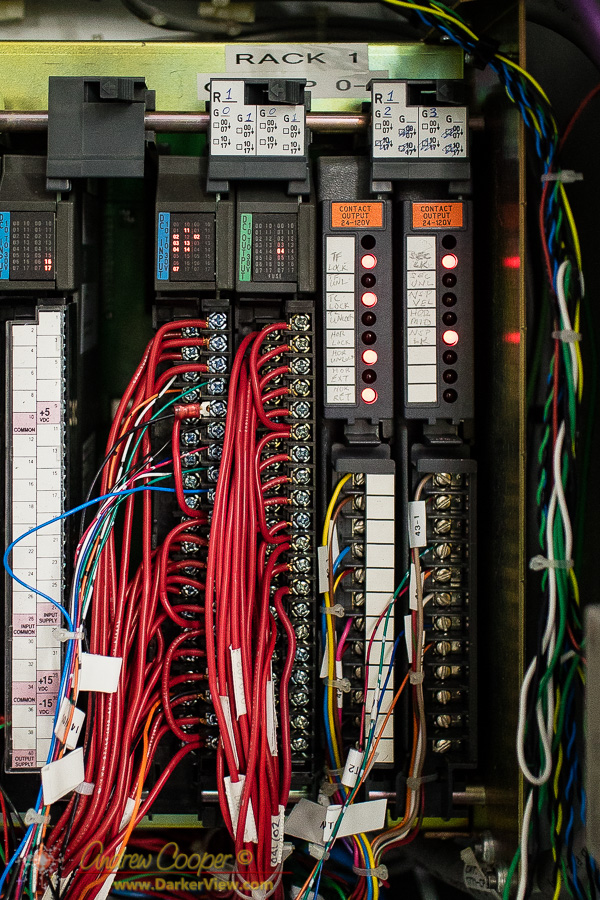
Not that the project was finished there… The new sensor does not come with any sort of network interface. Rather surprising given that just about everything else Vaisala sells has either a serial interface or an ethernet interface. This sensor has just a couple simple outputs… A logic level indication of precipitation, an analog output representing roughly how much, and a frequency output representing the same thing. I needed to interface this unit to the network. As I have installed a terminal server in the rack below the weather mast, at the minimum I needed a serial port.
While I was at it there are a couple other little devices I want to install on the weather mast. These need a network interface as well. May as well put together another little PIC controller and assemble it all together in one neat little package. a few evenings of coding and I had my solution, an interface that allowed remote computer control and status read-back. How many microcontrollers do I have performing little tasks at the summit now? Quite a few.