The W. M. Keck Observatory has confirmed the first near-Earth-size planet in the “habitable zone” around a sun-like star. This discovery and the introduction of 11 other new small habitable zone candidate planets were originally made by NASA’s Kepler space telescopes and mark another milestone in the journey to finding another “Earth.”
This artist’s concept compares Earth (left) to the new planet, called Kepler-452b, which is about 60 percent larger in diameter. Credit: NASA/JPL-Caltech/T. Pyle“We can think of Kepler-452b as bigger, older cousin to Earth, providing an opportunity to understand and reflect upon Earth’s evolving environment,” said Jon Jenkins, Kepler data analysis lead at NASA’s Ames Research Center in Moffett Field, California, who led the team that discovered Kepler-452b. “It’s awe-inspiring to consider that this planet has spent 6 billion years in the habitable zone of its star; about 1.5 billion years longer than Earth. That’s substantial opportunity for life to arise, should all the necessary ingredients and conditions for life exist on this planet.”
The data from Kepler suggested to the team there was a planet causing the light from it’s host star to dim as is orbited around it. The team then turned to ground-based observatories including the University of Texas at Austin’s McDonald Observatory, the Fred Lawrence Whipple Observatory on Mt. Hopkins, Arizona, and the world’s largest telescopes at Keck Observatory on Maunakea, Hawaii for confirmation.
Specifically, the ten-meter Keck I telescope, fitted with the HIRES instrument was used to confirm the Kepler data as well as to more precisely determine the properties of the star, specifically its temperature, surface gravity and metallicity.
The discovery of a super-Earth-sized planet orbiting a sun-like star brings us closer than ever to finding a twin of our own watery world. But NASA’s Kepler space telescope has captured evidence of other potentially habitable planets amid the sea of stars in the Milky Way galaxy.
This artist’s conception of a planetary lineup shows habitable-zone planets with similarities to Earth: from left, Kepler-22b, Kepler-69c, the just announced Kepler-452b, Kepler-62f and Kepler-186f. Last in line is Earth itself. Credit NASA/Ames/JPL-CaltechTo take a brief tour of the more prominent contenders, it helps to zero in on the “habitable zone” around their stars. This is the band of congenial temperatures for planetary orbits — not too close and not too far. Too close and the planet is fried (we’re looking at you, Venus). Too far and it’s in deep freeze. But settle comfortably into the habitable zone, and your planet could have liquid water on its surface — just right. Goldilocks has never been more relevant. Scientists have, in fact, taken to calling this water-friendly region the “Goldilocks zone.”
The zone can be a wide band or a narrow one, and nearer the star or farther, depending on the star’s size and energy output. For small, red-dwarf stars, habitable zone planets might gather close, like marshmallow-roasting campers around the fire. For gigantic, hot stars, the band must retreat to a safer distance.
About a dozen habitable zone planets in the Earth-size ballpark have been discovered so far — that is, 10 to 15 planets between one-half and twice the diameter of Earth, depending on how the habitable zone is defined and allowing for uncertainties about some of the planetary sizes.
The new discovery, Kepler-452b, fires the planet hunter’s imagination because it is the most similar to the Earth-sun system found yet: a planet at the right temperature within the habitable zone, and only about one-and-a-half times the diameter of Earth, circling a star very much like our own sun. The planet also has a good chance of being rocky, like Earth, its discoverers say.
Kepler-452b is more similar to Earth than any system previously discovered. And the timing is especially fitting: 2015 marks the 20th anniversary of the first exoplanet confirmed to be in orbit around a typical star.
Today Mercury passes through superior conjunction, passing behind the Sun as seen from the Earth. The planet will appear in the sunset in ten days or so, reaching maximum elongation on September 4th.
A long wait for your files to transfer!As we wait for the New Horizons Data to be returned to Earth it is worth considering the difficulty in getting it back. 2.9 billion miles is a long way away for a radio signal. This is not the record, we can still communicate with the Voyager spacecraft at over 12 billion miles out. Unlike Voyager, there is a great deal of data in the memory of New Horizons, we want it here on Earth ASAP.
Each LORRI image is a 1Mpix image at a 12bit depth, even with image compression this is 2.5Mbyte per image. LORRI was one of three cameras taking imagery during the encounter, there is also the data from Alice and Ralph. At the distance of Pluto about the best data transfer rate we can expect is around 1Kbit/sec. I am old enough to remember the days when a 1200 baud modem was state-of-the-art, large files were painful. At this data rate it will take about sixteen months for the entire Pluto encounter data set to be returned to Earth. I can only imagine the anticipation within the mission team, waiting for their data to be arrive.
With the New Horizons spacecraft successfully making its flyby of Pluto, we are now getting the first close up images of this distant world. The spacecraft went into radio silence for 22 hours while it maneuvered to photograph Pluto and its moons. The first signal returned was simply a full status report, and only now, a day later are we beginning to see the imagery returned. Given the 2.9 billion miles between the spacecraft and Earth, it will take about 16 months to get all of the data back.
The first images are fascinating! Eleven thousand foot high ice mountains create a rugged landscape. I find myself waiting for further images, the surface of Pluto promises to be far different than any terrain we have seen elsewhere in the solar system.
New close-up images of a region near Pluto’s equator reveal a giant surprise: a range of youthful mountains rising as high as 11,000 feet (3,500 meters) above the surface of the icy body. Credit: NASA/Johns Hopkins University Applied Physics Laboratory/Southwest Research Institute
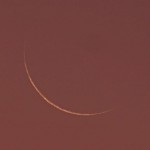
A very young moon over Waikoloa, this is only 26 hours after new, visible to the unaided eye as a sliver in the fading glow of sunsetNew Moon will occur today at 15:24HST.
In this illustration a black hole emits part of the accreted matter in the form of energetic radiation (blue), without slowing down star formation within the host galaxy (purple regions). Credit: M. Helfenbein, Yale University / OPACAn international team of astrophysicists led by Benny Trakhtenbrot, a researcher at ETH Zurich’s Institute for Astronomy, discovered a gigantic black hole in an otherwise normal galaxy, using W. M. Keck Observatory’s 10-meter, Keck I telescope in Hawaii. The team, conducting a fairly routine hunt for ancient, massive black holes, was surprised to find one with a mass of more than 7 billion times our Sun making it among the most massive black holes ever discovered. And because the galaxy it was discovered in was fairly typical in size, the study calls into question previous assumptions on the development of galaxies. Their findings are being published today in the journal Science.
The data, collected with Keck Observatory’s newest instrument called MOSFIRE, revealed a giant black hole in a galaxy called CID-947 that was 11 billion light years away. The incredible sensitivity of MOSFIRE coupled to the world’s largest optical/infrared telescope meant the scientists were able to observe and characterize this black hole as it was when the Universe was less than two billion years old, just 14 percent of its current age (almost 14 billion years have passed since the Big Bang).
Even more surprising than the black hole’s record mass, was the relatively ordinary mass of the galaxy that contained it.
Most galaxies host black holes with with masses less than one percent of the galaxy. In CID-947, the black hole mass is 10 percent that of its host galaxy. Because of this remarkable disparity, the team deduced this black hole grew so quickly the host galaxy was not able to keep pace, calling into question previous thinking on the co-evolution of galaxies and their central black holes.
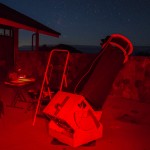
My 18″ telescope Deep violet set up under the stars at the MKVIS.There have been some revisions to the rules as originally proposed. Most notably the closure hours begin at 10pm in place of 8pm, this would allow the VIS to operate the normal evening public program.
I have yet to locate a copy of the final approved rules, it is only a few minutes ago that the decision was approved. I expect they will appear on the DLNR website eventually (Tonight? Monday?). They are effective immediately, I would expect there to be a legal requirement to post them.
It is safe to say that there will be no overnight observing at or near the Mauna Kea VIS. You will need to find a site elsewhere or at least one mile from the access road.
These rules are effective for 120 days, after which we will see what happens. In that time they may be allowed to lapse. It also allows the DLNR time to approve similar, permanent rules through the regular process in place of these emergency rules.
120 days and counting… I make that November 8th, 2015.
Update: Found them!
(a) The area referred to in this rule as the “restricted area” is defined as any lands in the public hunting area that includes the Mauna Kea Observatory Access Road and one mile on either side of the Mauna Kea Observatory Access road.
(b) As used in this rule, the term “transiting” means operating, or being a passenger in, a motor vehicle traveling at a reasonable and prudent speed and having regard to the actual and potential hazards and conditions then existing.
(c) No person shall at any time possess or control in the restricted area any of the following items: sleeping bag, tent, camping stove, or propane burner.
(d) No person shall enter or remain in the restricted area during the hours of 10:00 p.m. to 4:00 a.m., unless the person is transiting through the restricted area on the Mauna Kea Observatory Access Road or is lawfully within or entering or exiting an existing observatory or a facility operated by the University of Hawaii.
To celebrate the arrival of the new Horizons Probe at Pluto next week the W. M. Keck Observatory is holding a special lecture.
Tantalizing signs of geology on Pluto are revealed in this image from New Horizons taken on July 9, 2015 from 3.3 million miles (5.4 million kilometers) away. Credit: NASA/Johns Hopkins University Applied Physics Laboratory/Southwest Research InstituteNASA Spacecraft New Horizons Pluto Flyby:
Special Talk by NASA Scientist Eliot Young
Just hours before their observing run at Keck Observatory will start, NASA scientists Eliot Young and his team will give a talk in the Hualalai Conference room at Keck Observatory’s headquarters in Waimea. Join us at 7:00p to learn about the science of Pluto, the Kuiper belt, dwarf planets and more.
At 1:49am the next morning, the NASA New Horizons spacecraft is scheduled to make its closest approach to Pluto, and Young’s team will be collecting close-up data on the dwarf planet and other distant solar system objects for the first time ever.
Young is the principal scientist from the Southwest Research Institute, one of the partners involved in the building of the New Horizons craft.
As we are all aware, the TMT protests are having direct consequences for everyone who goes to the mountain. Regular mountain users and tourists alike are dealing these consequences. The summit road closed to the public for a second week, the MKVIS also closed, even before these closures the protests had curtailed many activities.
My 18″ telescope Deep violet set up under the stars at the MKVIS.It looks to get worse.
Go the the Mauna Kea Visitor Information Station on the weekends nearest new Moon and you will find telescopes. While the MKVIS telescopes get put away at 10pm there are ‘scopes that are operating late into the night, often still there when dawn colors the sky. These telescopes belong to local amateur astronomers who bring them here to enjoy perfect Mauna Kea skies.