So last month the observatory clocks decided is was 1995. A software bug interfered with proper decoding of the GPS time signal. For a few weeks we got by by kludging two of the old clocks together in a creative way to provide good time for the telescopes.
The new clocks are now fully online and operational. I ran one of the new time servers for a couple weeks while keeping the old time servers in place as a backup. These have now been removed, with a second new unit installed as an in-place spare.
Hopefully this will keep everything on-time for the foreseeable future. Two new precision clocks, Microsemi SyncServer S350’s, time accurate to microseconds.
Meantime there may be a fix for the old equipment, a new GPS module by Heol Design. We have one on order to try. It would be a shame to throw out these very nice clocks.
Two new GPS time servers installed in the Keck 2 computer room
Over the past few years the West Hawaii Astronomy Club has visited nearly every telescope on Mauna Kea. One glaring exception to this is Subaru, the 8.2 meter telescope belonging to NAOJ.
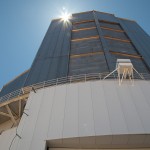
The sun glints over the tall Subaru telescope enclosureSubaru… Check.
Subaru is the only telescope with an active tour program. By making reservations ahead of time you can visit the interior of the facility with a guide. This made making the arrangements for a tour quite simple, even when the observatories are worried about events on the mountain. We did quite well for tour guides, Rieko Murai and Josh Walawender made the tour a bit better than the usual tour. Josh is well known to the local amateur community, bringing his own small telescopes to observe at the VIS.
The limit for any group visiting the telescope is eight due to practical considerations such as safety. Thus I had set up two tours, using both the 10:30 and 11:30 slots. This allowed most of the club an opportunity to visit the telescope. This did mean we were unable to enjoy the experience together. While we waited for our later tour I led a short walk to some interesting geologic features and one of the ancient ahu that are near the road.
Over the next two months the two brightest visual planets will dance in the sunset. Jupiter and Venus make for a brilliant pairing. With Venus shining at -4.3 and Jupiter somewhat dimmer at magnitude -1.9, the two are already quite obvious in the evening sky. Jupiter will swing just north of Venus approaching to within 0.3° on June 30th. The pair will separate slowly after that and disappear into the sunset glow together.
Around June 30th the two will be easily close enough to bee seen together in the low power view of amateur telescopes. It makes a fascinating sight to see the two planets together in the eyepiece.
As an added bonus the planet Mercury will join the pair around August 3rd, the trio forming a nice triangle of bright planets low in the sunset.
When the police reports hit the web we were all a bit worried. A bullet hole reported in a door at Subaru Observatory. The photos circulated shortly after the reports did not help, it really looked like a bullet hole in the door.
A hole in an exterior door at Subaru, mistaken for a bullet hole.While the news circulated Sunday it was all conjecture and accusations flew everywhere. The threats made against the telescopes were discussed. Protesters protested their innocence, and claims of “false flags” and inside jobs were made on Twitter and Facebook. The national news picked up the story and reports could be found all across the web.
Arriving at the summit Monday morning we took the few minute walk over to Subaru to look at the door in question.
This was not a bullet hole.
The plumbing on the adjacent wall that made the hole at Subaru.We had gotten word over the radio a few minutes before that it was not a bullet hole, but there was no explanation as to how that had been determined. A close look and I had to agree, the hole looked wrong to me. I do have a fair amount of practical experience in making real bullet holes. It was clear that the door had slammed against a bit of piping on the adjacent wall, possibly pushed by high winds.
Today Venus will be at maximum eastern elongation, as high in the evening sky as it will appear for this current apparition. After today the planet will begin a slow slide back into the sunset, passing through inferior conjunction on August 15th and reappearing in the dawn during the first weeks of September.
Look for Venus to pass by the Beehive cluster around Jun 12th and have a close conjunction with Jupiter on a few evenings around Jun 30th.
The planet Mercury is starting a morning apparition. The planet should become visible this week just above the dawn as a magnitude -1 object. The planet is moving more than 1° further from the Sun and higher in the morning sky each day, reaching a maximum elongation of 22° on June 24th.
With the controversy again raging over the TMT we are again seeing complete mis-representation of astronomy in the press and social media. These postings and comments make interesting reading. These show the wide range of feelings in the community. There also seems to be a misunderstanding about the roles of large telescopes in general.
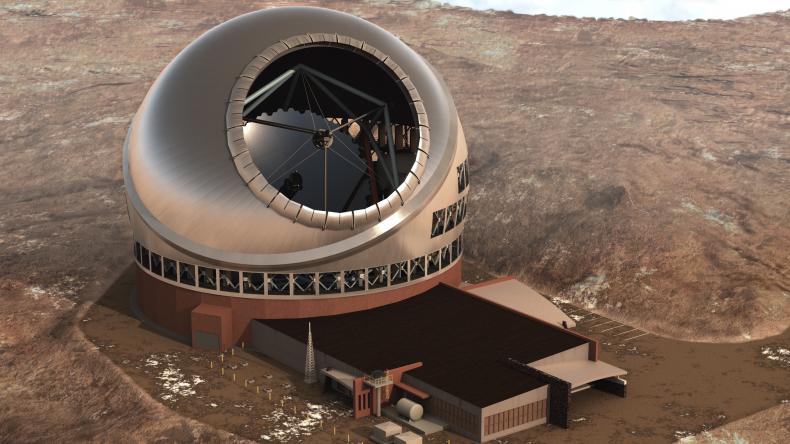
An overhead view of the proposed Thirty Meter Telescope, credit TMT Observatory CorporationThe last two decades has seen an enormous advance in our understanding of the universe and its history. We now know the age of the universe, we have discovered planets around other stars, we have learned that ordinary matter makes up only a small fraction of the universe. These represent huge leaps in our understanding and these revelations have come, to the greater degree, from ground based astronomy. Many of these discoveries have been made, or greatly assisted, by the telescopes atop Mauna Kea.
Note: This post was originally written and posted to the old DarkerView blog in August 2008. Re-posted again as it answers on of the common comments in the current episode of the TMT debate. A few edits thrown in to update for the current context seven years after the first publication.
One of the themes that popped up in the comments several times was the idea that space telescopes are where to put the money and the belief that ground telescopes were “obsolete’, thus projects like TMT are not needed. This could not be further from the truth. Yes there are advantages to space telescopes with respect to interference from the atmosphere. But space telescopes face several severe and inherent disadvantages.
Expense
Space telescopes are hugely expensive for what you get. Hubble is a mere 2 meter class telescope. Very small in the terms of modern telescopes. This limits the performance drastically. Hubble can only collect a little more light than a single segment of the current Keck telescope, and Keck has 36 segments in it’s 10 meter mirror. Work out the math and you find that Keck gathers 25 times more light than than Hubble. The new James Webb Space Telescope will be a 6.5 meter telescope. The Thirty Meter Telescope will be 30 meters with 492 segments, thus will gather 28 times more light than JWST. Continue reading “TMT versus Space Based Alternatives”
Today the planet Mercury passes through inferior conjunction, passing between the Sun and the Earth. In a week or so the planet will again be visible in the dawn sky, climbing higher each day. Maximum elongation will occur June 24th.
We have known this was coming for some time. With ALMA coming online the Caltech Submillimeter Observatory is looking decidedly obsolete. It’s closure was announced a few years back as Caltech planned to reallocate the budget.
The Caltech Submillimeter Telescope (CSO) observing into the dawnStill, we are sorry to see it go. This telescope has been truly groundbreaking in opening up the submillimeter part of the spectrum to the science of astronomy. Submillimeter is a region of the spectrum that has proven quite challenging to observe. Many of the technologies that make submillimeter science possible were first tested at CSO.
Last year I arranged a tour of CSO for the members of WHAC. It was great to get a good look at this facility before it becomes part of history.
After almost 29 years, the California Institute of Technology (Caltech) will end operations of the Caltech Submillimeter Observatory (CSO) in Hawaii in September, 2015. As previously announced, Caltech will begin the planning for the dismantling of the observatory. This process will be planned in close coordination with the Office of Mauna Kea Management, University of Hawaii at Hilo, to ensure that it is undertaken promptly and in a culturally and environmentally respectful manner. Caltech is sincerely grateful to the people of Hawaii Island for the use of Maunakea for nearly three decades, enabling superb research from this excellent astronomical site for the betterment of humanity. Caltech commits to the dismantling of the telescope and site restoration according to the Decommissioning Plan approved by the Board of Land and Natural Resources.
The CSO is a cutting-edge facility for astronomical research and instrumentation development. The CSO’s 10.4-meter radio telescope was designed and assembled in the 1980s by a team led by the late Robert Leighton, Caltech’s Valentine Professor of Physics. Under the leadership of CSO founding director Tom Phillips, the John D. MacArthur Professor of Physics, Emeritus, at Caltech, new instrumentation for the CSO was developed over the years by Caltech faculty, students, and staff; by staff scientists from NASA’s Jet Propulsion Laboratory (which is managed by Caltech); and by collaborators at institutions around the world.
Located near the summit of Mauna Kea, the CSO began operation in early 1987, under the management of Caltech by agreement with the University of Hawaii. For nearly three decades, astronomers from around the world have used the observatory to pursue research and to accomplish groundbreaking achievements in submillimeter and millimeter astronomy—the study of light emitted by atoms, molecules, and dust grains in the interstellar space where stars and planets form. Well over 100 students, from Caltech and other institutions, have used the CSO for their PhD research.
“The CSO has played a central role in the development of the science and instrumentation of submillimeter and millimeter astronomy over the last three decades,” says Sunil Golwala, current director of the CSO and a professor of physics at Caltech. “The CSO legacy of combining training in instrumentation development, hands-on observing, and science will live on via its former students and researchers as well as in new projects for which it has laid the foundation.”
“This has been a most exciting time in which the field of submillimeter astronomy has been developed, leading to an understanding of astrochemistry, star formation, and distant, dust-obscured galaxies,” says Phillips, now the CSO’s director emeritus. “We thank the National Science Foundation, which funded the CSO continuously from construction in 1984 to the end of 2012.”
“The CSO has been foundational in creating the thriving discipline of submillimeter astronomy,” says Tom Soifer (BS ’68), Kent and Joyce Kresa Leadership Chair of Caltech’s Division of Physics, Mathematics and Astronomy. “It is with a deep sense of gratitude to the people of Hawaii that we thank them for hosting this magnificent facility for all this time.”
CSO Scientific Achievements:
Development of superconducting-tunnel-junction detectors and spiderweb bolometers for radio astronomy, now commonly used on ground- and space-based radio observatories (ALMA, CARMA, Herschel, Planck), as well as the first astronomical demonstrations of an emerging new technology, kinetic inductance detectors
Determination of the role of atomic carbon in the interstellar medium
Detection of the submillimeter “line forest” using the line-survey technique, as well as of key hydride molecules, which has led to an improved understanding of interstellar chemistry
Discovery of a new phase of stellar evolution for red giant stars, which occurs just before they completely lose their envelope of gas during the formation of planetary nebulae
Mapping of the molecular gas of the radio galaxy Centaurus A, among others
Determination of the volatile composition of comets, including the first ground-based detection of HDO (heavy water) in a comet, leading to an improved understanding of the origin of comets and of terrestrial water
Discovery of ND3, a rare type of ammonia, with emission about 11 orders of magnitude stronger than initially presumed
Discovery of signs of intermittent turbulence in interstellar molecular clouds
Use of tools such as the Submillimeter High Angular Resolution Camera (SHARC) to image distant, dusty galaxies that are difficult to observe with optical telescopes
Spatially resolved imaging of nearby stellar debris disks, using SHARC, providing evidence for the presence of planets in these systems
Spectroscopy of distant and local galaxies using the Z-Spec spectrometer—developed at CSO—which has helped yield a better understanding of the processes of galaxy formation and provides a method for measuring galaxies that are too dusty to be seen with optical instruments
Mapping of the pressure in the gaseous component of massive galaxy clusters via its interaction with the cosmic microwave background (the thermal Sunyaev-Zel’dovich effect)
The first detection of the change in the cosmic microwave background caused by its interaction with the gaseous component of a high-speed subclump within a massive galaxy cluster (the kinetic Sunyaev-Zel’dovich effect)