Time… It is simply a matter of time. At 00:00UT May 3rd, many of the observatory computers suddenly started reporting that the date was September 17th, 1995. To say that this created some problems is a dramatic understatement.
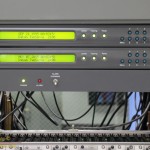
Two Datum TS2100 time servers installed above the telescope drive control computer (TDC)
The problem came from the primary observatory clock. This clock, properly called a time server, uses GPS signals to create a time reference that is accurate to microseconds. This is made possible by referencing to the atomic clocks carried by each GPS satellite. A time server is intricately connected to the network to distribute this time. Any computer in the building can ask it for time via the NTP protocol, but that has some inaccuracy due to network delays. For equipment requiring more precise time the server distributes a hard wired time reference using the IRIG-B protocol or a 1PPS timing pulse.
Without accurate time a telescope will simply not point in the correct direction. The calculation that the computers perform must take into account our rotating planet. Feed incorrect time to that calculation and you will point to the wrong piece of sky. A few milliseconds off can result in a pointing error of arcseconds, a large error for a large telescope.
Walking into the building I saw the first sign. A prominent message placed in the windshield of a car parked by the entrance… “TMT, Too Many Telescopes” The protesters were here. I had hoped they would not be, we had things to get done in this meeting. A disruption of the meeting by protesters would mean another delay.
To that end I had written a proposal for the new instruments with a description of exactly what we wished to do. Attached is an appendix of photos and drawings to answer any possible questions. I was present to answer the inevitable questions I had not thought of and feared would get asked.
The room was filling rapidly when we arrived, far beyond the usual audience of one of these meetings. As I greeted the many people I know, I noted many new faces. They seemed out of place, a little on edge, a sense of having entered enemy territory. Many of those present were young, in their teens and early twenties, one a young mother, child carried in her arms. The t-shirts betrayed their allegiance, they came with cameras and poorly concealed protest signs.
I have no problem with those who oppose the telescopes atop Mauna Kea attending a meeting like the OMKM board meeting. Public participation is a good thing. Indeed, these meetings are open to the public for a reason, to allow anyone interested to attend and to see for themselves how those charged with managing the mountain do their jobs.
I worried about a protest that would disrupt the meeting, making it impossible to accomplish anything. This did not happen. I will give those who attended credit for showing respect for the proceedings and to those discussing the effort of caring for the mountain.
Today Mercury will be at maximum eastern elongation, as high in the evening sky as it will appear for this current apparition. After today the planet will slide back into the sunset, passing through inferior conjunction on May 30th and reappearing in the dawn during the first weeks of June.
What do we really spend our days doing on the mountain? Usually pretty mundane stuff, just fixing stuff and making improvements to the gear. A little peek into one of those improvements over at CFHT, a fiber run to allow the 8 meter Gemini telescope to feed a spectrograph next door at CFHT. Something not so mundane, rather fun actually…
An international team of astronomers, led by Michele Cappellari from the University of Oxford, has used data gathered by the W. M. Keck Observatory in Hawaii to analyze the motions of stars in the outer parts of elliptical galaxies, in the first such survey to capture large numbers of these galaxies. The team discovered surprising gravitational similarities between spiral and elliptical galaxies, implying the influence of hidden forces. The study will be published in The Astrophysical Journal Letters.
The top panel shows the original stellar velocity data, as collected using the DEIMOS spectrograph at the W.M. Keck Observatory. The bottom panel shows a numerical model that matches the data remarkably well. Credit: M. Cappellari and the SLUGGS teamThe scientists from the USA, Australia, and Europe used the powerful DEIMOS spectrograph installed on the world’s largest optical telescope at Keck Observatory to conduct a major survey of nearby galaxies called SLUGGS, which mapped out the speeds of their stars. The team then applied Newton’s law of gravity to translate these speed measurements into the amounts of matter distributed within the galaxies.
“The DEIMOS spectrograph was crucial for this discovery since it can take in data from an entire giant galaxy all at once, while at the same time sampling the speeds of its stars at a hundred separate locations with exquisite accuracy,” said Aaron Romanowsky, of San Jose State University.
One of the most important scientific discoveries of the 20th century was that the spectacular spiral galaxies, such as our own Milky Way, rotate much faster than expected, powered by an extra gravitational force of invisible “dark matter” as it is now called. Since this discovery 40 years ago, we have learned that this mysterious substance, which is probably an exotic elementary particle, makes up about 85 percent of the mass in the Universe, leaving only 15 percent to be the ordinary stuff encountered in our everyday lives. Dark matter is central to our understanding of how galaxies form and evolve – and is ultimately one of the reasons for the existence of life on Earth – yet we know almost nothing about it.
“The surprising finding of our study was that elliptical galaxies maintain a remarkably constant circular speed out to large distances from their centers, in the same way that spiral galaxies are already known to do,” said Cappellari. “This means that in these very different types of galaxies, stars and dark matter conspire to redistribute themselves to produce this effect, with stars dominating in the inner regions of the galaxies, and a gradual shift in the outer regions to dark matter dominance.”
The speeds of stars on circular orbits have been measured around both spiral and elliptical galaxies. Credit: M. Cappellari and the SLUGGS teamHowever, the conspiracy does not come out naturally from models of dark matter, and some disturbing fine-tuning is required to explain the observations. For this reason, the conspiracy even led some authors to suggest that, rather than being due to dark matter, it may be due to Newton’s law of gravity becoming progressively less accurate at large distances. Remarkably, decades after it was proposed, this alternative theory (without dark matter) still cannot be conclusively ruled out.
Spiral galaxies only constitute less than half of the stellar mass in the Universe, which is dominated by elliptical and lenticular galaxies, and which have puffier configurations of stars and lack the flat disks of gas that spirals have. In these galaxies, it has been very difficult technically to measure their masses and to find out how much dark matter they have, and how this is distributed – until now.
Because the elliptical galaxies have different shapes and formation histories than spiral galaxies, the newly discovered conspiracy is even more profound and will lead experts in dark matter and galaxy formation to think carefully about what has happened in the “dark sector” of the universe.
“This question is particularly timely in this period when physicists at CERN are about to restart the Large Hadron Collider to try to directly detect the same elusive dark matter particle, which makes galaxies rotate fast, if it really exists!,” said Professor Jean Brodie, principal investigator of the SLUGGS survey.
Here is the video of last Friday’s presentation, Perspectives on the Future of Mauna Kea. Well worth the watch for anyone interesting in the issue. My thanks to Doug Simons for representing the observatories!
If there is any complaint about the camera work… My fault.
An impassioned argument is one thing. I realize that tempers can flare and some people may say things that they might otherwise not say. But strong emotion can also reveal the truth behind the facade that we all maintain. What is revealed under stress can be our finest or our worst.
A Facebook posting full of obscenity and threats.I have seen several Facebook posts that threaten violence to telescope supporters, and have received reports of threats from others who work on the mountain. Sometimes it just crosses the line. This is the case with one prominent individual opposing the construction of TMT…
A lot of emotion and bandwidth has been swirling around our mountain this past month. It has been unfortunate that two otherwise positive forces have collided atop one summit. Last night the local community had a chance to listen to various perspectives in a more personal and reasoned forum. The Honokaʻa Peoples Theater, located on the slopes of Mauna Kea is the perfect place for this to happen. An evening of face to face discussion.
Hāwane Rios addresses the audience at the Honokaʻa People’s TheaterWhile the issues surrounding Mauna Kea have captured international attention, this conversation was all the more powerful as it was limited to those of us who live and work on this mountain, many from families who have lived for generations in the mountain’s shadow. The conversation was all the more impressive in that it was conducted in the full spirit of aloha… There was no yelling, no waving signs, just respectful listening.
The format was simple, a presentation by Hāwane Rios, explaining her perspective on growing up in the traditions of Mauna Kea. This was followed by a presentation by Doug Simons, executive director of the Canada-France-Hawaii Telescope. After a 15 minute intermission there was another hour of panel discussion with questions provided by the audience. What started at 6pm went on until well after nine, with personal conversations that kept the theater a buzz until well after 11pm.
Unfortunately one of the featured speakers Lanakila Mangauli was unable to attend, having flown to Oahu for a hasty meeting with OHA and state officials. He was not completely absent, a Skype connection projected on the theater screen allowed him to give a short presentation at the start. After having watched video of his tirade (Yes, I will call it that!) at the TMT groundbreaking ceremony, I had been given a somewhat less than flattering opinion of him. The person who addressed the audience this night was much more impressive, giving an intelligent and reasoned argument to his cause. I wish he had been able to address the audience in person.
Doug Simons, Hāwane Rios, and Ruth Aloua participate in Perspectives on the Future of Mauna Kea, Apr 24th, 2015Thus it was up to Hāwane Rios to present the traditional and cultural perspective, a role she filled spectacularly well. She relater her personal relationship with the mountain, whom she considers part of her family. Impressing upon the audience the importance of place, the importance of continuity to the culture. Her discussion was interspersed with song, chants composed in traditional form and a notable song with a more modern flair. I could attempt to describe her presentation further, but I do it no justice, I suggest you watch the video.
Doug Simons also related his personal connection to the mountain, having spent the last 30 years working, hunting and raising his family here in Waimea and on Mauna Kea. Starting with the great discoveries that have been accomplished by the telescopes atop Mauna Kea, Doug did an admirable job of covering the importance of the research done at the telescopes and why these great instruments belong to all of mankind.
A plethora of computers illuminate the technical crew at Perspectives on the Future of Mauna KeaThe question and answer went smoothly, no real surprises in the questions or the answers. Asked of the future of the telescopes Doug reflected that there will probably be fewer telescopes in the future, but that those should be the best in the world, nothing else is worthy of Mauna Kea. Asked about her personal vision of the future of the summit Hāwane asked for nothing less that the dismantling of all of the telescopes.
I spent the evening listening and operating a production video camera we had brought over from Keck. CFHT, Subaru and Keck staff operated a battery of audio/visual gear, live casting the event on YouTube, recording video for later editing and managing a Skype connection for Lanakila. I expect we should have good videos up shortly, they are definitely worth watching by anyone interested in the issues surrounding our mountain. The presentation by Hāwane should be worth watching just to hear her sing. I will put the links here as soon as they become available.