Astronomy Talk: America’s Space Program – NASA’s Roadmap to Tomorrow’s Missions
This image was taken by NASA’s Dawn spacecraft of dwarf planet Ceres on Feb. 19 from a distance of nearly 29,000 miles (46,000 kilometers). Credit: NASA/JPL-Caltech/UCLA/MPS/ DLR/IDANASA Administrator Charles Bolden will discuss America’s space program and the challenges the agency faces for the missions of tomorrow. Using a stepping stone approach that builds on the capabilities of our unique orbiting laboratory – the International Space Station – the growing abilities of commercial providers to reach space, and a new rocket and crew vehicle to travel to deep space, NASA is extending human reach into the solar system even as its amazing science missions are rewriting textbooks about our universe and inspiring the next generation of explorers.
The agency currently has spacecraft speeding toward Jupiter and Pluto and roving on Mars, and is searching for planets that could potentially harbor life beyond our solar system. An unprecedented mission to capture and redirect an asteroid to an orbit near to Earth is in the planning stages, and the Space Launch System and Orion Crew vehicle are reaching new milestones in development to take astronauts to an asteroid and on to Mars.
NASA has been a 1/6 partner in the W. M. Keck Observatory since 1996 and it is an honor to offer this program to the community.
The bright dot on Ceres has the UFO community all a twitter.
The Dawn spacecraft observed Ceres for an hour on Jan. 13, 2015, from a distance of 238,000 miles (383,000 kilometers). Credit: NASA/JPL-Caltech/UCLA/MPS/ DLR/IDAAs the Dawn probe approaches Ceres each day brings ever higher resolution photos. The bright dot first showed up as a large white blotch on the disk. Not a huge surprise, even Earth based images showed areas of the dwarf planet were much brighter.
As the spacecraft neared the dot has been revealed to be quite small. Indeed the images are quite intriguing, a very bright dot with a smaller dot directly beside it. The two features are near the center of a fairly large impact crater.
This image was taken by NASA’s Dawn spacecraft of dwarf planet Ceres on Feb. 19 from a distance of nearly 29,000 miles (46,000 kilometers). Credit: NASA/JPL-Caltech/UCLA/MPS/ DLR/IDAOf course the images are intriguing. Whenever something this odd shows up in a NASA mission image there is a group of folks who go off the rails entirely, the UFO/alien community. I looked at the image and went “Hmmmm?”. Then as I sat for a moment I wondered what the UFO websites were saying about this photo. A quick sampling showed that the UFO/alien community has let speculation run rampant.
The articles and YouTube videos are popping up, fueled by the latest Dawn mission image releases… It is an alien city, a giant spacecraft, and, of course Ceres is a fragment of the destroyed planet Phaeton. After the buzz about the UFO in orbit around asteroid 2004 BL86 the UFO community is ready for something new. Even the British newspaper The Daily Mail has let this “alien” speculation seep into its reporting.
The planetary science community has a more likely theory for the dot, a cryo-volcano. It is known that Ceres harbors a great deal of water. A vent of some sort allowing water to escape into space from a subsurface deposit is not that unlikely. The process would not be that dissimilar to what we have observed on comets. The location of the feature at the center of an impact crater is also interesting. Note that there is another light colored feature at the center of another impact crater on the lower left of the latest image. An older, less active or dormant cryo-volcano?
When looking at the image you have to remember that the surface of most asteroids and comets is actually quite dark, about the same as charcoal. Ceres has a v-band albedo of 0.09, thus only 9% of the sunlight is reflected by the surface. Anything bright white, like fresh ice, is going to be stunningly bright in comparison.
When Dawn arrives at Ceres and settles into orbit we will have our answers, the images should show the phenomena in exquisite detail. We just have to wait a few months. It would be totally cool if the bright dot did turn out to be some sort of alien artifact. But I have to agree with the mission team, it is probably some form of cryo-volcano, also cool.
Today Mercury will be at maximum western elongation, as high in the morning sky as it will appear for this current apparition. After today the planet will slide back into the dawn, passing through superior conjunction on April 9th to reappear in the evening sky around the end of April.
Standing in front of the crowd under a starry sky, I spend an evening answering questions. There are many versions of “The Question”… God, UFO’s, anything where astronomy crosses with the unknown, or imagined.
There are things we just do not know. When faced with an unknown many people prefer to simply make something up, or adopt a common belief that may have no basis in fact. This is where belief and science clash… A critical skill for a true scientist it the ability to be comfortable with the unknown.
Having answered the usual questions so many times I do get better at it. I also enjoy watching other folks answer these same thorny questions, I learn and borrow some of the good lines. The trick is to somehow convey the proper skepticism of a scientific view without directly confronting the closely held beliefs of your audience. Not an easy task.
No one is better at explaining science than Neil deGrasse Tyson, Director of Chicago’s Hayden Planetarium. Watching him field questions from an audience is pure gold to anyone who does public outreach. He is personable, he connects well with the audience, and he nails the science with perfection.
Note: This article originally posted July 7, 2011 on the old Darker View blog.
Don’t take my word for it, watch the video as Neil answers “The Question”. At the end of the video Neil gives the answer I use most often for the UFO version of the question… Amateur astronomers, like myself, do not generally report UFO’s, because we have seen, and understand many of the interesting things nature can display in the sky. Education is the key.
Twice in the last week I have gotten The Question. Anyone who works around the public and telescopes will get this one, and you need to be ready to answer it. There is so much history and myth around the subject that the answer can be challenging. For this one, a simple, short answer will not suffice, you need a good, concise and clear response. This is made no easier by the problem that the answer I give is not the one they want to hear.
“Have you ever seen a UFO?”
Scene from Day The Earth Stood Still (1951)Of course by UFO they mean some sort of alien spacecraft, visitors from another star or dimension. I have seen things in the sky I didn’t know what they were, unidentified objects. But I have always been able to figure out what they were with a little checking. While the answers are usually interesting they have always been natural or human phenomena.
Note: This article originally posted Dec 13, 2008 on the old Darker View blog.
Take a breath, look the person straight in the eyes, and say it…
No.
I have never seen any evidence of an alien visitor, nor has any of the many, many other astronomers, amateur or professional I know ever mentioned anything to me. We have all seen odd things, but no good evidence for alien visitors.
I am pretty certain there is life out there. Given the sheer odds of hundreds of billions of stars in each major galaxy and hundreds of billions of galaxies, there are simply too many chances. We now know that there are planets around just about every star, we have discovered over three hundred, and that is just around nearby stars within the reach of our instruments. There is life out there, but complex, intelligent life? That is another level of question.
They are not visiting us.
Most people who ask The Question have no concept of just how big space is, or how difficult travel among the stars would be. We have seen too many episodes of Star Trek, where the next planet is reached after the ad break and warp speed solves all of the problems. If it exists, interstellar travel will be rare and difficult, involving titanic amounts of energy. An alien ship coming into our solar system will not only been seen by every instrument we have, and there are a lot these days, but everyone with a backyard telescope. The sort of energy needed to decelerate would be more than obvious.
I have more than a little trouble with many of the eyewitness accounts, they describe a wild array of craft, all different, yet the same, as if they are just elaborating on previous stories. UFO’s with lots of lights that fly in strange ways, suddenly changing directions like the pilot has just left the bar after a heavy night. Advanced technologies will still obey the laws of physics, intelligent beings will act with purpose, what is so often described does not make any sense at all. Descriptions of little grey men are far too familiar, a head, two eyes, two arms, and two legs… far too much like us. If we ever do meet aliens they will look nothing like us, they will be truly alien.
I don’t base this answer on just circumstantial evidence, but on the lack of any reliable evidence that anything has visited. The concept of alien visitation is too extraordinary, the level of proof required is similarly extraordinary. The burden of proof lies on those that say there are aliens, and so far they have failed in that respect. I have a lot of trouble with the concept of aliens that haunt the boondocks and abduct hapless farmhands. Sorry, just not believable.
Who would I believe?
Not certain about that, but I am not sure I would trust any eyewitness. As any police detective will tell you, the human mind is simply too easy to fool, we are horrible witnesses. I would expect the best possible witness would be those who watch the sky regularly, astronomers and the far more numerous amateur astronomers, a community to which I belong.
Phil Plait at Bad Astronomy, put it very well indeed, his point is one I know well and bears repeating. The amateur astronomy community spends more time under the stars than almost any other group. We keep good optics and cameras handy, if there is anything to be seen, this large group of people would see it.
We don’t.
On any clear night, particularly weekends, there are thousands of amateur astronomers sitting with telescopes under dark skies. We see lots of things, but we know what they are. This community is educated in the many beautiful and arcane phenomena that sky can produce. We make a point to see these things and recognize them for what they are. Flickering planets low on the horizon, aircraft flares, high altitude balloons, the bright flash of a bursting meteor, satellite flares and many more. Those of us who have spent time around civilian aviation, or the military have seen even more.
If you are sure I am wrong… Show me the evidence!
Sorry, bad photos, odd Mayan carvings or unreliable eyewitness accounts don’t do it. Been there, read and seen it. When an alien ship lands on the Ellipse in front of the White House, or some other solid proof is produced I will re-examine my conclusion. But until then…
The planet Mercury is starting a morning apparition. The planet should become visible this week just above the dawn as a magnitude -1 object. The planet is moving more than 1° further from the Sun and higher in the morning sky each day, reaching a maximum elongation of 27° on February 24th. This will be the best morning apparition for Mercury in 2015.
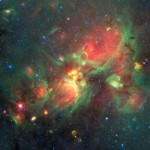
Sometimes it takes a village to find new and unusual objects in space. Volunteers scanning tens of thousands of starry images from NASA’s Spitzer Space Telescope, using the Web-based Milky Way Project, recently stumbled upon a new class of curiosities that had gone largely unrecognized before: yellow balls. The rounded features are not actually yellow — they just appear that way in the infrared, color-assigned Spitzer images.
The center of our Milky Way Galaxy taken by NASA’s Spitzer Space Telescope. Image credit: NASA/JPL-Caltech“The volunteers started chatting about the yellow balls they kept seeing in the images of our galaxy, and this brought the features to our attention,” said Grace Wolf-Chase of the Adler Planetarium in Chicago. A colorful, 122-foot (37-meter) Spitzer mosaic of the Milky Way hangs at the planetarium, showcasing our galaxy’s bubbling brew of stars. The yellow balls in this mosaic appear small but are actually several hundred to thousands of times the size of our solar system.
“With prompting by the volunteers, we analyzed the yellow balls and figured out that they are a new way to detect the early stages of massive star formation,” said Charles Kerton of Iowa State University, Ames. “The simple question of ‘Hmm, what’s that?’ led us to this discovery.” Kerton is lead author, and Wolf-Chase a co-author, of a new study on the findings in the Astrophysical Journal.
The Milky Way Project is one of many so-called citizen scientist projects making up the Zooniverse website, which relies on crowdsourcing to help process scientific data. So far, more than 70 scientific papers have resulted from volunteers using Zooniverse, four of which are tied to the Milky Way Project. In 2009, volunteers using a Zooniverse project called Galaxy Zoo began chatting about unusual objects they dubbed “green peas.” Their efforts led to the discovery of a class of compact galaxies that churned out extreme numbers of stars.
Today the planet Mercury passes through inferior conjunction, passing between the Sun and the Earth. In a week or so the planet will again be visible in the dawn sky, climbing higher each day. Maximum elongation will occur February 24th.