
After spending much of the year in dawn skies, this week will see Venus disappear into the dawn. Superior conjunction will occur October 24th, with the planet appearing in the evening sky at the end of November.
Category: Astronomy
Exploring the cosmos
Gemini Panorama
Last week I visited Gemini to see their TBAD installation. While we were on the dome floor I used Google Photo Sphere to shoot a few full panoramas of the telescope…

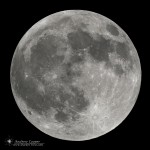
Full Moon
Postcard from the Summit – Mamane in the Fog

Mauna Kea Summit Panorama

It may look small, but this image is anything but small, click on it to find out. The panorama is assembled from seven frames, with final dimensions of over 12,000 x 2,000 pixels. The version posted here is a bit smaller, only 4,000 pixels wide. While it is a big image it does not really come close to the effect of actually standing there beside the camera. Also missing from the photo? The biting cold wind.
The image includes ten telescopes, two planets, two galaxies, two meteors, four volcanoes, and innumerable stars.
Milky Way over Mauna Loa

Comet C/2014 E2 Jacques Animation
With 24 exposures, each 4 minutes long, it is possible to animate the comet’s movement among the stars. Just process the photos individually and import into photoshop as an animation, then export as an animated GIF. Just click on the image to view…

Comet C/2014 E2 Jacques
An assembled version of the imagery I took of comet C/2014 E2 Jacques. 24 x 4min exposures, stacked in Images Plus and final processed in Photoshop. While traces of the tails were visible, I was unable to preserve the faint signal in this processed color frame.

The Tails of Comet C/2014 E2 Jacques
The tails are faint!
I have talked to a couple folks who have observed the comet in mid-sized telescopes, 14 and 24 inch, instruments. One thing they note is the absence of any visual tails on this otherwise bright comet. In processing the imagery from last night I can see the tails, but only in a very strong stretch of the data.
Below is an inverted version of mostly the green channel. Both the ion tail and dust tail are visible, but they are truly subtle. The ion tail is visible as a streak going to the right in the image, quite thin and straight, extending well over three degrees. The dust tail is visible as a wide are below the coma in this image.
Still working to properly the process the full image, the data looks very good so far.

Keck Observatory Gives Astronomers First Glimpse of Monster Galaxy Formation
W. M. Keck Observatory press release…
After years of searching, Yale University astronomers have discovered a window into the early, violent formation of the nuclei of the Universe’s monster galaxies. After spotting a potential candidate with the 2.4-meter Hubble Space Telescope, the team of astronomers pointed the 10-meter Keck II telescope, operated by the W. M. Keck Observatory, to witness the turbulent, star-bursting galactic core forming millions of stars at a ferocious rate. The data collected during their five day run in Hawaii offers important clues about the galaxy’s development as it was 11 billion years ago — just 3 billion years after the Big Bang. The research is being published today in the journal Nature.
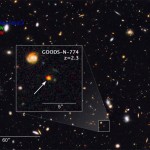
Only the most powerful telescopes have the ability to look back far enough to gather this important insight. “It’s a formation process that can’t happen anymore,” said Erica Nelson, Yale graduate student and lead author of the paper. “The early universe could make these galaxies, but the modern universe can’t. It was this hotter, more turbulent place — these were boiling cauldrons forging stars.”
Continue reading “Keck Observatory Gives Astronomers First Glimpse of Monster Galaxy Formation”