Segment
When you want to see the stars, find someplace dark

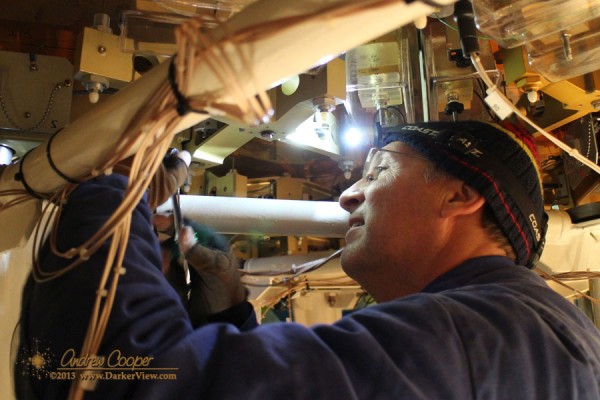
During the morning meeting we discuss our plans for the day. This is done to coordinate activities, to insure we will not get in each other’s way during the day. This also lets everyone know if we are doing anything that might have a safety concern, so we can watch out for each other. With this last part in mind I noted that I would be climbing to the top of the Keck 2 dome.

After the meeting Denny approaches me. “Can I come?” he asks. Denny is our network manager, in charge of our computer systems, he has never had an opportunity, or reason, to climb the dome. The top of the dome is just a bit spectacular, and it is a beautiful day, I can not blame him for wanting to go.

Walking from the Sun to Neptune is easy… At least when they are set up in a scale model along main street Waimea.
A fun day… The Sun, telescopes, the planets, a few asteroids represented by meteorites, and plenty of activities for the kids. It was a great day to be in Waimea as CFHT and Keck put on the Solar System Walk 2016…


Heartbeat stars, discovered in large numbers by NASA’s Kepler space telescope, are binary stars (systems of two stars orbiting each other) that got their name because if you were to map out their brightness over time, the result would look like an electrocardiogram, a graph of the electrical activity of the heart. Scientists are interested in them because they are binary systems in elongated elliptical orbits. This makes them natural laboratories for studying the gravitational effects of stars on each other.
In a heartbeat star system, the distance between the two stars varies drastically as they orbit each other. Heartbeat stars can get as close as a few stellar radii to each other, and as far as 10 times that distance during the course of one orbit.

Using near-infrared adaptive optics on two of the world’s largest telescopes — the 10-meter Keck II and the 8-meter Gemini North, both located near the summit of the dormant volcano Maunakea in Hawaii — UC Berkeley astronomers tracked 48 volcanic hot spots on the surface over a period of 29 months from August 2013 through the end of 2015.
“On a given night, we may see half a dozen or more different hot spots,” said Katherine de Kleer, a UC Berkeley graduate student who led the observations. “Of Io’s hundreds of active volcanoes, we have been able to track the 50 that were the most powerful over the past few years.”
Continue reading “Long-term, hi-res tracking of eruptions on Jupiter’s moon Io”

It is always a good day when I drive up the mountain to a broken telescope, then drive down leaving a working telescope. Easy to say, not always easy to accomplish, the simple statement obscuring a day of struggle to solve the problem and fix it.
The Keck 2 telescope drive is a complex beast of dozens of relays, miles of cabling, servo amplifiers and power supplies, plus several circuit boards designed and built in the 1980’s holding a bewildering array of arcane logic.