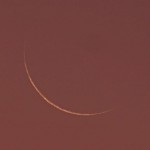
An annular solar eclipse will occur with this new moon across central Africa and the Indian Ocean.
When you want to see the stars, find someplace dark

An annular solar eclipse will occur with this new moon across central Africa and the Indian Ocean.
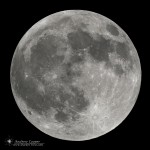
This evening at sunset a nice crescent Moon and the bright planet Jupiter will be quite close. As sunset around 19:00 the two will be separated by a mere 46′, just a little over the width of the full Moon. The two should make a very attractive pair as they sit above the glow of sunset.
Keep an eye out for Mercury and Venus closer to the horizon. At 19:00 Venus will be 9° above the horizon with Mercury a bit higher at 14°. The Moon and Jupiter will be higher yet around 25°. Since Mars and Saturn are also visible in the southern sky all five naked eye planets will be visible.
A very thin crescent Moon will pair with Venus in the sunset this evening. The Moon will be about 3.5° from Venus, well above the glow of sunset, perfectly placed to create a nice view. With sunset occurring at 18:58 HST, the pair will be 10° above the horizon at 19:00 and will set almost an hour later at 19:48 HST. The Moon will be quite thin, only 1.9% illuminated and only 1.3 days old. Creating a triangle with the pair of solar system bodies, the bright star Regulus will be 2° above Venus, while Mercury will be 8° higher in the sky. Jupiter will also be visible higher in the evening sky making for a nice lineup of bright planets.
