
Ornate Butterflyfish
When you want to see the stars, find someplace dark

One of the major problems in underwater photography is the loss of color as you descend. The water filters out the red end of the spectrum, creating the blue world all divers are familiar with.
Visually this is a problem, divers are unable to appreciate the beautiful colors of marine life without using an artificial light source. Most divers carry lights, even on daytime dives, for this reason. It can be quite dramatic to turn on a light and watch brilliant reds and yellows appear where there was little color without the light.
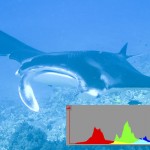
Photographically it is even more challenging, a strobe can light up nearby objects, revealing the colors. For more expansive scenes even the most powerful strobes fail, resulting in photographs heavy in greens and blue, with very little red. For some photos, the blue works, a “true” representation of what was seen. Often the blue does not work, the resulting photograph is an unattractive blue tinged with green, that no amount of fiddling in Photoshop will salvage.
One method in dealing with the loss of color balance is to simply take the loss further, convert the image to a black and white photograph. This is a technique you will see used in underwater photography quite often. By removing the distraction of color, the viewer is able to focus on the subject. The same reason so many modern photographers eschew color, even in an age when wonderful saturated colors are easily reproduced.

Many reef fish change color for the night. Many lose their bright daytime colors to become rather drab, most likely in order to evade the predators who scour the reef at night. Moray eels, reef sharks, and more are on the hunt, looking for the fish hiding in the nooks and crannies of the reef. For the diver a nighttime reef it totally different, the clouds of fish hovering over the coral are gone. Here and there a few fish are visible, the color seemingly drained from them as they wait out the night.


You may know that a starfish can regenerate a lost limb. Seeing it in process? More extreme… A single limb regrowing the rest of the body? It is a bit surprising to see such a bold example of regeneration in process.
The limb may have been parted by injury. Another possibility here is reproduction. Some species reproduce by simply detaching an arm in a process called autotomy. The detached arm becomes a new individual. An impressive capability indeed.

Mark has done it again… Put together a great video on our diving with the Aqua Safari! The footage chronicles an absolutely fantastic day of diving back in July, the day before Tropical Storm Flossie rolled over the island, a day when the mantas danced with us…
It was a reasonably big eel, not the largest I have seen, but large. I stopped to take a couple pictures, even though I have plenty of photos of yellow-margin moray. The yellows are among the friendlier members of the morays, known to play with divers. Undulated morays, on the other hand, are downright nasty, biting at anything that intrudes on their space.
This is too close.
When this fellow comes out to inspect the camera, it is my turn to pull back a bit. True, it is the camera front and foremost, most likely to get nipped. Still, I give the eel a fair amount of respect, a “friendly” eel still possess a substantial bite.

Ever take a photo you think is going to be great, to have it ruined by too much color?
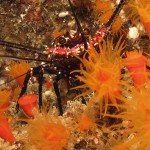
Some of the best underwater images I have are full of subtle colors and textures. While a splash of bright color can make a photo, too much bold color can take it too far. Another lesson in learning the art.
A number of parrotfish species can secrete an odd mucus cocoon in which the fish will sleep through the night. Divers will often find these fish at night, enveloped in a transparent balloon. The discarded cocoon makes an odd sight rolling around the reef the next day.
Even within the same species some fish will use this technique, some will not. It is not known how this behavior is useful to the fish. This very large bullethead parrotfish is sleeping without aid of a cocoon…
