Looks like freezing fog and snow left a bit of ice on the summit last night…


When you want to see the stars, find someplace dark

Looks like freezing fog and snow left a bit of ice on the summit last night…
When your Celestron GPS telescope will not get GPS fix for a long time, or the GPS will not work at all, it is time to replace the battery on the GPS receiver board. Another symtom is when the telescope may get a fix, but it is incorrect, the time or location no where close.
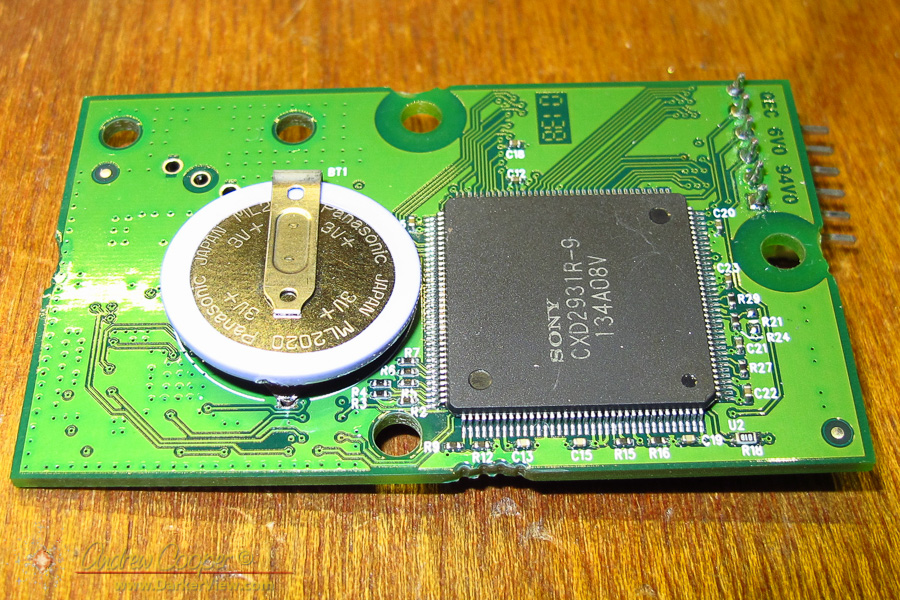
The GPS board is found in the main section on the oldest telescopes, but located in the arm in later ‘scopes. Our is located in the arm, a small circuit card just under the inside plastic panel connected to an antenna by a cable. Simply remove the four screws holding the plastic panel and you have access. The antenna cable can be disconnected with some gentle tugging, two screws for the board, one more connector and the board comes out. The battery is found hidden on the underside of the PCB.
Continue reading “Replacing the Celestron NextStar GPS Battery”
There is a pretty good article published on the Civil Beat website earlier this week. In it author Peter Apo questions many of the basic claims made by those protesting the construction of the Thirty Meter Telescope. The identity of the author is of particular relevance as Mr. Apo is Hawaiian and has served the state and community in various offices. He is currently a trustee for the Office of Hawaiian Affairs, very much at the center of the controversy. I highly suggest reading the article.

It is in the comment section that the true divide in the community becomes apparent. What is disturbing to see are the truly nasty accusations flung at Mr. Apo in the comments. For questioning some of the anti-TMT movement’s basic claims, for asking valid questions, the abuse he receives is unrelenting.
Peter Apo is a sell out! How dare he question the “Traditions” of his own Kupuna? – Herbert Faima
Fuckin fake Hawaiian! – Ricky Keona Kauanui
Peter Apo the quintessential sellout and all around parasite. – Kama Ki
Fortunately there are as many positive comments, thanking Mr. Apo for publishing the article. Many of those commenting clearly understand that it took a good deal of courage to write the article, undoubtedly knowing what would occur. Seen in these comments is the split revealed in polling data, that even among the Hawaiian community opposition for the telescope is not a complete majority.
Good article, arigato Peter. We, the silent majority, decided to keep quiet as the protesters were getting violent and out of hand. Threats were made to individuals, families and businesses. Many business owners kept quiet so that no one would get hurt. – Russell Arikawa
I have to hand it to you, you’ve got the nads to speak what you feel is the truth. For that, you are to be commended. We should never be afraid of a discussion. I see that this discussion is quite healthy. Mahalo for helping light the fire of dialogue. – Tim Orden
I agree with the necessity to question dogma. In a controversy like this the facts become somewhat malleable. Often exaggeration or complete misinformation slips into the conversation, to be repeated so often that it becomes truth to those inclined to believe. In this I too must congratulate Mr. Apo in looking back to the old records to see what may have been added to the conversation, to get a little closer to the truth.
In Arizona, during the heat of summer we would head for the mountains. We knew dozens of fire roads and meadows where a telescope could be set up under the stars among the cool forest pines. When the weather chilled, we headed to the low desert, our favorite site was Sentinel, Arizona. A desolate volcanic field just off Interstate 8 between Gila Bend and Yuma. It was still cool at night, a beautiful place to enjoy the desert skies…

The last few days have been something like this…

How far do you need to go for a good photo? My trips to Central America or Alaska have resulted in a catalog of great images. On the other side, so many of my good photos can be found close to home, the geckos in my garden or the shoe rack a few feet from the desk where I process my photos…

Scientific instruments have a habit of presenting us with uncomfortable truths. Galileo’s telescopes showed that our solar system did not conform to the prevailing teachings of the day. The great particle accelerators show a complexity underlying reality that defies a simple explanation of the universe. Likewise an almost forgotten instrument sitting atop a volcano has shown that humans have altered our world in very damaging ways.

It was in the main building that we stopped to look at a little instrument parked rather oddly in the hall. Not much, a simple box with a few aluminum tubes and a bit of circuitry and wiring. It took me a moment to realize I was looking at a piece of scientific history. Here was the Scripps Carbon Dioxide Analyzer that has provided the data that has changed our relationship with our planet.
Continue reading “The Most Reviled of Scientific Instruments”
W. M. Keck Observatory press release…
A team of Australian researchers used two Maunakea-based observatories – Gemini North and W. M. Keck Observatory – to discover why some galaxies are clumpy rather than spiral in shape and it appears that low spin is to blame. The finding challenges an earlier theory that high levels of gas cause clumpy galaxies, and sheds light on the conditions that brought about the birth of most of the stars in the Universe. The finding was published today in The Astrophysical Journal.

A combination of integral field spectroscopy data from Keck Observatory and Gemini Observatory was the key to obtaining measurements for a galaxy’s spin. Keck Observatory’s OSIRIS instrument collected data high spatial resolution in the galaxy centers, and the Gemini Multi-Object Spectrograph (GMOS) collected data for high surface brightness sensitivity out to large radii.
Lead author Dr. Danail Obreschkow, from The University of Western Australia (UWA) node of the International Centre for Radio Astronomy Research (ICRAR), said that ten billion years ago the Universe was full of clumpy galaxies, but these developed into more regular objects as they evolved; the majority of stars in the sky today, including our five billion-year-old Sun, were probably born inside these clumpy galaxies.
Continue reading “Mauna Kea Observatories Put New Spin on Galaxy Formation”
A reminder that tonight is the peak of the Geminid meteor shower. Meteors will begin to appear around 8pm when the constellation Gemini and the radiant rises. The peak occurs at 8am on the 14th, favoring the early morning hours. As the Geminid meteors have a broad peak activity can be expected to be good all night long.
Ceres reveals some of its well-kept secrets in two new studies in the journal Nature, thanks to data from NASA’s Dawn spacecraft. They include highly anticipated insights about mysterious bright features found all over the dwarf planet’s surface.

Credit: NASA/JPL
Ceres has more than 130 bright areas, and most of them are associated with impact craters. Study authors, led by Andreas Nathues at Max Planck Institute for Solar System Research, Göttingen, Germany, write that the bright material is consistent with a type of magnesium sulfate called hexahydrite. A different type of magnesium sulfate is familiar on Earth as Epsom salt.
Nathues and colleagues, using images from Dawn’s framing camera, suggest that these salt-rich areas were left behind when water-ice sublimated in the past. Impacts from asteroids would have unearthed the mixture of ice and salt, they say.
“The global nature of Ceres’ bright spots suggests that this world has a subsurface layer that contains briny water-ice,” Nathues said.
The surface of Ceres, whose average diameter is 584 miles (940 kilometers), is generally dark — similar in brightness to fresh asphalt — study authors wrote. The bright patches that pepper the surface represent a large range of brightness, with the brightest areas reflecting about 50 percent of sunlight shining on the area. But there has not been unambiguous detection of water ice on Ceres; higher-resolution data are needed to settle this question.
Continue reading “New Clues to Ceres’ Bright Spots and Origins”