
Varicose Nudibranch
When you want to see the stars, find someplace dark

You may know that a starfish can regenerate a lost limb. Seeing it in process? More extreme… A single limb regrowing the rest of the body? It is a bit surprising to see such a bold example of regeneration in process.
The limb may have been parted by injury. Another possibility here is reproduction. Some species reproduce by simply detaching an arm in a process called autotomy. The detached arm becomes a new individual. An impressive capability indeed.

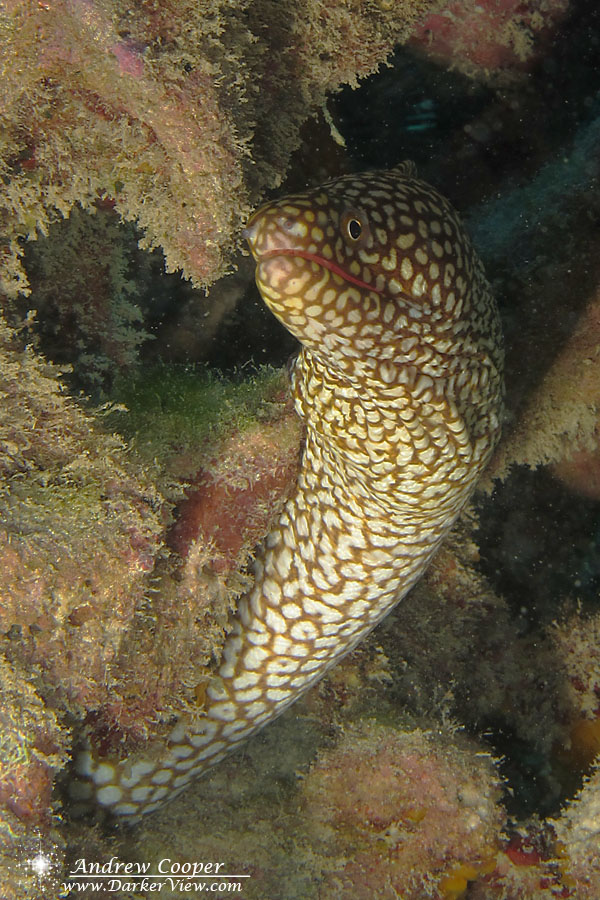
It was a reasonably big eel, not the largest I have seen, but large. I stopped to take a couple pictures, even though I have plenty of photos of yellow-margin moray. The yellows are among the friendlier members of the morays, known to play with divers. Undulated morays, on the other hand, are downright nasty, biting at anything that intrudes on their space.
This is too close.
When this fellow comes out to inspect the camera, it is my turn to pull back a bit. True, it is the camera front and foremost, most likely to get nipped. Still, I give the eel a fair amount of respect, a “friendly” eel still possess a substantial bite.

Ever take a photo you think is going to be great, to have it ruined by too much color?
Some of the best underwater images I have are full of subtle colors and textures. While a splash of bright color can make a photo, too much bold color can take it too far. Another lesson in learning the art.
A number of parrotfish species can secrete an odd mucus cocoon in which the fish will sleep through the night. Divers will often find these fish at night, enveloped in a transparent balloon. The discarded cocoon makes an odd sight rolling around the reef the next day.
Even within the same species some fish will use this technique, some will not. It is not known how this behavior is useful to the fish. This very large bullethead parrotfish is sleeping without aid of a cocoon…

It is worth a moment, even in the limited time of a dive, to stop and look close at the coral itself. Never mind the psychedelic fish, the coral is what makes a reef. Untold billions of small polyps, each a separate animal, cooperate to build the largest natural structures in the world.
Some corals are easier to examine closely. Honeycomb coral has corallites much larger than most, easier to get a good look without magnification. Getting your mask close allows you to appreciate each little animal, part of the larger colony.

Access is through the Hualalai Resort. You must check in at the security shack just off the highway at the southern entrance, just 1/4 mile south of the main entrance to the resort. There you get a beach pass from the guard and head down to the public parking area. Get directions from security, you have to double back and take a right. There are only so many public parking spaces available, to ensure entry just get there early, arrival before 8am is pretty much guaranteed access.

A small sign noting the presence of public restrooms at the beach is the marker to turn off the path and head straight to the water. Head to the little inlet where a small point of rock creates a protected pool where you can finish gearing up and swim. The pool is deeper towards to the right and the small rocky point.
Tropical storm? What storm, it was one of the prettiest days on the water we have ever seen. Apparently everyone thought so, the water was busy with dive and tour boats everywhere. The sky was clear blue, the water a blue crystal. No wind and just a bit of south swell. The day seemed at complete odds to the dire storm watch messages on the radio. We will do the storm thing tomorrow, today we dive…

At one point I filmed a manta cruising the reef right below me. Just after it passed by the manta swung about and came right at me. I continued to film and the manta bumped the camera. Yes, it was that kind of day. The mantas were coming in close. These manta are familiar with the idea that divers mean food. During the night manta dives the dive lights attract plankton, creating a buffet for the mantas. The behavior seems to spill over into the daytime, with the mantas coming very close to divers.

After the last dive we often head for harbor. Today we just hung out at the mooring for a while, it was such a nice day. Out of air? Not problem, a mask and fins is enough, just take another swim.
I dove with the usual crew the day before, but I did not go out with them Sunday. Now I am wonder if I should have. They came back with a fish tale and the video to prove it…
Lavern is a well known fixture around the entrance to Honokohau Harbor. She is big and easily identified through the messed up dorsal fin. She has not eaten any divers… yet.