Despite a rough introduction the Canon EOS-M series is developing into a solid product offering. And it was a rough start, the first model with the first software version was so bad I sent the first camera I ordered back in frustration and disappointment.
The Canon EOS-M3 with the 18-55mm EOS-M lens
In time, and after receiving a withering round of criticism, Canon fixed some of the most striking deficiencies in the original EOS-M, in particular the sluggish and erratic focusing. With the fixes in place, and steep price discounts, I gave the camera another try. I have gradually come to like this little camera. The photo quality is quite good, the EOS-M lenses are nice and sharp, and the touch screen a very usable feature I have often missed in my full size DLSR’s.
After a couple years of shooting with the EOS-M I decided to order the EOS-M3, the latest offering in the product line. For reasons a mystery outside Canon the camera was originally not released in the US, available in Japan since early 2015. Only in the last month has news come that the camera will become available for order here in the US. Not willing to wait, and the start of an adventure looming on the calendar I ordered a Japanese version on eBay. No issue, there are YouTube videos that explain how to navigate the kanji menus and set the language to English. Thus my fun with a new camera began.
Taking astrophotos or time lapse often involves leaving a camera out in the dark for long periods. Cameras are somewhat more robust than humans, tolerating the cold for a bit longer. As a result often the cameras are unattended while the human seeks shelter in some warmer place. This can result in the theft of the unattended camera.
A camera security block for unattended camera operationThis was recently highlighted when a camera was stolen from near the Keck 2 telescope last week. Left outside for a nighttime time lapse it simply vanished. We all commiserated with the victim in a Facebook conversation, we have all run the same risk and worried about this happening to us. I usually place the camera somewhere inaccessible to the public or somewhere remote enough that it is unlikely to be found. I still worry.
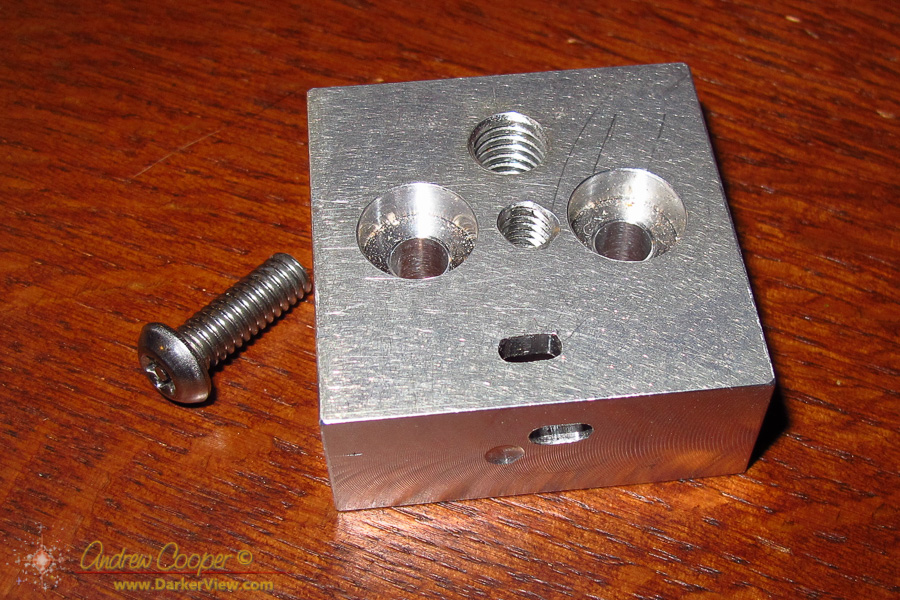
On the mountain is not the only place this risk exists. I have often left a camera operating for hours in my driveway at the front of my house attached to a telescope. In an attempt to make it somewhat more difficult to simply grab and run I designed a simple security device. A little block of aluminum with a slot that accommodates a standard computer cable lock.
Machined from aluminum the block took very little time to make and provides a great deal peace of mind. It is not impervious to a determined attack, but does prevent the camera from simply walking away. In place of aluminum it could probably be 3D printed if you do not have a machine shop available. With a little more patience it could be manufactured with simply hand tools.
The slot is the standard Kensington security slot, a 3mm x 7mm slot as found in almost all laptop computers. The locks are available from just about anyplace that sells computer accessories.
The screw I use is a tamperproof button head screw, one that requires a special tool to remove. A standard hex button head screw would probably work in most situations, it is unlikely that an opportunistic thief will have a set of allen keys handy.
The block can be used on a telescope, with the cable wrapped around a tripod leg. It can also be used on a tripod, a ¼-20 hole is tapped to allow the block to sit between the camera and the tripod head. The security cable can then be secured to anything available. Atop Mauna Kea there are many railings, guardrails and signposts that would provide a solid locking point. In nature there are fewer steel poles, but a tree trunk or something similar would also serve.
The design can be modified to suit ones needs, the mechanical drawing above shows the device in its simplest form. As you can see in the photo my prototype block includes two screw holes for the camera and a 3/8″ threaded hole for larger tripods. I also put a second lock slot on the bottom to have the option of having the lock stick out in a different direction.
Check the dimensions of your camera, tripod head or favorite adapter plate to insure that the lock will fit without interference. You can always adjust the dimensions or the mounting hole positions to accommodate your setup.
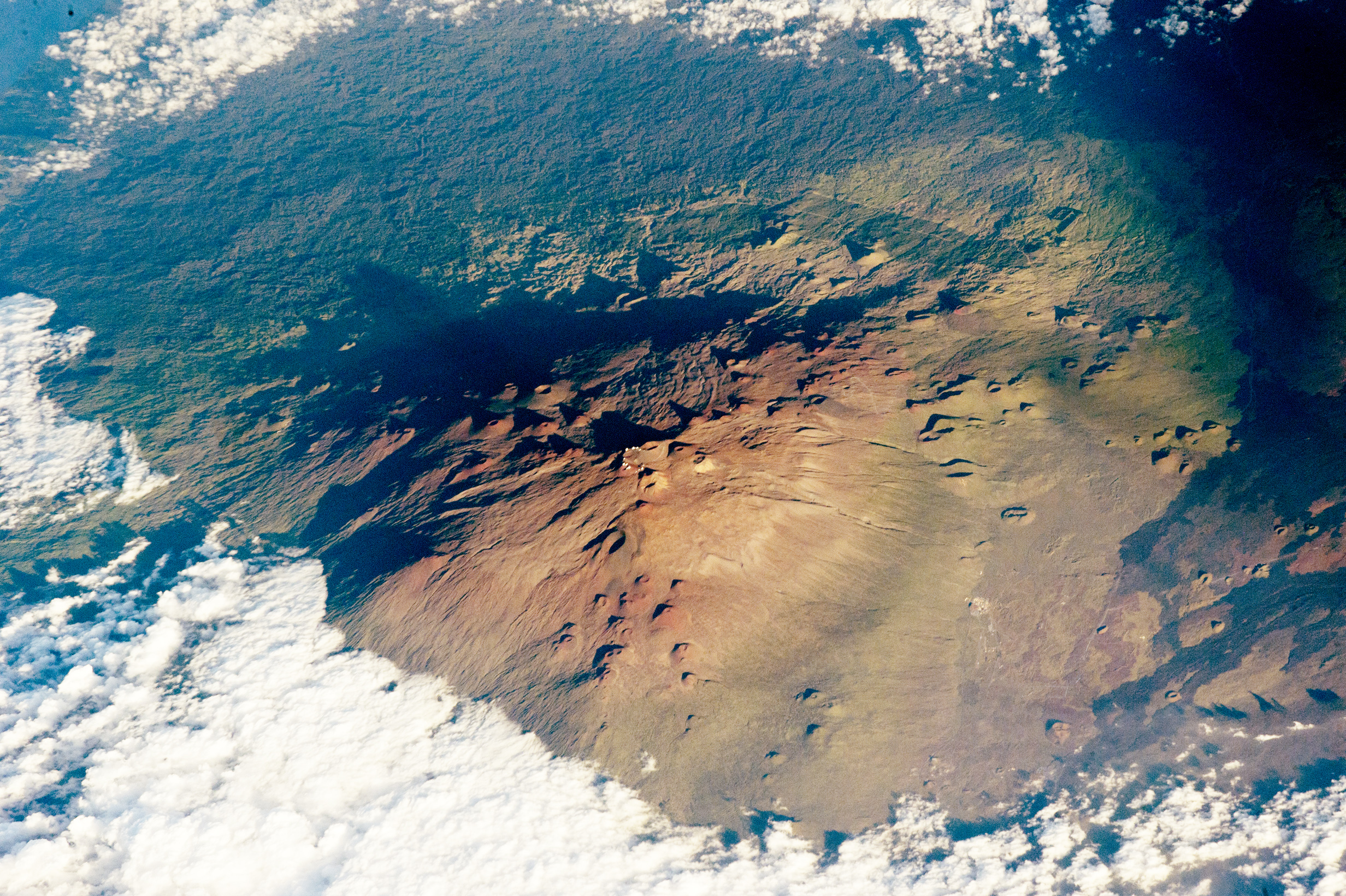
A beautiful image of Mauna Kea taken from the International Space Station. The image was taken using a Nikon D4 DLSR using an 800 millimeter lens. At the time the ISS was at an altitude of 215 nautical miles (398km) over the island.
Taken in the afternoon the low Sun angle causes the terrain to cast long shadows. The summit pu’u each stand out strongly in relief and the summit observatories are easily visible.
Mauna Kea as seen from the International Space Station, image taken Nov 1, 2015 with a Nikon D4 and an 800mm lens
It may be the day after Thansgiving, but that did not stop the electrical contractors installing new streetlamps in Waikoloa Village.
The electrical contractors show off the new LED lights for our neighborhoodWe noticed the truck and crane setup mid-morning under the light across the street from our house. It was no surprise, the streetlights have been getting changed throughout the neighborhood over the last couple months. The new LED lamps are far better, with almost no glare seen from the side.
We are not sad to see the old low pressure sodium light go, it has been a nuisance. The poorly designed sodium lamp creating glare into our windows We had called to complain with the county, but nothing was ever done. The glare intruded on our bedroom window, a real issue, somewhat alleviated by the growth of our plumeria along the front blocking the light, a deliberate solution on my part.
The big question is whether the new LED light improves the astronomy situation from my driveway. The old sodium lamps along the street made it impossible to do visual observing, there was simply too much glare. The new lamps should darken the sky and create far less light directed at my driveway.
Even better, the lamps in question are C&W Energy Star Friendly® units with reduced blue emissions. Elimination of almost all of the blue light greatly reduces scatter in the atmosphere and is better for the observatories.
The view down the street from the driveway with the new LED lampsThis seems to be the case. I can see the light from our driveway where it is strong enough to cast shadows. Still, it is much darker than it was with the sodium lamps. The overall amount of light is way down, indeed the entire neighborhood is darker.
With the old light I was able to do astrophotography from the driveway using an LPR filter that blocked the 589nm of sodium light. The new lights will have a broader spectrum and be more difficult to block. On the other hand they send very little light upwards, possibly improving the situation. It will be interesting to see what the difference is. When the Moon is a few days further gone I will have to setup the camera and find out.
It may also be a good idea to check the old CloudCam images against new images as the replacement continues. It will be interesting to see if the emissions from the neighborhood are effectively reduced as seen from the top of the mountain.
The planet Mercury is starting an evening apparition. The planet should become visible this week just above the fading glow of the setting Sun as a magnitude -1 object. The planet is moving about 1° further from the Sun and higher in the sunset each day, reaching a maximum elongation of 20° on December 28th.