Recently traveling with United Airlines for our Nicaragua trip I ran face first into their in-flight entertainment system. My choice of words is literally accurate here, as the system is in-your-face in a most unappreciated way.
The United Airlines in-flight entertainment systemThe unit consists of a seven inch LCD screen in every seat back, and a small control pad on the arm rest. A selection of movies and shows can be purchased by running a credit card through the slot beside the screen. Content in this system is strictly paid for, there is very little free material, one channel with a sliced up documentary and other segments that are essentially long ads. A preview period is run at the start of the flight with payment required to continue your chosen show.
The unit is also used to replace the traditional cabin safety briefing with a video that runs before takeoff. Aside from the safety briefing you will need headphones with a standard stereo plug to hear the soundtrack.
Today Mercury passes through superior conjunction, passing behind the Sun as seen from the Earth. The planet will appear in the sunset in ten days or so, reaching maximum elongation on Dec 29th.
Modern air travel is an extraordinary complex system. The endless series of arrivals and departures at any large airport is a carefully choreographed dance. Unfortunately this system can be easily snarled when the process is disturbed.
Gate seating, where to spend far too many hours in the Houston airportThe first sign of trouble was our aircrew securing the cabin for arrival early. They stopped the last beverage service and hurriedly gathered the trash long before we began descent. The reason quickly became apparent as towering thunderheads appeared all around us and the aircraft began to bounce and shudder in the unstable winds. Despite the promise of worse our landing in Houston proceeded without issue. Rolling down a wet runway and noting the pools of water covering the grass between the taxiways, clearly the airport had been visited by the heavy rains of those thunderstorms.
Next problem? No gate was available and we spend 45 minutes sitting on a taxiway waiting our turn at a gate for disembarking. I have plenty of time to observe that puddled water and the low slung engines of a 737 can create fascinating little vortexes of swirling water just below the engine intake. We were not worried, we had a five hour layover in our schedule and being late to the gate was not an issue. Many of our fellow passengers were not quite so relaxed, fretting about tight connections and missed flights.
Packing the camera for a trip always presents a set of vexing decisions for a photographer. What do you plan on shooting? What gear will be needed? This particular trip would be to a place I have never been and would present a range of unique photo opportunities. Nicaragua for the first time!
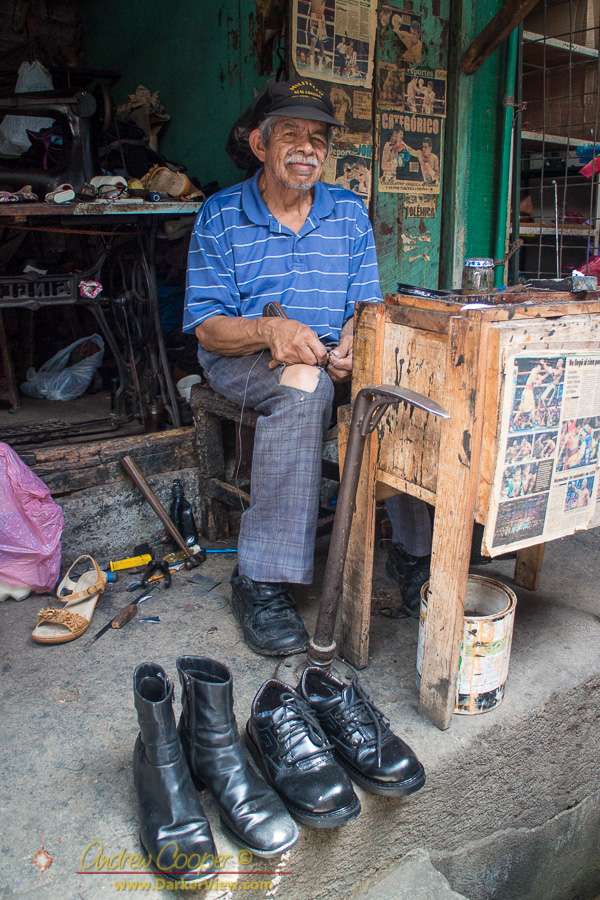
A cobbler practices his trade in the Boaco market
While I had never visited Nicaragua I had been in Mexico many times, I expected the photographic situation to be much the same, an expectation that was not disappointed. Each town in Latin America may be unique, but at at the same time looks much the same as the last. The character of these towns offers varied photo opportunities. Best of all to my thinking… Many towns feature markets, a sampling of the people and goods unique to the region, a condensation of the local culture in one convenient place.
Thus I chose my gear uncompromisingly for street photography. Leaving the big DSLRs and lenses at home I loaded two EOS-M bodies. I have one original model and one of the new M3’s purchased just before the start of the trip. These two cameras would take very little room in the luggage and offer a good range of capability. Traveling with only a single backpack meant space was at a premium. The primary lens would be the 18-55mm to allow a good general purpose walkabout capability.