Astronomers using several of the largest telescopes on Earth and space have discovered the brightest galaxy yet found in the early Universe and have strong evidence that examples of the first generation of stars lurk within it. The results have been accepted for publication in The Astrophysical Journal.
A team — led by David Sobral from the Institute of Astrophysics and Space Sciences, the Faculty of Sciences of the University of Lisbon in Portugal, and Leiden Observatory in the Netherlands — peered back into the ancient Universe, to the reionization period approximately 800 million years after the Big Bang. Instead of conducting a narrow and deep study of a small area of the sky, the team broadened their scope to produce the widest survey of very distant galaxies ever attempted.
The Keck 1 dome lit by the glow of sunsetI pressed the button.
It moved.
700 tons of steel and aluminum smoothly rotated until I hit the stop button.
Nothing crashed or seriously broken.
It even moved the right direction.
The risk of breaking something was a real possibility. A mistake here could leave the dome damaged for days or weeks and the telescope useless. I reviewed my plan one more time before starting. A fully written plan with a step by step testing method carefully thought out and reviewed by the other engineers in the department. The plan also had a whole section of “what can go wrong” risk analysis, with risk mitigation steps. What if the brakes release but the motors do not come on? What if the old controller fails when removed from the system?
After a fitful night’s sleep and a long ride to the summit the moment came when I brought the new controller online. Swapping out the connections with the old controller and applying power, the correct indicator lights came on. Even better, as I tested each of the controls in turn the dome and shutters operated perfectly. It worked from the control panel, from the radio controller, under computer mode from the control room. I even tracked the telescope and dome together for an hour without trouble. The tracking was excellent, within 0.1° the whole time.
Today is the day I will close my eyes, cross my fingers, and press a button.
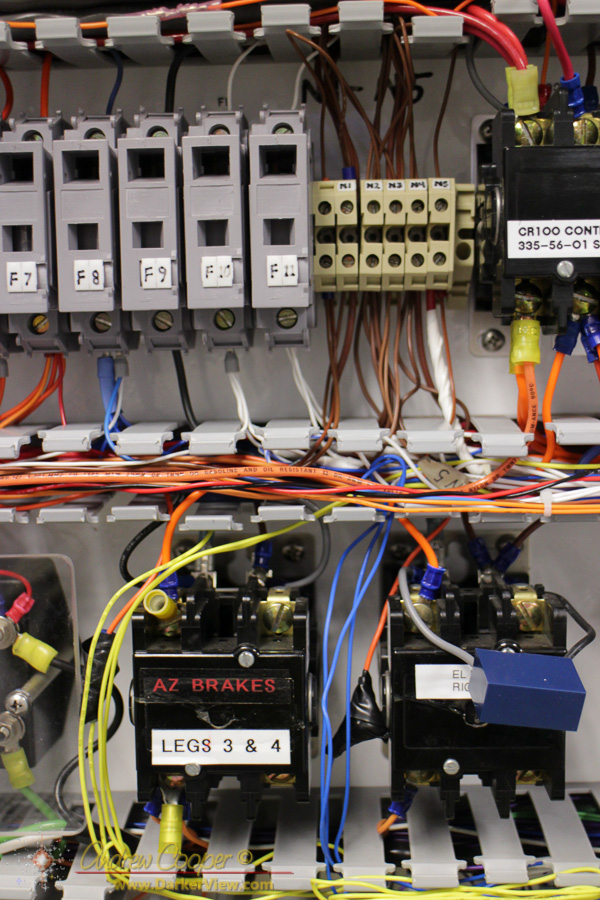
The old and new programmable logic controllers installed in side the control cabinet.If all goes well, 700 tons of steel and aluminum will move at that button press. the Keck 2 dome will rotate and I will be able to breathe again. There is just a little apprehension here. Replacing the controller that commands the motors and brakes has been my major effort for the last couple months. A great deal of time has been spent testing and retesting the software in the new controller.
Further tests will open and close the shutters. If anything this part is even more worrisome. The controller is responsible for releasing the brakes on the shutters. If the brakes were to open without motor power the shutters will be able to simply run downwards.
Fortunately they will not fall, but they can run downwards to the hard stops rather quickly. There will be a tech stationed at the shutters with a finger poised over the e-stop button during these first tests. The button blows the dome main breaker, which removes power from the brakes, causing them to close.
A brain replacement is fraught with opportunities for error. Currently the old and new PLC’s sit next to each other in the cabinet, installed last week. Monday morning I will remove the old one and slave the I/O cards to the new controller.
So last month the observatory clocks decided is was 1995. A software bug interfered with proper decoding of the GPS time signal. For a few weeks we got by by kludging two of the old clocks together in a creative way to provide good time for the telescopes.
The new clocks are now fully online and operational. I ran one of the new time servers for a couple weeks while keeping the old time servers in place as a backup. These have now been removed, with a second new unit installed as an in-place spare.
Hopefully this will keep everything on-time for the foreseeable future. Two new precision clocks, Microsemi SyncServer S350’s, time accurate to microseconds.
Meantime there may be a fix for the old equipment, a new GPS module by Heol Design. We have one on order to try. It would be a shame to throw out these very nice clocks.
Two new GPS time servers installed in the Keck 2 computer room
A photographer needs a guide around Keck for the night? Setup time-lapse cameras throughout the facility? Sounds like fun… Sign me up.
Two AO lasers aimed at the galactic center with a large red glow coming from KilaueaThus I meet local photographer Jason Chu at Keck in the afternoon and help him drag a mountain of camera gear into the summit facility. We loaded quite a pile onto the cart, eight full DSLR cameras and a stack of tripods. The plan is to set them up in the domes for the night then re-collect the cameras in the morning. Six cameras in the domes and a couple more to carry through the night.
Two lasers, both aimed at the galactic center were on the schedule for the second half of the night. Andrea Ghez and her team having time on both telescopes. The weather looked a bit problematic, thick cirrus covered the sky, but the forecast called for clearing after midnight.
Jason came with a carefully drafted plan, where to set and aim each camera, timer settings, lens choice, all carefully considered. A pretty good plan too, only a few details needed changing as we placed each camera. Four cameras in Keck 1, another two in Keck 2. One camera placement was my idea… Clamped to the Keck 1 dome where it would track with the telescope. I had spent a few minutes in the machine shop putting together a solid camera clamp.
Unfortunately the clouds did not clear as predicted, thin cirrus hanging on through the night. It was clear just to the west, but stubbornly would not give us the clear skies we needed overhead. Several times it looked to clear, but the clouds would thicken again. We did have both lasers on sky for a few minutes, just enough for a few photos and not long enough to do any science.
With high hopes for some dual laser time-lapse I was ready to set up my own camera, but ended up with only a few still photos. Jason got a few nice shots during that short time, having eight cameras helped make the most of those few minutes. I did get a nice video clip of the telescope shot by rotating the dome with a camera.
Jason is working on a personal project and will be out shooting more images in the dark. I will certainly feature the results of his effort here on DarkerView when he finishes. For myself? I will have to schedule another opportunity to go up and shoot some laser time-lapse. There is an intriguing night at the beginning of July on the schedule with both Keck lasers. I also need to mail Jason a camera remote, an accomplishment that only one bit of camera gear got left behind.
A collection of unidentified blobs was discovered toward the Coma cluster of galaxies, using the Dragonfly Telephoto Array. Credit: P. Van Dokkum, R. Abraham, J. BrodieAn international team of researchers led by Pieter van Dokkum at Yale University have used the W. M. Keck Observatory to confirm the existence of the most diffuse class of galaxies known in the universe. These “fluffiest galaxies” are nearly as wide as our own Milky Way galaxy – about 60,000 light years – yet harbor only one percent as many stars. The findings were recently published in the Astrophysical Journal Letters.
“If the Milky Way is a sea of stars, then these newly discovered galaxies are like wisps of clouds”, said van Dokkum. “We are beginning to form some ideas about how they were born and it’s remarkable they have survived at all. They are found in a dense, violent region of space filled with dark matter and galaxies whizzing around, so we think they must be cloaked in their own invisible dark matter ‘shields’ that are protecting them from this intergalactic assault.”
The team made the latest discovery by combining results from one of the world’s smallest telescopes as well as the largest telescope on Earth. The Dragonfly Telephoto Array used 14-centimeter state of the art telephoto lens cameras to produce digital images of the very faint, diffuse objects. Keck Observatory’s 10-meter Keck I telescope, with its Low Resolution Imaging Spectrograph, then separated the light of one of the objects into colors that diagnose its composition and distance.
Using the W. M. Keck Observatory in Hawaii, a group of astronomers led by Joseph Hennawi of the Max Planck Institute for Astronomy have discovered the first quadruple quasar: four rare active black holes situated in close proximity to one another. The quartet resides in one of the most massive structures ever discovered in the distant universe, and is surrounded by a giant nebula of cool dense gas. Because the discovery comes with one-in-ten-million odds, perhaps cosmologists need to rethink their models of quasar evolution and the formation of the most massive cosmic structures. The results are being published in the May 15, 2015 edition of the journal Science.
Image of the region of the space occupied by the rare quasar quartet. The four quasars are indicated by arrows. Credit: Hennawi & Arrigoni-Battaia, MPIAHitting the jackpot is one thing, but if you hit the jackpot four times in a row you might wonder if the odds were somehow stacked in your favor.
Quasars constitute a brief phase of galaxy evolution, powered by the in-fall of matter onto a supermassive black hole at the center of a galaxy. During this phase, they are the most luminous objects in the Universe, shining hundreds of times brighter than their host galaxies, which themselves contain hundreds of billions of stars. But these hyper-luminous episodes last only a tiny fraction of a galaxy’s lifetime, which is why astronomers need to be very lucky to catch any given galaxy in the act. As a result, quasars are exceedingly rare on the sky, and are typically separated by hundreds of millions of light years from one another. The researchers estimate that the odds of discovering a quadruple quasar by chance is one in ten million. How on Earth did they get so lucky?
Clues come from peculiar properties of the quartet’s environment. The four quasars are surrounded by a giant nebula of cool dense hydrogen gas, which emits light because it is irradiated by the intense glare of the quasars. In addition, both the quartet and the surrounding nebula reside in a rare corner of the universe with a surprisingly large amount of matter. “There are several hundred times more galaxies in this region than you would expect to see at these distances,” said J. Xavier Prochaska, professor at the University of California Santa Cruz and the principal investigator of the Keck Observatory observations.