As I came clear of the sea cave I knew I was right under the surf crashing on the rocks. Not truly dangerous, we would not have been out in a really big swell, bad enough if I had decided to go right into it. Kicking out a bit further I surfaced, into a swarm of needlefish hunting along the edge of the foamy water. These little predators appeared to be taking advantage of the reduced visibility and noise of the waves and bubbles to hunt. As they darted through the intense blue water, I attempted to take a few photos. First, get the camera out of macro, turn off the strobe, daylight color balance, anything else?
A school of keeltail needleflish (Platybelone argalus) hunt along a the edge of a surf zone.
It was small, but I was looking for small, scouring a reef wall at Kua Bay. At first glance I hoped I had found a nudibranch, a closer look revealed a flatworm. A pretty little creature moving quickly across a sponge covered surface. I did not recognize the species, not one of the usual flatworms we see by day. Certainly not another fuchsia flatworm, I had lost count of those early in the dive.
I am not alone in not being able to identify the species. It was not in the book, I had to search the websites before I found any reference to a matching species. The reference on Hoover’s website came without an identification, merely a genus name and a description that perfectly matched the flatworm I had found. Active by day on a shaded wall… Check. Found at 15-20ft… Check, more or less, found at 30ft. Reported from Maui by a known expert in the field Cory Pittman.
The worm does resemble a species known in Indonesia, the Philippines and the Mariana Islands, Pseudoceros bimarginatus. There are some differences in the photos as well. No clear answer, best leave this ID to experts. I have forwarded my photograph.
Thus my identification remains… Pseudoceros sp?
An unidentified flatworm (Pseudoceros sp?) found at 30ft on a wall at Kua Bay
I have taken closeups of the top ot the crown-of-thorns before, the view produces a very alien landscape. This time I positioned the light behind the spines for a different effect…
A closeup of the top of a crown-of-thorns starfish (Acanthaster planci) with some creative lighting
There are numerous guides to the reef life found around the Hawaiian Islands. Most are superficial, suitable for the casual tourist snorkeler at best. Short of delving into the professional level publications there are two sources I use all the time. The books by Hoover, one on fish and the other for the invertebrates, are my first stop when attempting to identify an animal. These well thumbed references are usually found on my desk beside the computer.
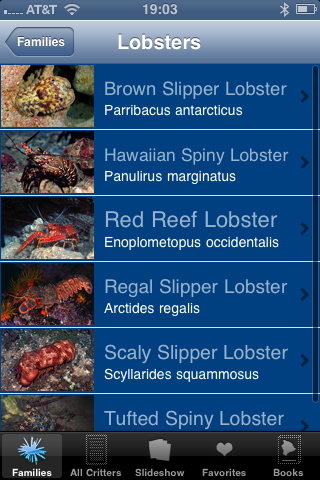
Screenshot of the Reef Critters Hawaii AppAnother source I use regularly is the fantastic collection of photographs found on Keoki Stender’s Marinelife Photography website. This is well organized and fairly comprehensive collection of photos that allow a good shot at identification. One advantage of the website over the books is that there are often numerous photos of each species on the website showing variations between individuals and ages of the critter. More than once we have used this website to ID a species from a smartphone on the boat between dives.
What about an app to do that?
To my pleasant surprise I have found that there is indeed an app. Combining information from John Hoover, Keoki Stender’s excellent photography, plus information from a few other contributors, you can now download everything to your phone for easy reference, even without a data connection.
Actually there are several apps in the series. As with Hoover’s books, fish and invertebrates are handled separately. You can get the phone version or the iPad oriented HS version.
This snorkelers guide to the most common invertebrates and other commonly seen water inhabitants in Hawai’i includes 374 gorgeous photos together with extensive notes for each. All content is by an experts in the field: Keoki and Yuko Stender, and snorkeling guidebook authors, Judy and Mel Malinowski. As a bonus, links to underwater videos by Keller Laros, Rob Whitton, Mel Malinowski and others are provided. – Description of Reef Critters Hawai’i
The apps are well organized and quick to use. As with any book, it helps to be able to recognize at least the family of fish or critter, this helps in navigating to the correct section. Scrolling though a list of species, each with a thumbnail image, allows quick choice of possible identifications.
It is unlikely that the apps will replace my use of the books… The listings are not as complete as the books or websites, many of the less common species are missing. There is generally only one photo per species, neglecting some color phases and juvenile stages. Still, a quick ID reference in the phone is quite convenient. There are a number of videos which I find fairly useless, I would gladly trade the memory requirements for a more complete species listing.
I have no trouble with the $4.99 cost of the apps, I consider it a contribution to the folks who have put together the great references I have used for many years of diving Hawaiian reefs.
I did not see them coming. Sweeping in from above and behind I saw them come over the top. With a kick upwards I was in the school, surrounded by beautiful silver fish. A large school of Heller’s barracuda!
These fish feed at night, spending the day hanging out in large schools over the reef. Even resting they move with graceful speed. I attempt to stay in the school for a while, shooting as I go. I am soon out of breath, sucking air from the tank, worth the effort for such a sight!
Amongst a school of Heller’s Barracuda (Sphyraena helleri)