Pete shot a nice photo of me as we dove Kua Bay. It is an action shot too! Well, at least it shows my usual action on the reef… Nose into the coral, camera front, shooting something too small to see from any distance. Thanks Pete!

When you want to see the stars, find someplace dark

Pete shot a nice photo of me as we dove Kua Bay. It is an action shot too! Well, at least it shows my usual action on the reef… Nose into the coral, camera front, shooting something too small to see from any distance. Thanks Pete!

Snails move at a surprising speed underwater, much faster than their terrestrial counterparts. This shell was moving much to fast even for a marine snail. A hermit crab, of course. The shell was familiar, I had photographed a snail wearing the same shell a few mere minutes earlier. The hermit crab was using a basket snail shell.

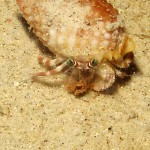
In the course of identifying the hermit crab I was surprised to learn it was an anemone crab. These usually host an anemone or three on their shells. This crab had none. A new shell? No time yet to recruit the usual anemone? It was fairly small for the species, perhaps a young example.
Yes, I occasionally publish porn… Nudibranch porn.
Search engines must have fun with nudis. Just consider the website Nudi Pixel. A great website, I often use the photos to check my identification of a species. How many surfers hit upon the site looking for something totally different?


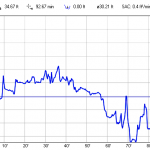
I have had a few dives over 90 minutes, an hour and a half, on a standard 80 cubic foot aluminum tank. This time I managed two back to back dives totaling nearly three hours on two tanks. Not bad for air consumption! Admittedly I was moving slow, doing photography, on the other hand neither dive was all that shallow, averaging 30ft with deeper excursions.
Kua Bay is the last public day use mooring north of Kona for a long distance, the next buoys are at Anemoʻohalu Bay, almost 10 miles further north. The mooring is adjacent to the popular Maniniʻowali Beach, a beautiful crescent of sand that is well loved and heavily used. A prominent finger of coral juts out from the shore north of the beach, creating a nice 20ft wall to explore.
I spent the entire dive poking along this wall, looking for small invertebrates. I was rewarded by an assortment of nudis and flatworms. Most were species I had seen before. One flatworm was something different, a species I am still trying to identify.
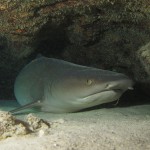
I signal to him, making a shark symbol, a flat hand held sideways to the forehead, that gets his attention. I lead him under a ledge a few feet away, where there is indeed a white tip shark hanging out. When we surface a few minutes later he sums up the encounter… “That is the biggest white tip I have ever seen!” Yeah, it was pretty big. Living up to the scientific name as well, Triaenodon obesus, a well fed shark, a little fat even.
After washing up the boat we head into Bite Me for dinner and to talk story. We thumb though the photos of the day reviewing all we had seen. It was an excellent day diving. The water conditions were notably better than a month ago. Summer is arriving, the swell settling down, bringing clearer water conditions. Looking forward to a summer of more diving!
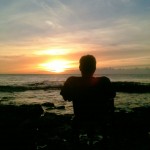
Watching sunset is one way to end the day, in this case it heralded the start of our activity. We were waiting for the Sun to go away, for the skies to grow dark. We were preparing for a night dive.
Once again into the black water, looking to meet the the reef’s night shift. It would be our usual crew… Pete, Sky, Mark and myself for the dive. Dennis joined for dinner, but did not stay for the dive.
While I had never used this particular entry, we were all familiar with the Puakō reef, having dove the area many times over the years. The layout is pretty straightforward. A shallow reef slopes away from shore for about 50-100yards, reaching about 10ft deep. There you will find ancient sea cliffs, a sheer rock wall that drops to 25′ or 35′ depth. Below this wall the reef slopes away, sometimes gently, sometimes steeply. At 70-100ft you reach sand that slopes further into the abyss. Our goal would be the old cliffs. These are pockmarked with small caves and overhangs, excellent terrain to explore on a night dive, there should be plenty of small invertebrates about.
The plan was simple, taking advantage to the nature of the Puakō reef and the multiple entries available along the shoreline. We would enter at one point, do a one way dive along the submerged seacliffs at 20-30ft, then exit at another entry about a quarter mile further south. Exit would be aided by a strobe left at the designated exit point, a bright light in flash mode easily visible to lead us back to the correct landfall.
Overhead a full Moon rose, lighting the sky and aiding our visibility. Once under water the moonlight would ad another dimension to the dive. The glow of moonlight coming through the water was sometimes quite pretty.
At one point I did something I almost never do on a Hawaiian reef. I was actually forced to use my compass for navigation. Normally the slope of the reef quickly indicates which way is shore. I had followed Mark out onto the reef below the wall. After a little photography I found myself disoriented, which was was the shore? I held my compass to the divelight to charge the glow-in-the-dark dial, then got my bearings to head back to the wall. I know I bought the console with a compass for some reason. Just a reminder of how easy it is to lose ones bearings in the dark water.
The strobe worked very well, we were able to head inshore, across the reef shallows, to just the right point. The shallows at Puakō can be a nuisance to cross in the day, they are more so at night. There was no real surf to complicate the issue, but you are just feeling your way across the rocks. I only put my hand on one urchin.
It was a pretty stroll back to the house along Puakō Road. A warm tropical night, a bright full Moon high overhead. We were chatting about the dive, reveling in the experience. One car did pass us as we walked, it must have been an interesting sight… A group of four guys in full scuba gear, dripping wet, walking down the center of the road.
Back at Pete’s place we broke out snacks and drinks. Beer and scotch appeared, dive photos reviewed, as we talked story for hours. Yeah, it was that sort of night.
Normally I do not snorkel around the reef, rather I prefer donning full kit including tank and regulator allowing a more immersive experience. Staying down allows me a freedom of movement, to explore well beyond the twenty five feet or so that I can reach without the gear. Scuba permits me to carry a camera with time to compose a subject and observe behavior.
I skim along, the large fins providing effortless speed. The view is different than that of scuba, you are always looking down. I stay in the shallower water where the coral comes close to the surface. On occasion I dip down below the surface to get a closer look, weaving through the coral on long shallow dives. To go up I simply stop swimming to allow my buoyancy to lift me to the surface. A sharp breath clears the snorkel of water. With practice the actions are almost reflex, as natural as breathing on shore.
There are species that prefer the shallows, rarely seen when diving, often common in just a few feet of water. Snowflake morays, the colorful lagoon triggerfish, snorkeling allows spotting of a different reef community. I often make a point to sweep the areas just off the shore in three feet of water or less, just to see what can be found.