Keck again holds the record, for the moment at least, of the farthest galaxy ever observed. It is a record that we have been passing back and forth with the neighboring Subaru Telescope for some years now. We currently have the advantage of MOSFIRE, a fantastic spectrograph to discover these objects. I expect our hold on this title will be transitory, there are candidate objects that may even be somewhat further away and back in time.
EGS-zs8-1, the farthest confirmed galaxy observed to date. Credit: NASA, ESA, P. Oesch and I. Momcheva (Yale), and the 3D-HST and HUDF09/XDF teamsWhy try to observe these galaxies? They tell us a great deal about the formation of the first stars and galaxies after what astronomers call the “Dark Ages”, a period of time after the Big Bang when light could not travel through the galaxy, absorbed by a fog of neutral hydrogen. These first stars and galaxies ionized this hydrogen, creating the transparent universe we see today. By studying these galaxies we learn a great deal about how the universe we see today came to be.
An international team of astronomers, led by Yale and the University of California, Santa Cruz, pushed back the cosmic frontier of galaxy exploration to a time when the Universe was only five percent of its present age. The team discovered an exceptionally luminous galaxy more than 13 billion years in the past and determined its exact distance from Earth using the powerful MOSFIRE instrument on the 10-meter Keck I telescope at the W. M. Keck Observatory in Hawaii. These observations confirmed it to be the most distant galaxy ever measured, setting a new record. The findings are being published in Astrophysical Journal Letters today.
Time… It is simply a matter of time. At 00:00UT May 3rd, many of the observatory computers suddenly started reporting that the date was September 17th, 1995. To say that this created some problems is a dramatic understatement.
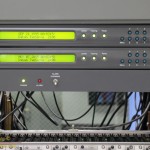
Two Datum TS2100 time servers installed above the telescope drive control computer (TDC)
The problem came from the primary observatory clock. This clock, properly called a time server, uses GPS signals to create a time reference that is accurate to microseconds. This is made possible by referencing to the atomic clocks carried by each GPS satellite. A time server is intricately connected to the network to distribute this time. Any computer in the building can ask it for time via the NTP protocol, but that has some inaccuracy due to network delays. For equipment requiring more precise time the server distributes a hard wired time reference using the IRIG-B protocol or a 1PPS timing pulse.
Without accurate time a telescope will simply not point in the correct direction. The calculation that the computers perform must take into account our rotating planet. Feed incorrect time to that calculation and you will point to the wrong piece of sky. A few milliseconds off can result in a pointing error of arcseconds, a large error for a large telescope.
Walking into the building I saw the first sign. A prominent message placed in the windshield of a car parked by the entrance… “TMT, Too Many Telescopes” The protesters were here. I had hoped they would not be, we had things to get done in this meeting. A disruption of the meeting by protesters would mean another delay.
To that end I had written a proposal for the new instruments with a description of exactly what we wished to do. Attached is an appendix of photos and drawings to answer any possible questions. I was present to answer the inevitable questions I had not thought of and feared would get asked.
The room was filling rapidly when we arrived, far beyond the usual audience of one of these meetings. As I greeted the many people I know, I noted many new faces. They seemed out of place, a little on edge, a sense of having entered enemy territory. Many of those present were young, in their teens and early twenties, one a young mother, child carried in her arms. The t-shirts betrayed their allegiance, they came with cameras and poorly concealed protest signs.
I have no problem with those who oppose the telescopes atop Mauna Kea attending a meeting like the OMKM board meeting. Public participation is a good thing. Indeed, these meetings are open to the public for a reason, to allow anyone interested to attend and to see for themselves how those charged with managing the mountain do their jobs.
I worried about a protest that would disrupt the meeting, making it impossible to accomplish anything. This did not happen. I will give those who attended credit for showing respect for the proceedings and to those discussing the effort of caring for the mountain.
An international team of astronomers, led by Michele Cappellari from the University of Oxford, has used data gathered by the W. M. Keck Observatory in Hawaii to analyze the motions of stars in the outer parts of elliptical galaxies, in the first such survey to capture large numbers of these galaxies. The team discovered surprising gravitational similarities between spiral and elliptical galaxies, implying the influence of hidden forces. The study will be published in The Astrophysical Journal Letters.
The top panel shows the original stellar velocity data, as collected using the DEIMOS spectrograph at the W.M. Keck Observatory. The bottom panel shows a numerical model that matches the data remarkably well. Credit: M. Cappellari and the SLUGGS teamThe scientists from the USA, Australia, and Europe used the powerful DEIMOS spectrograph installed on the world’s largest optical telescope at Keck Observatory to conduct a major survey of nearby galaxies called SLUGGS, which mapped out the speeds of their stars. The team then applied Newton’s law of gravity to translate these speed measurements into the amounts of matter distributed within the galaxies.
“The DEIMOS spectrograph was crucial for this discovery since it can take in data from an entire giant galaxy all at once, while at the same time sampling the speeds of its stars at a hundred separate locations with exquisite accuracy,” said Aaron Romanowsky, of San Jose State University.
One of the most important scientific discoveries of the 20th century was that the spectacular spiral galaxies, such as our own Milky Way, rotate much faster than expected, powered by an extra gravitational force of invisible “dark matter” as it is now called. Since this discovery 40 years ago, we have learned that this mysterious substance, which is probably an exotic elementary particle, makes up about 85 percent of the mass in the Universe, leaving only 15 percent to be the ordinary stuff encountered in our everyday lives. Dark matter is central to our understanding of how galaxies form and evolve – and is ultimately one of the reasons for the existence of life on Earth – yet we know almost nothing about it.
“The surprising finding of our study was that elliptical galaxies maintain a remarkably constant circular speed out to large distances from their centers, in the same way that spiral galaxies are already known to do,” said Cappellari. “This means that in these very different types of galaxies, stars and dark matter conspire to redistribute themselves to produce this effect, with stars dominating in the inner regions of the galaxies, and a gradual shift in the outer regions to dark matter dominance.”
The speeds of stars on circular orbits have been measured around both spiral and elliptical galaxies. Credit: M. Cappellari and the SLUGGS teamHowever, the conspiracy does not come out naturally from models of dark matter, and some disturbing fine-tuning is required to explain the observations. For this reason, the conspiracy even led some authors to suggest that, rather than being due to dark matter, it may be due to Newton’s law of gravity becoming progressively less accurate at large distances. Remarkably, decades after it was proposed, this alternative theory (without dark matter) still cannot be conclusively ruled out.
Spiral galaxies only constitute less than half of the stellar mass in the Universe, which is dominated by elliptical and lenticular galaxies, and which have puffier configurations of stars and lack the flat disks of gas that spirals have. In these galaxies, it has been very difficult technically to measure their masses and to find out how much dark matter they have, and how this is distributed – until now.
Because the elliptical galaxies have different shapes and formation histories than spiral galaxies, the newly discovered conspiracy is even more profound and will lead experts in dark matter and galaxy formation to think carefully about what has happened in the “dark sector” of the universe.
“This question is particularly timely in this period when physicists at CERN are about to restart the Large Hadron Collider to try to directly detect the same elusive dark matter particle, which makes galaxies rotate fast, if it really exists!,” said Professor Jean Brodie, principal investigator of the SLUGGS survey.
Here is the video of last Friday’s presentation, Perspectives on the Future of Mauna Kea. Well worth the watch for anyone interesting in the issue. My thanks to Doug Simons for representing the observatories!
If there is any complaint about the camera work… My fault.
A team led by astronomers from the Jagiellonian University in Krakow, Poland, recently used the W. M. Keck Observatory in Hawaii to observe and measure a rare class of “active asteroids” that spontaneously emit dust and have been confounding scientists for years. The team was able to measure the rotational speed of one of these objects, suggesting the asteroid spun so fast it burst, ejecting dust and newly discovered fragments in a trail behind it. The findings are being published in Astrophysical Journal Letters on March 20, 2015.
Active asteroid P/2012 F5 captured by Keck II/DEIMOS in mid-2014. Credit: M. Drahaus, W. Waniak (OAUJ) / W. M. Keck ObservatoryUnlike the hundreds of thousands of asteroids in the main belt of our solar system, which move cleanly along their orbits, active asteroids were discovered several years ago mimicking comets with their tails formed by calm, long lasting ice sublimation.
Then in 2010 a new type of active asteroid was discovered, which ejected dust like a shot without an obvious reason. Scientist gravitated around two possible hypotheses. One states the explosion is a result of a hypervelocity collision with another minor object. The second popular explanation describes it as a consequence of “rotational disruption”, a process of launching dust and fragments by spinning so fast, the large centrifugal forces produced exceed the object’s own gravity, causing it to break apart. Rotational disruption is the expected final state of what is called the YORP effect – a slow evolution of the rotation rate due to asymmetric emission of heat.
As the new year is well underway I find myself in the midst of my major project for this year. For the next few months I will be replacing the control system for the Keck 2 dome. The project is well underway, but the real work remains ahead of me.
The Allen-Bradley PLC/2 that controls the Keck 2 dome and shuttersIt is a project that is long overdue. The current controller for the dome and shutters is an Allen Bradley PLC/2, a thirty year old piece of equipment that is sadly obsolete. Yes, a PLC, programmable logic controller, one of those machines I thought were a completely horrible way to do anything. I was appalled when I first encountered this technology, now I have to master it.
Parts for the PLC/2 are still available, but the programming software is a real issue. The software runs on a DOS (as in pre-windows) operating system, and does not run under the emulation modes of later Microsoft systems. You need a real DOS computer, something that is a bit rare these days. If the controller running the Keck 2 dome were to fail, I am not certain we could repair it.
I have the computer that is used to do the programming in my office, an ancient Compaq Portable III. Portable is an odd word to use with this computer, it weighs over 20lbs and is huge by modern laptop standards. This museum piece still works! Last month I booted it up and wandered through the file system. At power up I was greeted by a monochrome amber screen and a DOS prompt. I still remember a few basic DOS commands, enough to check things out. It appears that all of the software and files are still present on the hard drive. Sometime I need to see if I can indeed program the old PLC/2. If something goes wrong in the update I need to be able to revert to the original control system.
A reminder that the Keck public lecture is tomorrow night…
Astronomy Talk: America’s Space Program – NASA’s Roadmap to Tomorrow’s Missions
This portrait looking down on Saturn and its rings was created from images obtained by NASA’s Cassini spacecraft on Oct. 10, 2013. Credit: NASA/JPL-Caltech/Space Science Institute/G. UgarkovicNASA Administrator Charles Bolden will discuss America’s space program and the challenges the agency faces for the missions of tomorrow. Using a stepping stone approach that builds on the capabilities of our unique orbiting laboratory – the International Space Station – the growing abilities of commercial providers to reach space, and a new rocket and crew vehicle to travel to deep space, NASA is extending human reach into the solar system even as its amazing science missions are rewriting textbooks about our universe and inspiring the next generation of explorers.
The agency currently has spacecraft speeding toward Jupiter and Pluto and roving on Mars, and is searching for planets that could potentially harbor life beyond our solar system. An unprecedented mission to capture and redirect an asteroid to an orbit near to Earth is in the planning stages, and the Space Launch System and Orion Crew vehicle are reaching new milestones in development to take astronauts to an asteroid and on to Mars.
NASA has been a 1/6 partner in the W. M. Keck Observatory since 1996 and it is an honor to offer this program to the community.