
Banded Urchin
When you want to see the stars, find someplace dark

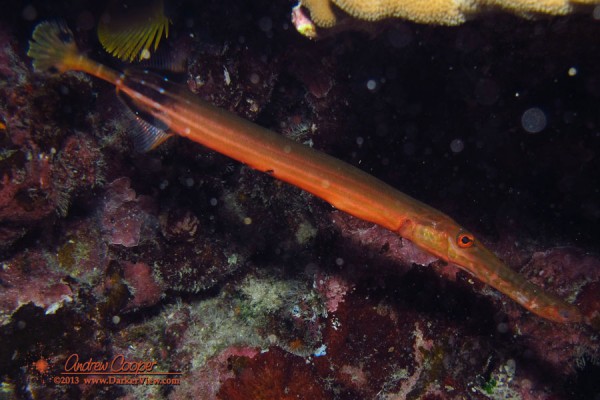
The term supermoon may be a bit of over-the-top hype, it was still nice to dive under the light of a bright full moon. The plan is simple, meet at 4pm for a late afternoon dive, followed by a night dive. Gear and dinner loaded we quickly slip the lines and head out in a smoothly practiced routine. Where is the boat going, I really do not care, wherever we dive it is going to be good.

I love the late afternoon light on the reef. As the light dims the shades become more blue. The lower intensity allows me to control the light better, the strobe overpowering the ambient light on the target of interest. The background becomes an attractive blue, open water photos loose the odd green cast that is difficult or impossible to fix in Photoshop. The fish are less flighty as well, beginning to shift from daytime routine to finding a place in the coral for the night.
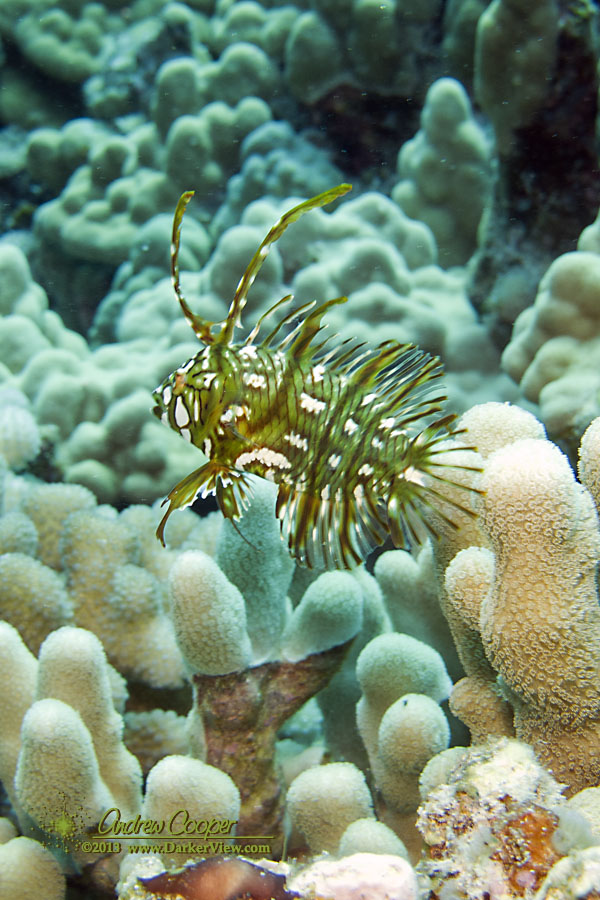
The juvenile rockmover wrasse, sometimes called a dragon wrasse is a wild appearing fish. With an abundance of frilly appendages it moves like a bit of seaweed caught in the swell. In my experience this fish is always found in an open area, a coral or sand flat between large heads or in wave channels.
While not rare, they are not all that common either. This is another fish that is frustrating to photograph, it moves constantly, never quite letting you get close. The only advantage is that it keeps the same territory, making the same circuit, even when bothered by a large, noisy diver with a strobe.
Not a great shot, the fish is not quite sharp and the lighting is poor. Best I have so far, despite several dragon chases. I’ll just have to try again…
Pete shot a nice photo of me as we dove Kua Bay. It is an action shot too! Well, at least it shows my usual action on the reef… Nose into the coral, camera front, shooting something too small to see from any distance. Thanks Pete!


Snails move at a surprising speed underwater, much faster than their terrestrial counterparts. This shell was moving much to fast even for a marine snail. A hermit crab, of course. The shell was familiar, I had photographed a snail wearing the same shell a few mere minutes earlier. The hermit crab was using a basket snail shell.

In the course of identifying the hermit crab I was surprised to learn it was an anemone crab. These usually host an anemone or three on their shells. This crab had none. A new shell? No time yet to recruit the usual anemone? It was fairly small for the species, perhaps a young example.
Yes, I occasionally publish porn… Nudibranch porn.
Search engines must have fun with nudis. Just consider the website Nudi Pixel. A great website, I often use the photos to check my identification of a species. How many surfers hit upon the site looking for something totally different?

