The GoPro HD Hero 2 for Diving

I know, I am late to this party. Not unusual, I do not often jump on the latest tech. I still use an iPhone 3GS, only three models back. It was, as usual, my wife who bequested this latest toy upon me. Without her I would be hopelessly out of date.

The GoPro HD Hero 2 camera is interesting to us as it comes with a standard waterproof housing good to scuba depths. The price was right, Deb picked it up as a Costco special.

Thus I attached it to the top of my usual rig to give it a try on a dive or two. As it turns out, it is a good thing I had my regular camera along, there are some issues with a stock GoPro underwater.

The first obvious issue is focus, as I had heard the camera will not focus properly underwater with the standard dome port. The solution to this is to get a flat port.

The more concerning issue is the burned out highlights visible in the video below. This is not unusual in a camera using a typical exposure algorithm designed for daylight above water. Underwater the red light is gone, absorbed by the water. This lack of red creates a tendency for the camera to overexpose the green or blue.

The usual solution is to set a slight under exposure in the scene using exposure compensation. However, the Hero 2 has no exposure compensation control. There are a couple possible solutions… Commonly available is a red filter for the flat port camera. Will this solve the burnouts? Another possibility lies in using a less saturated color profile as available in the new firmware.

While there were issues with the image, the sound seems pretty good for being in a case, much the same as what I hear when diving. The real test would be to dive with a few whales around to see how well it records whalesong. Alas, the humpbacks headed north a couple months ago. I miss the whalesong soundtrack on our dives. A pod of dolphins perhaps?

I plan to set up the GoPro as a stand alone camera and video rig for diving. Just the camera, an Ultralight handle and arm I have on-hand, plus a video light, which I also have on-hand. I just need to manufacture a tray for the setup, another hour in the machine shop. This should make a compact, lightweight dive or snorkeling camera rig.

I can think of a few other interesting uses for the camera, it has some nice timelapse facilities I need to test. Just the camera to use on the top of a boat. The camera does not do low light, just too small a sensor and lens. Still, there are quite a few things it should do well, a fun addition to the kit.

Postcard from the Reef – Hawaiian Cleaner Wrasse

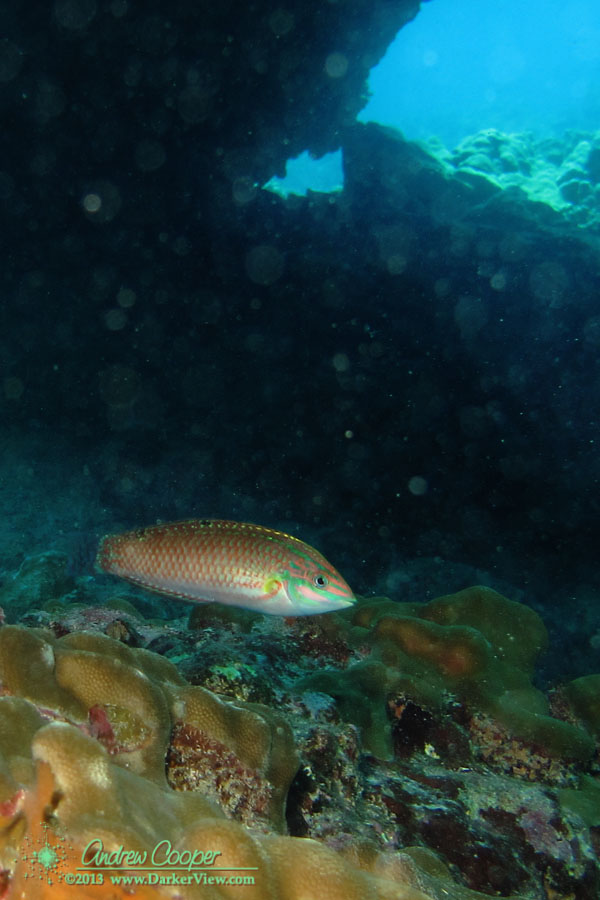
A very common fish, endemic to Hawaiian reefs, the pretty cleaner wrasse easily catches your attention with a brilliant neon color scheme. You see these fish nearly every time you get in the water. They are usually found in some cleft in the reef or above a prominent coral head working over another reef fish. They feed on parasites, mucous and dead skin of the other fish. The cleaning services offered by these small wrasse are so popular that there will often be several fish waiting their turn.

While cleaner wrasse are quite pretty they are also infuriatingly difficult to photograph. You can usually get close, they are not overly shy. The problem is that they never stop moving, swimming with an odd, jerky motion in the water. I have long since lost count of the number of blurred photos I have of this fish.

Cleaner Wrasse
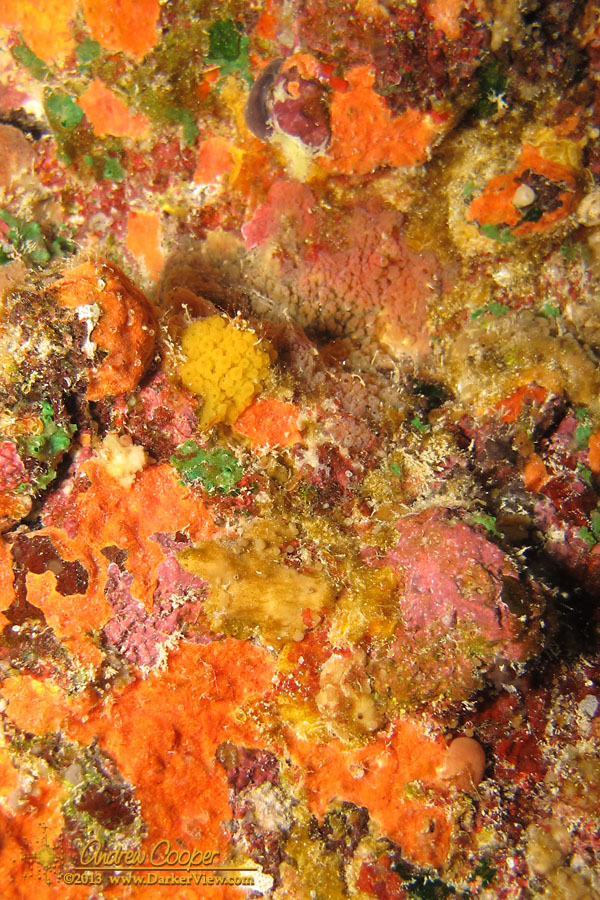
A cleaner wrasse (Labroides phthirophagus) in an overhang filled with red sponges and coralline algae

Postcard from the Reef – Frogfish

Six years I have been diving the reefs of the Big Island. Despite this I have never seen a frogfish. They are rare, but not that rare!

A flashing light catches my attention from across the open coral. Pete is signaling, he does not do that often, when he does it is usually worthwhile. Pete had been working one wall while I worked the other side of a small channel in the reef. So far I had found nothing unusual.

There it was, a bright yellow frogfish just at the edge of a small plate of coral. Not only a nice find, but a nicely posed one as well, conveniently placed for photography. By the time Pete and I had finished photographing this fish it probably had sunburn.

I owe Pete a beer.

Commerson's Frogfish
Commerson’s Frogfish (Antennarius commerson) at 25′ depth

Postcard from the Reef – Toby

A very pale whitespotted toby found in the recesses of a cave. This particular fish was so pale I was re-checking the books to see if it was a different species. Nope, as far as I can tell this is the same whitespotted toby that is commonly seen on our reefs.

Hawaiian Whitespotted Toby
A very pale Hawaiian whitespotted toby (Canthigaster jactator) in a cave at 25ft depth at The Pentagon

A Trip Up The Coast

We limped back in on one engine.

An odd sound alerted Dennis to something amiss, a chuffing sound that the engine does not normally make. Opening the hatch showed more trouble, the engine had dumped all its oil into the bilge. It could be something bad, or something really bad, no way to find out without taking things apart, not something we were not prepared to do.

Nudi Photography
Pete photographing a nudi in a cave at The Pentagon
Already moored at the dive site buoy we decided to forget about the engine, at least for a little while, and do the dive.

Conditions were decent, but not great, some surge was stirring up the water. Faint echoes of whale-song could still be heard, probably the last we will hear this season.

Just underneath the mooring at Pentagon is a wonderful complex of caves, this was where we spent much of the dive. This is a great dive site, a shallow coral plain pocked with numerous caves and small sandy areas. It is a good place to look for invertebrates, big and small. The caves shelter nudibranch and other small critters. The sand patches are home to one of the largest invertebrates found on Hawaiian reefs, the horned trumpet snail.

I located a species of nudibranch that was new to me, the snow-goddess nudibranch (Ardeadoris poliahu). A pretty animal about 4cm long among the algae covered rock in a cave. The nudi was nicely positioned on a boulder in a cave, no problem to photograph, except for the surge sweeping me back and forth. I also found a gold-lace nudibranch that was well positioned for photography. I got some good photos, so did Pete when I showed him where to find the critters.

We would head home on a single engine without making a second dive for the day. Never having done this we all wondered how fast we would go on a single engine and how long it would take to return to harbor. We were a long way north, over twenty miles up the coast from Honokohau, the absolute worst time for an engine to fail. Everyone good for docking at midnight? Would we all make it to work tomorrow morning? Our speculation was for naught, we could manage seven knots without straining the remaining engine, we could return to harbor in good time.

The trip back may have been a bit slower, but this was not a problem either. There were humpback whales along the coast. We had good views of several groups as we traveled, including a couple nice breaches right off the bow. Another group, a mother, calf and escort played about in very shallow water at Makalawena. It was just a nice day to be on the water, nobody was in a real hurry to get back to harbor.

The trouble with the engine has turned out to be fairly minor, the oil pressure switch failed, allowing the engine to pump itself empty of oil. A quick and inexpensive fix, but a real mess in the engine compartment.

A little iPhone video of a whale breach, courtesy Deborah