The first astrophoto taken with the EOS-M. Considering the trouble it is to manually trigger the exposures without proper camera control, I am surprised I stuck it out to take 40+ subs. Since 30 seconds was the longest I could program the camera for I simply maxed out the ISO and took a lot of subs plus a dozen darks. There is still way too much noise in the resulting frame. Still, the ISO 12,800 frames are not all that bad, better than I expected. If this camera had remote control it would be a decent little astro camera. Longer subs and a lower ISO would deliver decent results.
The Orion Nebula with and EOS-M, 40x30s exposures @ ISO12,800, AT6RC and 0.8x focal reducer, a set of 12x4s exposures used to reveal detail in the core.
A telescope needs to move smoothly, without any binding or sticking. The elegantly simple bearing design used in dobsonian telescopes uses a smooth surface riding on a small pad of some low friction material. This requires a pad of some material that slides smoothly and does not stick, to provide the motion. The standard answer of telescope builders is polytetrafluoroethylene, simply referred to by the acronym PTFE or the trade name Teflon.
Elevation bearing of an Orion XT8 8" dobsonian telescopeI recently spent some time rebuilding a small dobsonian telescope, one of the telescopes that belongs to the Mauna Kea VIS and is used every night in the public program. The ‘scope is a commercial unit built by Orion Telescopes, an 8″ f/6 ‘scope. These telescopes are quite popular, with good reason… low cost, decent performance and very easy to use. The 8″ version I was working on retails in price for about $330.
The price is excellent for an 8-inch telescope, but there is some sign of cost cutting in the more recent versions. One interesting difference I found in this ‘scope was the bearing material. The bearing pads that are supplied do not appear to be PTFE, but instead a much harder material, possibly HDPE instead, which would be cheaper than PTFE. replacing these with PTFE results in a nice improvement in the smoothness and ease of movement of the telescope.
This particular telescope was missing two bearing pads, so some replacement was required, whatever the material. Without access to the original parts it was necessary to obtain whatever material was available, and that would be PTFE. Since it came in a different thickness than the original bearing it was also necessary to replace all four pads.
Elevation bearing pad on an Orion XT8 8" dobsonian telescopeTeflon in sizes suitable for bearing pads can be ordered from a number of suppliers across the web. The material shown here was purchased from Scopestuff, where a 12″ x 3/4″ strip of 1/8″ thick PTFE is available for $11, just the right size to cut bearing pads for the Orion XT series telescopes.
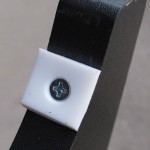
In place of the original staples, a small flat head screw is used to secure the Teflon in place. The soft material is easy to work. As long as the tools are sharp drilling and countersinking the pieces is easy. Best use a new drill bit if you have one, or grab one of the odd sizes that never seem to be used.
Position of the bearing around the radius of the trunnion have some impact into how easily the telescope will move. Positioned closer together and closer to the bottom of the bearing and the telescope will move more easily. Positions further part and higher on the bearing sides will result in more friction as the trunnion presses outwards against the pads.
The repair worked quite nicely, with a ‘scope that move smoothly across the sky. A bit more cleaning and a few minutes collimating the optics had the small telescope again ready for the sky.