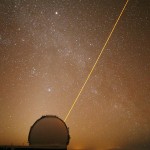
Another great video from my friend Dan Birchall. There are more opportunities to see multiple lasers on the galactic center in coming months. I hope to get up and do some more shooting of my own.
When you want to see the stars, find someplace dark

Another great video from my friend Dan Birchall. There are more opportunities to see multiple lasers on the galactic center in coming months. I hope to get up and do some more shooting of my own.
Join us for an astronomy talk tonight at the Kahilu Theater in Waimea…
First Light in the Universe: The End of the Cosmic Dark Ages
Dr. Michael Bolte from UC Santa Cruz
7:00pm, June 19th 2014
Kahilu Theater, Waimea
Free and open to the public
In the first several hundred million years after the Big Bang, the Universe was too hot for stars and galaxies to form. As the Universe cooled and its expansion slowed, gravity caused the first stars to collapse and re-light the Universe. Most theories suggest these first stars were unusual super-massive objects that evolved quickly and ended their lives in gigantic explosions. In this talk, Dr. Michael Bolte from UC Santa Cruz will discuss observations from Keck Observatory that identify the physical properties of the first stars based on the chemical elements they produced as they ended their lives.


Join us for an astronomy talk on June 19 at the Kahilu Theater in Waimea…
First Light in the Universe: The End of the Cosmic Dark Ages
Dr. Michael Bolte from UC Santa Cruz
7:00pm, June 19th 2014
Kahilu Theater, Waimea
Free and open to the public
In the first several hundred million years after the Big Bang, the Universe was too hot for stars and galaxies to form. As the Universe cooled and its expansion slowed, gravity caused the first stars to collapse and re-light the Universe. Most theories suggest these first stars were unusual super-massive objects that evolved quickly and ended their lives in gigantic explosions. In this talk, Dr. Michael Bolte from UC Santa Cruz will discuss observations from Keck Observatory that identify the physical properties of the first stars based on the chemical elements they produced as they ended their lives.

TBAD is our Transponder Based Aircraft Detector, used to avoid illuminating an aircraft with the AO laser. A specially designed receiver that uses an antenna at the front of each telescope to detect the TCAS anti-collision transponder that is carried by all commercial and most civil aircraft.
Still, we are mandated to avoid the situation and to put in place measures to avoid such an occurrence. Before TBAD this involved hiring guys to sit outside and watch the skies for aircraft. I have done this, it can be pretty on a clear night with calm weather. It can be brutal on a cold and windy night. Even when taking precautions such as rotating two spotters every hour or two there is always the question of human fallibility under adverse conditions. Using an automated system like TBAD is far preferable.
W. M. Keck Observatory press release…
An international team of scientists, led by astronomers at Queen Mary University of London, report of two new planets orbiting Kapteyn’s star, one of the oldest stars found near the Sun. One of the newly-discovered planets could be ripe for life as it orbits at the right distance to the star to allow liquid water on its surface. The paper is being published by the Monthly Notices of the Royal Astronomical Society on June 4.

The astronomers used new data from the 3.6 meter La Silla Observatory in Chile to measure tiny periodic changes in the motion of the star, and followed up with two more high-precision spectrometers to secure the detection: W. M. Keck Observatory’s HIRES instrument installed on the 10-meter Keck I telescope on the summit of Mauna Kea, and PFS at the 6.5 meter Las Campanas Observatory in Chile.
Using the Doppler Effect, which shifts the star’s light spectrum depending on its velocity, the scientists can work out some properties of these planets, such as their masses and periods of orbit.
Continue reading “Ancient Worlds from Another Galaxy Discovered Next Door”
