
Postcard from the Universe – First Quarter
When you want to see the stars, find someplace dark

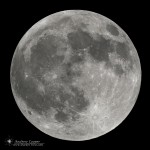
Tonight the Moon and Jupiter will be quite close. The pair will rise at nearly the same time, about 15:09HST, placing the two well up in the eastern sky by sunset. The Moon will be quite large, 87% illuminated and about 5° from the bright planet.
With Jupiter this close to the Moon it is an excellent time to see Jupiter in the daytime sky. Look 5° north of the Moon for a bright pinpoint of light. 5° is ten times the size of the Moon seen in the sky, north will be to the left seen as the pair rises above the eastern horizon.
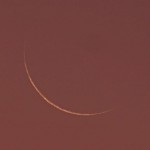

The following morning, January 29th, will see the Moon 10° below Venus, halfway to the rising Sun.
Tonight the Moon and Jupiter will be quite close. The pair will rise at nearly the same time, about 17:08HST. The Moon will be very near full, 98% illuminated and about 5° from the bright planet.
What is happening in the sky this year?
There are no exceptional sky events expected in 2014. A pair of good lunar eclipses, a decent Mars opposition, the usual meteor showers, and no bright comets predicted. There is one odd meteor shower that might provide some fireworks in May mentioned below. Otherwise there is always the possibility of a new discovery, a nova or supernova, or a new comet. For now this looks to be a routine year for sky watchers.

Venus is as always a fun planet to follow through the year. The brilliant morning or evening star is always notable when it passes other bright objects such as the Moon or Jupiter. In April and May Venus will pass both ice giants, Uranus and Neptune with under a degree of separation. In August it will be Jupiter, passing about 35′ away on August 14th. The approach will be even closer if you are able to observe the pair during daylight hours, closing to 12′ at 08:06HST on the 14th.
Mars will pass through opposition on April 8th this year. This is a relatively good viewing opportunity with the red planet appearing just over 15″ in size. Close approach will be a week later, on April 14th. On September 27th Mars will pass about 3° from Antares.
Jupiter and Saturn continue to be well separated in the sky. This results in one or the other being available for observation much of the year. We start with Jupiter in the evening sky until early July. Saturn is currently in the early morning sky, passing through opposition May 10th and available for observation in the evening sky for the latter half of the year.
The minor planets Ceres and Vesta are quite close all year. So close they will experience opposition in the same week. The dance will take place with the constellation Virgo as the backdrop. 4 Vesta will pass through opposition on April 13th, only two days later 1 Ceres will do the same on the 15th. At the same time the planet Mars will be just a few degrees south of the pair, going through opposition on April 8th. I wonder if the astrologers have noticed this? If so I am sure they will attach some ridiculous speculations to the event. They do not usually pay attention to the minor planets.
There are two solar eclipses and two lunar eclipses for 2014. An odd annular solar eclipse will be visible from Antarctica and Australia on April 29th. A deep partial solar eclipse will be visible across much of western North America on October 23rd. Neither will be visible from the islands.
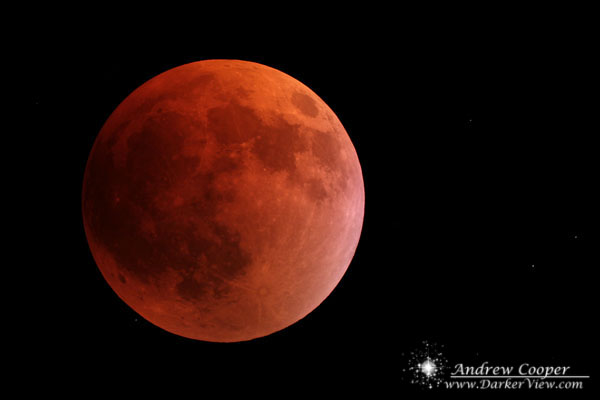
The two lunar eclipses are more interesting. Both total eclipses will feature good magnitudes and the eclipses will both be visible in their entirety from Hawai’i. Better yet, the first eclipse will begin soon after sunset, providing an excellent viewing opportunity for outreach. Occurring on April 14th and October 7th, these will be the highlight of the year for eclipse aficionados.
2014 offers an interesting year for meteor watchers. Of the three most reliable showers it is the Quadrantids that will be seen to best effect in 2014, untroubled by moonlight. The Geminids will be partly obscured, while the Perseids will peak quite close to full Moon.
In addition to the traditional showers there are predictions for a new shower associated with Comet 209P LINEAR. In late May this debris stream may produce a strong, or even storm level meteor shower. Watch here for more information on this possible event.
As usual you should keep tuned to Darker View for timely reminders of upcoming celestial events. Over a hundred posts are already entered and waiting for the appropriate date to pop up here, reminding you and I to keep looking up.
A very thin crescent Moon will appear below Venus in the sunset this evening. Look for a 1% illuminated crescent quite low, only about 10° elevation at sunset. Venus will be a bit higher, about 14° above the setting Sun.

A telescope will reveal that Venus also shows a thin crescent phase, only 3% illuminated as it approaches inferior conjunction, passing between the Earth and the Sun.