
Winter Sky over the Telescopes
When you want to see the stars, find someplace dark


I am truly jealous! My friend Dan Birchall got the photo I had hoped to get… All four Mauna Kea lasers in operation at the same moment. Better yet, all four lasers were on the same target, the center of our Milky Way galaxy. The result is a great photo of four yellew beams converging to the same spot in the sky.

The four beams come from our two Keck telescopes, plus one from Gemini and one from Subaru. the lasers are used to create reference beacons for the adaptive optics systems used on these large telescopes. I will, with a little possessive pride, point out that the Keck lasers are much more powerful than the others.
The scheduling of all four lasers at once is a rare occurrence. All four lasers on the same target? Even more luck was involved! It helps that Dan is a telescope operator and spends far more dark time on the summit than most of us. He took advantage of the situation correctly… Grabbing the camera and shooting.
Below is more footage from Dan, a little time lapse of the telescopes working…
W. M. Keck Observatory Press Release…
A team of researchers has discovered and photographed a gas giant only 155 light years from our solar system, adding to the short list of exoplanets discovered through direct imaging. It is located around GU Psc, a star with one-third the mass of the Sun and located in the constellation Pisces. See the article in The Astrophysical Journal.

The object was discovered using Gemini-South and followed-up with Gemini-North spectroscopy and CFHT photometry. Once Naud’s team had the entire spectrum, they realized the object had a very low temperature, with properties similar to substellar objects like brown dwarfs or planets.
One possibility was that the object had a peculiar spectrum simply from its youth, and that this had nothing to do with it being a binary, but the other tantalizing possibility was it was a binary planet, with one component being slightly warmer than the team derived from their analysis and the other component slightly cooler.
My father-in-law made a career of repairing the heavy machinery of the local plywood and paper mills in the lumber and farming community of LaGrande, Oregon. Large machines such as high speed saws, conveyors, process tanks and more. One evening he was working with something I did not recognize and I made the mistake of asking what it was.

As a computer engineering student I was appalled that anyone would program this way, I could not conceive of using such a backwards seeming technology. Why not just use a simple programming language like C to build the functions? Ladder logic was the worst sort of programming language, no abstraction, no compartmentalization, prone to building hard to understand spaghetti code.

Jumping ahead more than a decade… I now find myself using this same technology and programming in ladder logic. Many of the critical systems at Keck use PLC’s for control. The dome controllers, local controls and various safety systems use PLC’s to accomplish the task. Some of these systems are over two decades old, and for the most part spares can still be purchased.
The technology is not dead, far from it. The new telescope control systems currently being designed will feature modern ControlLogix PLC’s to implement the critical safety functions. There are dozens of interlocks throughout the telescope, switches that detect the condition of the system and prevent bad things from happening. If a lock pin is not installed, if a drawbridge is down or a crane not stowed properly, the telescope does not move.
Never mind me, I am just reading a twenty year old user manual, learning how to set the serial communications on a PLC-5.

The Galactic Center Group at UCLA has used the W. M. Keck Observatory for the past two decades to observe the center of the Milky Way at the highest angular resolution possible. This work established the existence of a supermassive black hole at the heart of our Galaxy. In this talk, Dr. Leo Meyer, Research Scientist for the UCLA Galactic Center Group, will focus on the black hole itself and the gas that it swallows. The feeding of the black hole is a turbulent process resulting in highly variable emission of infrared light. Observations of this variability provide a great way to learn about the black hole and its immediate environment.
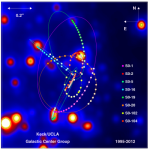
Dr. Leo Meyer – UCLA
May 20, 2014
Show starts at 7 p.m.
Kahilu Theatre, Waimea
Free and open to the Public

By the time you get to this point you are almost there, you are also out of breath from climbing the vertical ladders. The price of getting to the top of the Keck 1 dome.
Also a good spot to take a photo while catching your breath…

A job that takes me high inside the dome, installing a test antenna for TBAD. Going so far up in the basket is always a treat, the view of the telescope is great. A view few people ever get to see…
