To no one’s surprise those most opposed to astronomy on Mauna Kea have reacted negatively to yesterday’s statement by Governor Ige. Released statements by the Mauna Kea Hui, Kū Kia’i Mauna and other groups offer no compromise in response to the governor’s proposals.
A protest against TMT in Waimea, May 27, 2015A number of protests have been organized around the island, including one at Church Row, just across the lawn from Keck headquarters. The protest is a very island way of doing this, a sign waving event along a major highway. This is a very typical event during political campaigns or social controversies like this.
Today’s protest is interesting compared to earlier protests, it seems less energetic, with far fewer passing vehicles honking in support. The previous protest at this location was almost constant honking. Has the community sentiment shifted away from those protesting? Are many accepting the spirit of compromise that was exemplified by the governor yesterday? The real test will be when construction resumes, and we all expect it to resume soon.
It was in walking over to check on the protest that I had a more interesting conversation. A Hawaiian gentleman was selling fresh ahi and pickled mangoes from a roadside stand. He ask why they were protesting the telescopes. It made no sense to him that anyone would oppose the TMT.
This is in line with many quiet conversations I have had. Many in the local community do support the TMT, but the support has been muted by the most strident voices of opposition. Conflict is not comfortable to many in this community, traditional Hawaiian and to a large extent traditional Asian attitudes that so many follow here have steered many away from the controversy. As we chatted he offered me a piece of ahi free, he had a big catch yesterday. I deferred and thanked him, I still have plenty of halibut to use up in the freezer.
After weeks of being pretty much silent on the controversy, Governor Ige has issued a statement on the ongoing issue of TMT construction. It was big news around this place, pretty much the entire staff of Keck Observatory piled into our big conference room to watch the governor’s address live.
The true summit of Mauna KeaThe announcement contained no real surprises, rather a set of pragmatic proposals that attempt to move the issue forward. The governor outlined his proposals as a list of bullet points. These may seem to be merely proposals, but I would be very surprised these proposals would be announced without at least the tacit agreement of the various parties involved. There must have been a good deal of behind-the-scenes negotiation.
A night on the summit and a stay at Hale Pōhaku offers an opportunity to explore the mountain. The plan had been to take a short hike in the Hale Pōhaku area to visit some interesting geologic features before heading down the mountain. A cold misting rain made that idea much less attractive. Instead I paid a visit to my friends at the Visitor Information Station and along the way visited the protest camp across the street. The experience of the day was a conversation I had with the occupants of the camp, a conversation both interesting and odd, I spent the entire drive back down the mountain and much of the day mulling over what I had seen and heard in that conversation.
The protest encampment across the street from Hale PōhakuI will avoid the use of names here, I am not sure is the owners would appreciate my using them and they really add nothing to this description. Thus I will follow Galileo and use names that reflect the individual views. It is these views that were intriguing, for this day I met several people with entirely different motivations that make a very interesting contrast. It was fascinating to me that in the span of one conversation I would meet people who so typified the various groups that have become involved in the controversy.
The first to greet me as I came across the street was a gentleman I will call Mr. Sovereignty for his position on the matter. The argument atop Mauna Kea has become embroiled in a range of issues that have simmered in the islands for a long time. Among those who are against the construction of TMT are some who are simply against any further telescopes on Mauna Kea and also those who see the issue as wrapped up in questions on the legal status of the State of Hawaii. The main thrust of a common argument is that the Kingdom of Hawaii was illegally overthrown. Their goal is nothing less than the restoration of the kingdom as a sovereign entity.
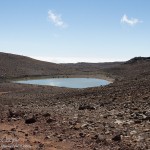
Our mountain is home to a wide range of geologic features, Aside from the wide range of volcanic features expected on a shield volcano, there are also glacial features and a small lake. Indeed, one could teach a fairly thorough course in geology simply visiting places on Mauna Kea. It is the lake that seems completely out of place, Lake Waiau should not exist.
Lake Waiau near the summit of Mauna KeaThe lake nestles in the crater of Puʻu Waiau, a low cinder cone on the south side of the summit at an elevation of 13,000ft (3,900m). It is not very large, about 100 yards across and about ten feet deep.
The lake is an anomaly. The cinder of Mauna Kea is highly permeable, water disappears into the ground at an impressive rate almost anywhere else on the summit. Something within the crater forms an impermeable layer that allows the water to persist at the surface.
The two most common theories are a layer of volcanic ash and/or clays, or a layer of permafrost beneath the surface. I prefer the ash and clay theory, there is suitable material present on several of the other cinder cones, most notably seen as yellow streaks down the side of Puʻu Poliʻahu and on the sides of Puʻu Waiau itself.
Walking into the building I saw the first sign. A prominent message placed in the windshield of a car parked by the entrance… “TMT, Too Many Telescopes” The protesters were here. I had hoped they would not be, we had things to get done in this meeting. A disruption of the meeting by protesters would mean another delay.
To that end I had written a proposal for the new instruments with a description of exactly what we wished to do. Attached is an appendix of photos and drawings to answer any possible questions. I was present to answer the inevitable questions I had not thought of and feared would get asked.
The room was filling rapidly when we arrived, far beyond the usual audience of one of these meetings. As I greeted the many people I know, I noted many new faces. They seemed out of place, a little on edge, a sense of having entered enemy territory. Many of those present were young, in their teens and early twenties, one a young mother, child carried in her arms. The t-shirts betrayed their allegiance, they came with cameras and poorly concealed protest signs.
I have no problem with those who oppose the telescopes atop Mauna Kea attending a meeting like the OMKM board meeting. Public participation is a good thing. Indeed, these meetings are open to the public for a reason, to allow anyone interested to attend and to see for themselves how those charged with managing the mountain do their jobs.
I worried about a protest that would disrupt the meeting, making it impossible to accomplish anything. This did not happen. I will give those who attended credit for showing respect for the proceedings and to those discussing the effort of caring for the mountain.
What do we really spend our days doing on the mountain? Usually pretty mundane stuff, just fixing stuff and making improvements to the gear. A little peek into one of those improvements over at CFHT, a fiber run to allow the 8 meter Gemini telescope to feed a spectrograph next door at CFHT. Something not so mundane, rather fun actually…
Here is the video of last Friday’s presentation, Perspectives on the Future of Mauna Kea. Well worth the watch for anyone interesting in the issue. My thanks to Doug Simons for representing the observatories!
If there is any complaint about the camera work… My fault.
An impassioned argument is one thing. I realize that tempers can flare and some people may say things that they might otherwise not say. But strong emotion can also reveal the truth behind the facade that we all maintain. What is revealed under stress can be our finest or our worst.
A Facebook posting full of obscenity and threats.I have seen several Facebook posts that threaten violence to telescope supporters, and have received reports of threats from others who work on the mountain. Sometimes it just crosses the line. This is the case with one prominent individual opposing the construction of TMT…
A lot of emotion and bandwidth has been swirling around our mountain this past month. It has been unfortunate that two otherwise positive forces have collided atop one summit. Last night the local community had a chance to listen to various perspectives in a more personal and reasoned forum. The Honokaʻa Peoples Theater, located on the slopes of Mauna Kea is the perfect place for this to happen. An evening of face to face discussion.
Hāwane Rios addresses the audience at the Honokaʻa People’s TheaterWhile the issues surrounding Mauna Kea have captured international attention, this conversation was all the more powerful as it was limited to those of us who live and work on this mountain, many from families who have lived for generations in the mountain’s shadow. The conversation was all the more impressive in that it was conducted in the full spirit of aloha… There was no yelling, no waving signs, just respectful listening.
The format was simple, a presentation by Hāwane Rios, explaining her perspective on growing up in the traditions of Mauna Kea. This was followed by a presentation by Doug Simons, executive director of the Canada-France-Hawaii Telescope. After a 15 minute intermission there was another hour of panel discussion with questions provided by the audience. What started at 6pm went on until well after nine, with personal conversations that kept the theater a buzz until well after 11pm.
Unfortunately one of the featured speakers Lanakila Mangauli was unable to attend, having flown to Oahu for a hasty meeting with OHA and state officials. He was not completely absent, a Skype connection projected on the theater screen allowed him to give a short presentation at the start. After having watched video of his tirade (Yes, I will call it that!) at the TMT groundbreaking ceremony, I had been given a somewhat less than flattering opinion of him. The person who addressed the audience this night was much more impressive, giving an intelligent and reasoned argument to his cause. I wish he had been able to address the audience in person.
Doug Simons, Hāwane Rios, and Ruth Aloua participate in Perspectives on the Future of Mauna Kea, Apr 24th, 2015Thus it was up to Hāwane Rios to present the traditional and cultural perspective, a role she filled spectacularly well. She relater her personal relationship with the mountain, whom she considers part of her family. Impressing upon the audience the importance of place, the importance of continuity to the culture. Her discussion was interspersed with song, chants composed in traditional form and a notable song with a more modern flair. I could attempt to describe her presentation further, but I do it no justice, I suggest you watch the video.
Doug Simons also related his personal connection to the mountain, having spent the last 30 years working, hunting and raising his family here in Waimea and on Mauna Kea. Starting with the great discoveries that have been accomplished by the telescopes atop Mauna Kea, Doug did an admirable job of covering the importance of the research done at the telescopes and why these great instruments belong to all of mankind.
A plethora of computers illuminate the technical crew at Perspectives on the Future of Mauna KeaThe question and answer went smoothly, no real surprises in the questions or the answers. Asked of the future of the telescopes Doug reflected that there will probably be fewer telescopes in the future, but that those should be the best in the world, nothing else is worthy of Mauna Kea. Asked about her personal vision of the future of the summit Hāwane asked for nothing less that the dismantling of all of the telescopes.
I spent the evening listening and operating a production video camera we had brought over from Keck. CFHT, Subaru and Keck staff operated a battery of audio/visual gear, live casting the event on YouTube, recording video for later editing and managing a Skype connection for Lanakila. I expect we should have good videos up shortly, they are definitely worth watching by anyone interested in the issues surrounding our mountain. The presentation by Hāwane should be worth watching just to hear her sing. I will put the links here as soon as they become available.