
Sunset Bound
When you want to see the stars, find someplace dark

All sky-watchers are hoping that comet ISON is spectacular when it emerges from the solar glare. there is no guarantee on this, we just do not know. But it could be as pretty as comet Ikeya-Seki or comet McNaught, both of which became far brighter after perihelion passage.

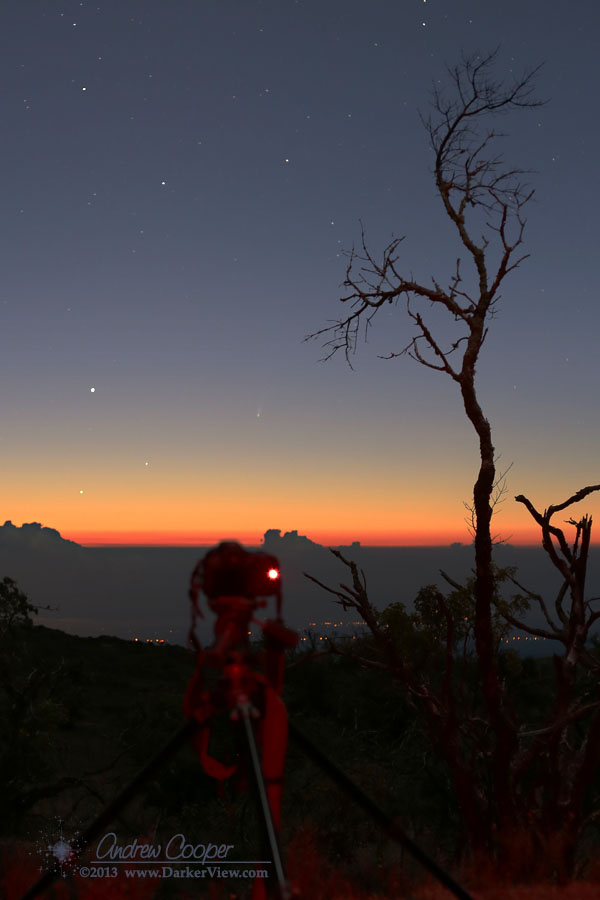
This recent Saturday I only went partway up the Mauna Kea access road, just high enough to be clear of the clouds and haze. There is a turnoff on the east side of the road just above the cattle guard at about 8,000 ft, one mile below Hale Pohaku. Plenty of room to park a vehicle or two and plenty of level ground to take photos from.

Plotted below is the path of comet ISON through perihelion. The image is zenith up on the morning of November 28th from the island of Hawai’i. The actual moment of perihelion will be Nov 28.77501UT (18:36UT or 08:36HST).
A few things are notable… The obvious one is how close the comet will get to the Sun. Not just in absolute terms, which is really close. But rather how close it will look to us. The comet will be under 30 arc-minutes from the center of the Sun, recalling that the Sun is about 30 arc-minutes across. The comet will not pass behind the Sun from our point of view. While we may not be able to see it while lost in the solar glare, it will remain in the view of those solar monitoring spacecraft that are near the Earth.
Separation will help in trying to spot the comet during the day. During the 27th, 28th and 29th the comet will be very close to the Sun. On the morning of the 29th the comet will be only 4.5° from the Sun. Best bet to attempt a daytime peek may be on the 30th or later, when the comet will again be more than 7.5° from the Sun. Look for the magnitude estimates and be prepared to give it a look.

Astrophotography is not normally a daytime activity, but there are exceptions. If a comet is bright enough, about magnitude -2 or brighter, it is possible to spot the comet in the middle of the day. Comet C/2012 S1 ISON may very well be visible near the Sun in the middle of the day.

This sort of solar intensity will cause the comet to emit enormous amounts of gas and dust. It is this cloud of material around the comet, the coma and tail, reflecting the sunlight that makes the comet bright.
Continue reading “Spotting Comet C/2012 S1 ISON in the Daytime”
Not quite the dramatic comet in the dawn shot I was hoping for. The comet is just barely able to compete with the dawn glow. Still, a beautiful morning.
Waiting to see what fate holds in store for this dirty snowball as it travels through the hell of the solar corona. I will try another photo session after perihelion.


While comet C/2012 S1 ISON is getting all of the attention, it is not the only comet currently visible. There are a couple other good comets available to observe or photograph. On Sunday morning I tracked down and photographed three comets.

Despite following comet ISON for the last year, I had never actually observed it myself. Attempts to change this repeatedly ran into problems, either work commitments or bad weather. Over the last month cloudy skies have been more common than clear, even the big ‘scopes on the mountain losing a large amount of time to poor conditions.
Wondering what comet C/2012 S1 ISON is looking like today? There is a very good camera aimed at the eastern horizon from the summit of Mauna Kea. Just what you need to take a look for yourself.
The CFHT Cloudcam is a DSLR camera that is programmed to take exposures constantly through the night. Used by the telescope operators to monitor oncoming weather, the camera shows the sky conditions over the eastern coast of the island and the city of Hilo. The images are live during the night, each morning you can load a timelapse video of the entire night.
The camera has quite a following, quite a few people check the camera constantly. This includes quite a few UFO consipracists. If anything odd shows up on the camera the video quickly shows up on YouTube and linked to postings on the UFO sites. When the launch of a missile from Vandenberg AFB in California created a glowing sphere of light these websites went into overdrive with wild speculation.
Most of the mornings this week have been too cloudy to see the comet. I have been checking the video each day. Currently at magnitude 5 the comet will be a small dot in the imagery. As the comet brightens it should appear nicely in Cloudcam.
