
Tag: Moon
New Moon
The Moon, Mercury, Mars and Jupiter
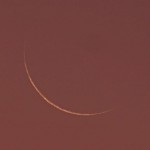
The dawn is getting crowded. While three planets, Mercury, Mars and Jupiter have been dancing on the dawn stage for weeks now, tomorrow morning a thin crescent, waning Moon will join in. Tomorrow morning the Moon will be 10% illuminated and 4.5° south of Jupiter.
Over the next couple mornings the Moon will continue to wane and slide along the line of planets in the dawn. On the morning of the 4th it will be 5% illuminated and between Mercury and Mars. On the 5th it will be lower than all three and only 1.6% illuminated.
Full Moon
New Moon
The Moon, Mars and Jupiter
Tomorow morning, July 6th, will see a nice 5-7° triangle made up of a slim crescent Moon, Mars and Jupiter. Look for the trio to start rising about 04:30 HST with Mars rising first, followed by a 2.5% illuminated Moon. Last up will be Jupiter, rising about 04:55 HST. The Sun will not rise until 05:48 giving plenty of time to enjoy this conjunction.
Full Moon
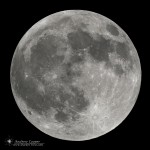
This full Moon will be a perigee full Moon, with the Moon appearing a bit larger and brighter. Today lunar perigee occurs within minutes of full, producing a full moon that is about 12% larger and 30% brighter than if full occurs while the Moon is at apogee.
The Moon, Mercury and Venus
This evening the Moon will join the ongoing dance of planets in the sunset. A very thin crescent Moon will be 13° above the horizon at sunset and 6° below and south of the brilliant Venus. 5° above Venus will be Mercury notably dimmer at only 0.4 magnitude.
Tomorrow the Moon will be a bit higher and show a little more crescent at 6% illuminated. It will be above Venus and about the same elevation as Mercury, if 7° further to the south.
Jupiter is still present, but probably too low into the sunset to spot at only 6° from the setting Sun. Maybe with perfect conditions?
New Moon
Full Moon
A penumbral lunar eclipse will occur, but it is so minor there is little point in trying to observe it. As the NASA eclipse site notes… “With a penumbral eclipse magnitude [6] of 0.0158, just 0.5 arc-minutes of the Moon’s southern limb will pass into Earth’s pale penumbral shadow; such a shallow eclipse is only of academic interest since it will be all but impossible to detect.”