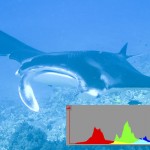
One of the major problems in underwater photography is the loss of color as you descend. The water filters out the red end of the spectrum, creating the blue world all divers are familiar with.
Visually this is a problem, divers are unable to appreciate the beautiful colors of marine life without using an artificial light source. Most divers carry lights, even on daytime dives, for this reason. It can be quite dramatic to turn on a light and watch brilliant reds and yellows appear where there was little color without the light.
A blue manta photographed at 40ft depth
Photographically it is even more challenging, a strobe can light up nearby objects, revealing the colors. For more expansive scenes even the most powerful strobes fail, resulting in photographs heavy in greens and blue, with very little red. For some photos, the blue works, a “true” representation of what was seen. Often the blue does not work, the resulting photograph is an unattractive blue tinged with green, that no amount of fiddling in Photoshop will salvage.
One method in dealing with the loss of color balance is to simply take the loss further, convert the image to a black and white photograph. This is a technique you will see used in underwater photography quite often. By removing the distraction of color, the viewer is able to focus on the subject. The same reason so many modern photographers eschew color, even in an age when wonderful saturated colors are easily reproduced.
Fall equinox occurs today at 10:44HST. Today there will be little difference between the length of the night compared to number of daylight hours. This is the first day of fall as marked by many cultures in the northern hemisphere.
Many reef fish change color for the night. Many lose their bright daytime colors to become rather drab, most likely in order to evade the predators who scour the reef at night. Moray eels, reef sharks, and more are on the hunt, looking for the fish hiding in the nooks and crannies of the reef. For the diver a nighttime reef it totally different, the clouds of fish hovering over the coral are gone. Here and there a few fish are visible, the color seemingly drained from them as they wait out the night.
A longnose butterflyfish (Forcipiger flavissimus) in nighttime coloration during a night dive at Puakō
Full Moon taken 27Aug2007, 90mm f/12 APO and Canon 20DaFull Moon will occur today at 01:13HST.
A penumbral lunar eclipse will occur this Full Moon. With a penumbral magnitude of 0.76 this is a relatively deep penumbral eclipse which should create a nice shadow effect across the Moon. Unfortunately none of this eclipse is visible from the central Pacific Ocean.
Recently, a video filmed at Honokohau Harbor has brought shame to our island. The video depicts some young people landing a large Tiger shark on the rocks at the harbor entrance. The tackle used is ropes tied to the land. This was neither fishing for food or sport-fishing where the animal is fought with a rod. It was simply disrespect.
The 14ft tiger shark Laverne at Honokohau, photo by Pete TuckerThe shark is an important part of the Hawaiian culture. For some, the shark is ‘aumakua. But for all, the shark was respected, not a plaything: “In old Hawai’i, catching the niuhi was the game of the chiefs, a dangerous sport for which special techniques were developed, according to historian Mary Kawena Pukui. Eating niuhi flesh was also taboo to women.”
Today, sharks are globally threatened by the finning industry, which wastes the life of the shark for a few pounds of fin. Meanwhile, live sharks are an economic benefit to the dive industry. Shark dives bring in at least $125,000,000 per year globally and any Big Island dive operator can attest to the enthusiasm that’s generated even by a small reef shark.
Further, the sharks at Honokohau are well known to the community. Everyone knows Laverne, the largest resident female, but the shark in the video is Tony. (Tony survived: He was filmed by some divers two weeks after the video was shot.) You can see photos of Tony and the other tiger sharks of Honokohau at http://milisenphotography.yolasite.com/tiger-shark-id.php.
When the young men in the video returned the shark to the water, they were putting a large injured predator back into an area where dozens of people swim every day. Alua Beach, a popular place for families to bring keiki, is only a few hundred yards from where the shark was landed. There are multiple dive sites within a quarter mile to either side of the boat channel.
As with most regular divers at Honokohau, I’ve watched the sharks and the sharks have watched me. I’ve never forgotten that these are apex predators and need to be treated with respect (and watched from a distance). The sharks are there because it’s their natural territory and, probably, because of scraps from fisherman. There’s never been a shark attack reported at Honokohau.
Since:
– Sharks are important and culturally respected by native Hawai’ians; and – Sharks are not targeted by shore-fisherman for either sport or food; and – The area is frequented by swimmers, SCUBA divers, and free divers:
I would ask that the County of Hawai’i and/or DNLR to declare the area near the entrance of Honokohau Harbor as a “niuhi conservation zone” and forbid the intentional targeting by fisherman of large sharks within that area. The ban should forbid the use of hooks larger than those used for commonly-targeted sports and food fish and the use of anchored ropes or chains for fishing.