DarkerView is a substantial part of who I am. Recorded here are my writings, photos and experiences spanning years. A personal diary recording so much of my life. While my blogging effort goes back to 2005, it is only the last few years that are hosted on the newer WordPress based DarkerView. Still, I worry about losing it all, this would be a stunning blow, not something I wish to contemplate. Thus I make an effort to back everything up.
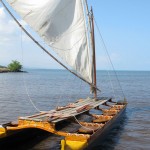
A Hawaiian double hulled canoe awaiting a crew below Pu’ukohala HeiauI use a plugin called, simply enough, WordPress Database Backup. The plugin is easy enough, just a few settings to make.
The settings are fairly stright forward to figure out… You can choose to exclude storing post revisions and any spam comments you may have not yet deleted. Any optional tables, not part of the basic WordPress setup, can be included. You can choose to set up an automatic backup at several different time intervals.
The plugin also gives you a few choices in what to do with the backup file. The backup can be stored on the same server as the site, emailed to the specified address, or simply downloaded to your local computer. I generally trigger my backups manually and download them to my local machine for storage at home.
The result is a compressed file containing the necessary SQL code needed to recreate the entire WordPress database. For DarkerView, a three year old blog with almost one thousand posts, the resultant backup file is just over a gigabyte.
Unpacking and perusing the resultant backup file is interesting. Laid before you is the entire structure and contents of the site in SQL query statements. In the case of DarkerView this currently results in over sixteen thousand lines of SQL. Not having really looked at the back-end database before it is quite interesting to examine.
The backup file does not include the uploaded files, the images and thumbnails. It is necessary to copy this section of the blog manually. This is easily accomplished with an FTP session opened to the hosting computer and a single copy command.
While science observations may be almost a decade away, the science possibilities of the Thirty Meter Telescope are already eagerly anticipated by astronomers. In the attempt to answer many of the basic questions of our universe, the limitations of the existing telescopes have become apparent. The eight and ten meter telescopes that represent the forefront of astronomy today are reaching their limit, a limit the research astronomy community is ready to step past.
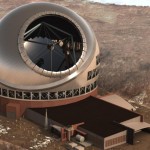
An overhead view of the proposed Thirty Meter Telescope, credit TMT Observatory CorporationTaking place this week is the Thirty Meter Telescope Science Forum. Over 140 astronomers and engineers representing all of the partner countries meeting in Waikoloa to discuss new science that will be made possible by the TMT.
One thing was clear from the science presentations… The science case for the TMT is compelling. The sheer size of the new telescope will allow observation of the early universe that is just out of reach of the current generation of large telescopes. The thirty meter primary mirror will provide significant advantages even over the next generation of space telescopes in resolution and flexibility of operation. The excellent site available on Mauna Kea allows advantages over the selected site for the European E-ELT in Chile.
While the goal of the conference is to look ahead. It is interesting that what is being presented is a wonderful summary of where current research stands today. In the effort to detail what research could be accomplish with TMT, the astronomers succinctly cataloged the state of current research as it is limited by today’s instruments and telescopes.
Much of the first day discussion was focused on the possibilities of observing the very early universe, the first stars and galaxies that formed in the era just after the big bang. Current telescopes can observe a few tantalizing glimpses of this era, just enough to show astronomers what they do not know about the formation of our universe. A few massive galaxies bright enough to be seen across the gulf of time, a few fainter galaxies that are luckily aligned with closer massive galaxy clusters. Clusters that form gravitational lenses that allow us to peer through a keyhole into the dim past. Astronomer have used every trick they can muster to allow observation of this first era. The TMT will open the door into this first era of stars, allow real study of the beginning of what we see around us today.
Planning for the TMT is in the final stages, where the capabilities of the telescope and the instruments can be forecast with reasonable assurance that those goals will be met. Astronomers can use the design data of the telescope to simulate exposures and signal to noise ratios of the data, on targets they can just barely see today. This sort of planning is critical to the astronomy community, it may be another ten years before science observations begin, but when they do the astronomers will be ready to use the telescope to its fullest capability.
This sort of feedback is critical to the engineers as well. As instruments pass through final development, it is important to know what capabilities are most valuable, what to prioritize when the final design is produced. Questions of spectral resolutions, throughput and exposure times are often heard in the discussions.
Through conferences like this one, the astronomy community will know what to expect when the new telescope comes online around 2022. They will be ready to push forward our understanding of the universe. We know what to expect. But, as Andrea Ghez reminded us, we must “Expect the unexpected!”. Many of the discoveries made by Keck and the other great telescopes of the current generation were completely unexpected. It is likely that the universe still has a few surprises for us.
Killer Tacos is not a tourist place. Hidden back in one of the little business strips in the old industrial park it is not likely to be found by wandering visitors.
The service counter at Killer Tacos, KonaWe often find ourselves looking for lunch in North Kona. Target, Pet Smart, and more, this is where the stores are, this is where we go shopping. There are a number of eating places in the Kona Commons shopping center, where we have often eaten in the past. This time Deb remembered another option, why not give it a try?
You can find Killer Tacos a couple blocks behind Target on Luhia, just past the four way stop at Kaiwi. Look makai for a busy little place in the middle of a strip mall of other, more industrial, businesses.
The storefront of Killer Tacos, KonaThe shop is a little reminiscent of mainland chains like Chipoltle Grill, with much the same basic concept. Bins and tubs of ingredients served in either tortillas or tacos, assembled in front of you the way you like it. It is a good formula, it works. As long as the ingredients are good the end product is good. No problems at Killer Taco.
When asked what meat I wanted my burro filled with I said “carnitas”. This received a funny look. Pork? Oh! I found it fun that staff serving Mexican food did not know the Spanish names of the items they were selling. Years past I often enjoyed eating Mexican meals in south Tucson, sometimes at places where you could not order without ordering in Spanish. This is however Hawai‘i after all. I continued to order in Spanish, it became a game, the gals behind the counter having fun trying to remember what each of the items was. Mexican food not made by Mexicans? It didn’t matter, it was still good food.
The food was a nice surprise, the prices were also a pleasant surprise. I suspect that not having to pay rent in a fancy neighborhood is an advantage. A meal for two cost us about what I would have expected to pay for myself alone. Fourteen dollars for two lunches and drinks. Good food, decent prices, and substantial portions… I may just be back here if I need a meal in North Kona.
A big brush fire in Kona today, just north of Kaloko. We were in the area for some diving and a few errands in Kona. A lot of fire department equipment responding, plus the helicopter doing air drops.
A large brush fire burning just north of Kaloko 20 July 2013
An evening conjunction of Mercury, Venus and Jupiter on 30 May, 2013Tomorrow morning and Monday morning will see a close pairing of Mars and Jupiter. While the two have been moving closer for a few days, during these two dawns the separation will be just under a degree.
Look for the pair to rise about 4:13am, almost two hours before the Sun. The two planets will be 20 degrees above the horizon at sunrise. They should be easy to spot with Jupiter at -2 magnitude and Mars dimmer but still easy at 1.5 magnitude. Look 8° below the pair for Mercury still rising towards maximum elongation.