Meeting Sean Faircloth and Richard Dawkins

There is one thing about working at Keck, everyone seems to come here.

I have met a few interesting folks working on the mountain… Famous astronomers like Alex Filippenko and Andrea Ghez, one of my favorite SciFi authors David Brin. Politicians of all levels, county through federal, routinely visit the facility. Just wait a bit, they will come.

Richard Dawkins
Richard Dawkins nice enough to pose with me for a quick photo despite the effects of jetlag and altitude.
This proved true again this week with visits from a pair of famous, infamous to some, visitors. Richard Dawkins is a British author and campaigner for science and reason in the public sphere. Sean Faircloth is an ex-politician, lawyer and eloquent speaker who has likewise taken up that torch. Knowing who was coming I had overstayed my usual shift on the summit to be around for an evening tour.

Unfortunately Richard was not in best form, his legendary wit and charm in short supply. I suspect a little too much travel combined with 13,600ft altitude was taking its toll, he was tired, but seemed to make the best of the tour. Sean on the other hand, was in fine form. The party was rounded out by Christopher Amos, Robin Cornwell, executive director for RDF and IfA astronomer Roy Gal. Our guests were full of questions about the facility and the work we were doing.

We toured the telescopes while the operators and astronomers were preparing for the night. It should have been no surprise that there were quite a few fans in this science centered place, even the visiting astronomers were fans, happy to pause and answer a few questions.

Dawkins Tour
Posing in front of Keck 2 are (right to left) Christopher Amos, Robin Cornwell, Roy Gal, Richard Dawkins and Sean Faircloth
Observing this night included the use of the Keck 1 AO laser and everyone was able to see the beam against a beautiful starry sky. I introduced Sniffen, one of our night attendants and laser spotters. Not that they could see his face, Sniffen was bundled to the eyes, comfortable in the spotter’s chair outside in the cold. The fact that we are mandated to use people to watch the sky for aircraft around the laser was an interesting subject of conversation.

It is always a bit odd meeting someone in person that you have known for years through electronic media. Having read their writings, seen the videos, you form a mental image of a person that may, or may not match who you meet. Personal interaction offers a chance to reconcile that mental image.

It was a pleasure to host a tour of Keck for guests such as these. People who tirelessly push back against the efforts of religious demagogues and extremists to control the path of our society.

Mercury and Saturn

As Mercury rises further from the Sun each day, Saturn is currently sliding into the sunset heading for superior conjunction. The two will pass each other on October 3rd through October 6th. The pair will be closest on October 4th, at a bit over 3° separation. The 5th will see the two quite close at about 3.5° separation. There will be about a magnitude difference in brightness between the two, with Mercury at -0.27 magnitude and Saturn at 0.69 magnitude. At about 15° above the horizon at sunset this will make for a nice pairing in the dusk.

Venus and Regulus

This morning finds Venus just 2° from the bright star Regulus, the brightest star in the constellation Leo. Tomorrow the pair will be much closer, about 42′. On the morning of October 3rd the separation will be much closer, a mere 29′. Despite its being among the brighter stars in the sky, Regulus is no match for Venus. The star’s 1.3 magnitude is vastly dimmer than the planet at -4.1 magnitude.

Walk through the Solar System

A scale model of the solar system, laid out along Mamalahoa Highway through the center of Waimea. That is what we create every year for the Waimea Solar System Walk.

Starting on the lawn of Keck Observatory headquarters you can walk from the Sun to the outer solar system at the Canada France Hawai’i Telescope headquarters. Four and a half billion kilometers reduced to one kilometer (2.8 billion miles to about 1/2 mile). At this scale the Earth becomes a the size of a small bead and Jupiter a marble. Walking a model like this give a whole new appreciation for the scale of our solar system, driving home the idea that space is really, really big.

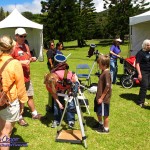
Dozens of kids and parents took advantage of the event to learn a bit about space and astronomy. Starting at the Sun they could wander from the inner solar system to the outer solar system. Passports handed out at Keck HQ were stamped at each planet along the way as the tour and each planet was manned by volunteers to answer questions.

Against the odds, it was a pretty nice day in Waimea. The characteristic strong winds and blowing drizzle was absent. We had sunny skies and when the wind died away in the afternoon, it became somewhat hot. This allowed for great views through the solar telescopes and nice conditions to stroll the length of the main street.

The experience was aided by volunteers who came in from organizations across the island, each bringing some educational fun to the planet walk. Nancy Tashima from the Onizuka Center covered Mercury, using some great material from the MESSENGER mission including 3D photos and glasses.

Gary Fujihara brought a splendid collection of meteorites. Using the asteroid belt as his home base to educate folks about the many minor bodies in the solar system and the material that falls to Earth.

Keck and CFHT staff put everything together and manned most of the booths. Members of the West Hawai’i Astronomy club helped out at registration and brought solar telescopes to view our Sun. Given clear skies in Waimea the view was fantastic. There were several good sunspots and wonderful prominences to be seen. It was great to see all those who volunteered their Saturday to help out.

A lot of smiling faces to be seen as kids and parents explored our solar system and learned. Always nice when you can slip a little knowledge in with the fun.

Comet C/2012 S1 ISON

A new comet discovered earlier this week has caught the attention of the astronomy community. Comet C/2012 S1 (ISON) was discovered Tuesday by a telescope affiliated with ISON, the International Scientific Optical Observation Network. This is a network of mid-sized telescopes dedicated to surveillance of the near earth region of our solar system.

The reason this comet is intriguing is a combination of a large estimated size and an orbit that appears to provide both a close approach to the Sun and favorable viewing from the Earth.

The comet will approach the sun as close as 0.012 AU on November 28th, 2013, quite close indeed. The comet will also approach Earth as close as 0.4 AU (60 million kilometers or 37 million miles) on December 26th, 2013. As a result this comet could achieve a magnitude well into the negative numbers, brighter than most objects in the sky except the Sun or Moon.

This comet is in addition to comet C/2011 L4 (PanSTARRS), expected to be an unaided eye comet during the spring of 2013. If we get lucky 2013 will be a great year for comets.

As I have cautioned in the past, comet predictions are to be taken with a good amount of skepticism. This could be a spectacular comet, or this could be a mediocre comet, we will just have to wait and see. In the meantime pay attention to the light curve as it nears the Sun. As my friend David Levy observed… “Comets are like cats; they have tails, and they do precisely what they want.”

A Line of Planets in the Sunset

As Mercury rises clear of the Sun’s glare it joins Mars and Saturn in the sunset sky. Tonight the three will form a nice line of planets. Mercury will still be quite low, about 12° from the Sun at sunset. Saturn is next in the line at 19° elevation at sunset. Mars will be over 30° high at sunset. As usual Mars and Saturn are about the same brightness, Mars at 1.2 magnitude, Saturn at 0.72. Mercury will be the brightest at -0.6 magnitude, which will aid in seeing the planets lower in the sunset.

The three will dance in the sunset over the coming weeks with Saturn and Mercury joining up for a close set around October 4th.

Dusty Road

Rush hour for Mauna Kea is just before sunset. This is when the day crews are coming down, while the summit tours and telescope operators are heading up.

The timing of this rush can be variable depending on time of year and what time sunset occurs. Twice a year this rush is at its worst, when everyone heads up and down at the same time. This can lead to some difficult driving conditions… A lot of vehicles on a road that can be challenging. A cloud of fine cinder dust and a setting Sun just adding to the confusion…

Dust Out
Fine cinder dust creating a hazardous “dust out” condition on the Mauna Kea summit access road