A line of bright planets will grace the dawn sky over the coming week. While Mercury has passed maximum elongation and is now headed back into the Sun’s glare, it is still 16° above the horizon at sunrise. Well above Mercury the brilliant Venus is hard to miss, 44° above the horizon at sunrise. Even higher in the sky is Jupiter, at about 67° elevation at sunrise.
Tomorrow morning will see a crescent Moon in the lineup, about 40% illuminated and above Jupiter. Over the next 7 days the Moon will work its way along the line, waning ever thinner as it goes. On the 11th the Moon will be under 2° above Jupiter, On the morning of the 13th the Moon will be very close to Venus, just over 1° away.
The changeover is inevitable. LEDs are the most power-efficient commercially available light source. Their longer lifetimes, greater light-per-watt and lower installation costs make it only a matter of time before most light sources in the world are LED. The fixtures and bulbs are still notably more expensive, but that’s offset by lower energy usage and longer lifetimes.
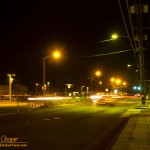
Downtown Waimea with new streetlightsNo light is exempt from the LED changover, not even the ubiquitous streetlamp.
Streetlights consume an enormous amount of the power generated across the globe. Here in the islands, where power is more expensive than much of the nation, the power savings make LED streetlights very attractive. As Hawai’i County taxpayers this is something that we should all be concerned with, we pay the power bill for the thousands of streetlights across the island.
The best competing technology is low pressure sodium (LPS). It is this streetlight technology that is currently used throughout Hawai’i. LPS emits all of its light at a single wavelength, 589nm, a golden yellow. Many people dislike the yellow color, and it can be confused with the yellow of a changing intersection signal. The large LPS bulbs are difficult to design fixtures around, resulting in lamps that throw light in all directions, not just where needed. As a result, many LPS fixtures create a lot of glare for drivers and surrounding homes and businesses.
LPS lights do have advantages, of course. They are quite power efficient, emitting all the light near the peak sensitivity of the human eye. Astronomers prefer the light of LPS lamps, as the single wavelength can be easily filtered or simply ignored when seen in their data. Between the power savings and the astronomy friendly aspects, LPS had been the outdoor lighting of choice across the state. The result is the familiar golden glow above any urban area in the islands.
But change is coming, with LEDs already beginning to replace LPS streetlights. Hawai’i County has planned for some time to convert to LED technology and evaluation of the new lamps has been going on at several test locations. With the success of those tests more widespread deployment is just beginning. This last month the new LED streetlights were installed around the town of Waimea. For many this is the first chance to see the new lights in place.
The recent conversion allowed an opportunity to compare the new with the old. Taken midway through the change out, the photo shows the new lights down the right side of the street, while the older low pressure sodium lights have yet to be replaced on the left side of the street. In order to faithfully reproduce the scene, the photo was taken in raw mode with daylight white balance used to produce the image shown.
The new lights are dramatically better than the old, unshielded LPS lights. Because of their vastly reduced glare, you simply do not see the lights themselves from any distance. Even nearby the lights do not produce the distracting glare of the older designs. Note, also, that all of the older LPS lights create yellow halos of glare in the photo, all the way down the street. While the new LED lights become hard to see once you are out from underneath the light. In the photo, the third LED light from the camera is just seen and the fourth is hard to pick out.
The improvement is immediately noticeable while driving the main street of Waimea. The LED lights are difficult to see directly, while the light provided on the roadway is just as good if not better than the older LPS fixtures. This is a street that has substantial pedestrian traffic and other vehicles pulling in and out of the many businesses, so good visibility is critical for safety.
The comparison here is not completely fair. The low pressure sodium fixtures used on much of the island, including Waimea are poor examples of modern lighting design. Well-designed low pressure sodium fixtures would compare somewhat more favorably. Still, LED’s are easier light sources to design a decent fixture around because LED’s are nearly point sources, not a large gas tube. Designing a good reflector and a decent cutoff shield is quite difficult for low pressure sodium bulbs.
One advantage of the better light design is reduced “light trespass.” That means less light shining onto areas where it is not needed. Directing the light properly onto the roadway means less light shining into the windows of adjacent homes, or upwards to light the sky and outwards to confuse birds or sea turtles.
Additionally, the new LED lamps installed on the island have specially designed blue cutoff filters. This is critical for the observatories. White LED lights use a blue or violet LED to excite a phosphor that converts the blue light to a white light. After the conversion a large amount of this blue light leaks through the phosphor. It is this blue light that is most troubling to astronomers because it readily scatters in air, an effect called Rayleigh scattering. This is the same effect that makes the sky blue during the day. The sky is naturally darker in the blue region of the spectrum, thus any light pollution at this wavelength creates a larger impact on astronomy. The special filters, therefore, keep the LED lamps from backfiring and creating more light pollution.
So far Hawai’i County’s conversion to LED lights is just beginning. One thousand lamps were ordered, and only a handful have been installed so far, mostly near intersections. While we hope that the effects improve safety, reduced light pollution, and reduced power bills, it will be some time before we see the real impact of the new lights and have a chance to measure the changes.
Mars is fast approaching a rendezvous with both Saturn and Spica this week. Currently moving in retrograde, the red planet will pass between the ringed planet and the star. All three will be close to 1st magnitude. Saturn and Spica are currently about 4.5° apart. Mars will pass directly between the two on the 13th, just under 2° from the star.
The trio will be close for a couple weeks. On the 21st a thin crescent Moon, 24% illuminated, will join to create a very nice quartet.
The second feline arrived this week. Another bundle of energy wrapped in fur is now bouncing around the house.
Rasalhague mugging for the cameraAs mentioned with Electra, household rules dictate that the chosen name is taken from stellar catalogues. I had the name chosen years ago and have oft threatened to use it… Rasalhague!
That look on your face? I have seen it already, on the face of a few folks when I mention the name. This includes the face of the Humane Society officer who gave me that same look. Try that again… I carefully pronounced it… Rass-al-ha-gway. She just shook her head and then asked me to spell it so she could type the name into the computer to complete the adoption paperwork.
You know the constellation! It should have been one of the signs of the zodiac, as familiar as Leo, Sagittarius, and Aquarius. The planets and Sun do go through this pattern of stars, but for some reason the ancient astrologers decided to ignore it. I like the constellation, situated just above the galactic core it is rich in targets for a telescope.
The name will, of course, be shortened to Ras for everyday use.
So far the name fits, even if corrupted to Rascal or other variations. While the name may roughly translate to “Head of the Serpent Collector”, there are no snakes in Hawai’i to collect. We have already found one dead gecko in the house. It appeared to have run afoul of the kittens, we just do not know which one.
Anything stringy or dangling, remotely snake-like is attacked. We have had to put away anything with a cord. Even so I found that the headphones I use with my iPad were only working in one channel, no sound to the left ear. Fixed, though the cord is now eight inches shorter.
A single kitten in the house is a shock, two is sheer mayhem. The first day was non-stop chasing and wrestling. This has settled down to where they only attack each other every five minutes. There is hope… When you are not looking they are curled up with each other.
It is nice to have a lively house again, perhaps a mite too lively. I expect it will settle down… In a couple years.
With the appearance, size and color of a rose, the moniker Reef Rose seems to fit. In reality these are the eggs of a large nudibranch, the Spanish dancer. Not at all hard to spot, I had been finding these for years before actually seeing the parent.
I always make a point to check the egg mass closely. There is another nudibranch, a tiny parasitic nudibranch that eats the eggs of the Spanish dancer, a species unsurprisingly called the egg-eating nudibranch.
The eggs of a Spanish Dancer nudibranch (Hexabranchus sanguineus) at Three Tables, Oahu
Mercury is beginning a morning apparition this week. Look directly above the sunrise for a starlike object shining at 3.2 magnitude. The planet will be over 10° from the Sun today, rising a little further each day until maximum elongation on August 16th.