M61 with a Supernova

M61 has been particularly bountiful when it comes to exploding stars. This should not be a huge surprise as M61 is also experiencing rapid star formation. With a lot of new stars around some of the largest stars will die early and die big.

Early this month the Zwicky Transient Facility noted a new supernova in M61, now cataloged as SN2020jfo. This explosion is now visible at 14.7 magnitude and can be seen by modest amateur telescope of at least 8-10 inches aperture.

Eight supernovae have now been observed in M61: SN 2020jfo, SN 2014dt, SN 2008in, SN 2006ov, SN 1999gn, SN 1964F, SN 1961I, and SN 1926A, an unusual number for any galaxy. In contrast our Milky Way galaxy last experienced a supernova in 1604.

Between shooting other targets I stopped by M61 last night to take a few exposures of the galaxy and see this supernova for myself.

NGC4303 - M61 with supernova SN2020jfo on the evening of Mar 14, 2020
NGC4303 – M61 with supernova SN2020jfo on the evening of Mar 14, 2020

Comet C/2018 W2 Africano

A modest comet is currently crossing the evening sky, at about 8th magnitude C/2018 W2 Africano can be appreciated in small telescopes. Last week I decided to add it to the target list for a few images.

The many images are registered on the comet during processing. Each image showing the motion of the comet as it moves fairly quickly among the stars in the hour or so the camera was taking frames. Thus the stars become multicolored streaks in this combined image…

Comet C/2018 W2 Africano taken on the evening of Sept, 24th, 2019 as it passed through Pegasus

Pleiades in Color

OK, I have color. Getting there, but not quite happy with the result. This is my first attempt at LLRGB layering to assemble the color and luminance data.

Too much noise and structural information is coming through with the color data. I had to use a lot of noise reduction in final processing.

Some odd rectangular structure around bright stars that might be coming from the microlenses of the CMOS sensor. This shows in the color data, but not so much the luminance.

Still have some learning to do…

The Pleiades, color image through LRGB filters

Pleiades

As I get back into astrophotography I am starting to conquer the little issues that make huge differences in the results.

I did get a nice session in last week, with several targets imaged. I am still struggling with processing LRGB color data and have some learning ahead of me. In the meantime the monochrome luminance images look pretty good.

I had hoped to get some more telescope time in tonight, the weather decided otherwise. May as well process photos while I listen to rain on the roof.

The Pleiades anyone?

The Pleiades in  monochrome
The Pleiades in monochrome

A First Attempt

Just getting back into astrophotography after quite a few years of observing visually. A new camera, updated software, it seems like I am learning all over again.

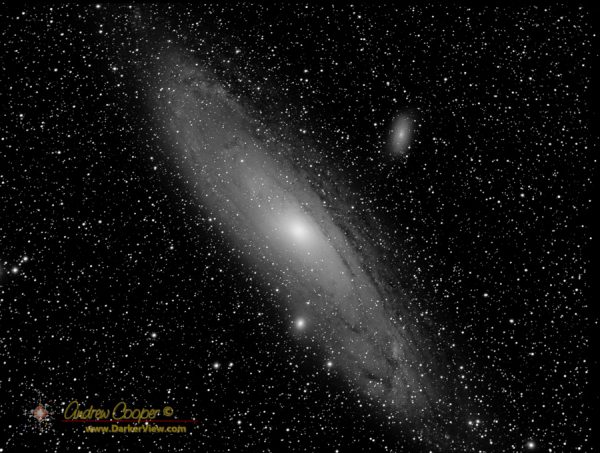
For a first run I processed a monochrome image of M31, the Andromeda Galaxy. A quick run of fourteen luminance frames, 8 at 5 minutes, 6 at 60 seconds combined into a single frame.

M31 or the Andromeda Galaxy, with M110 visible above and M32 visible below the core

I have color data for this image, but that will be a lot more processing. Given all of the various filters and calibration frames I really need to get the automated batch processing running before I do much color work.

Correcting a Baader Solar Film Solar Image

Take a photo with a thin film solar filter and you get a blue-white image of the Sun. Correcting this to a yellow gold image is fairly simple in most any photo processing package.

Baader Film Solar Image
The Sun as photographed through a Baader film solar filter
Correcting is probably the wrong word here. The Sun is actually closer to white as we define color. After all, the Sun is our normal source of light, what our eyes evolved to use.

Color is a fluid subject, simply our interpretation of frequency across a very small slice of the electromagnetic spectrum. As such there is no absolute right and wrong, just a set of conventions we normally use.

The issue is that people expect the Sun to be yellow-gold. Present an image of the Sun in any other hue and it is rejected as fake, or false color. We are accustomed to certain visual cues to identify and interpret our world, color is a major part of that. Unless you want to argue with a million people or two, you are better off making your Sun photos yellow-gold.

Continue reading “Correcting a Baader Solar Film Solar Image”

Milky Way Gallery

Nebulae!!