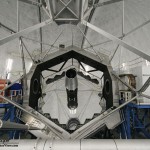
It used to be that if astronomers wanted to get rid of the blurring effects of the atmosphere, they had to put their telescopes in space. But a technology called adaptive optics has changed all that.
Always a good thing when a system I put so much of my life into receives some good press!
Uranus in two different wavelength, with and without the AO system on, credit Hammel/de Pater/Keck
The Observatory seeks a Student Assistant to support the Computer System Administrator on a variety of computer software/hardware oriented assignments.
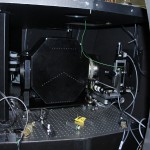
Looking into the optics of the Keck 2 telescopeEssential Functions:
Hardware and software data entry.
Windows computer software/hardware configuration/troubleshooting
Tape organizing.
Shipping and Receiving support.
Network Table data entry.
Assist as primary help desk for Systems Administration group.
Work effectively with coworkers and others by sharing ideas in a constructive, positive manner; listening to and objectively considering ideas and suggestions from others; keeping commitments; keeping others informed of work progress and issues; addressing problems and issues constructively to find mutually acceptable and practical solutions; and respecting the diversity of the WMKO workforce in actions, words, and deeds.
Maintain commitment to a high standard of safety, comply with all safety laws and WMKO safety policies/rules, and report actual and potential safety violations to appropriate supervisory or management personnel to further WMKO’s core value of safety.
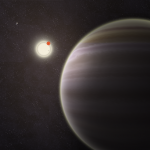
An artist’s illustration of the exoplanet PH1, Credit: Haven Giguere/YaleDr. Charles Beichman, executive director of NASA’s Exoplanet Science Institute at Caltech, will talk about how the dynamic duo of NASA’s Space Missions and Keck Observatory has led to some of the most exciting astronomy results in recent history.
Tuesday
June 25, 2013
Starts at 7 p.m.
Kahilu Theatre, Waimea
Free and Open to the Public
NASA’s Space Missions have identified more than 3,000 possible planets outside of our solar system and Keck Observatory has confirmed the existence of nearly half of the some 900 proven to exist. Join us for another Astronomy Talk to hear about this fascinating field of science unfolding before us.
These lectures are supported by Rob and Terry Ryan and Keck Observatory’s Rising Stars Fund.
The least massive galaxy in the known universe has been measured by UC Irvine scientists, clocking in at just 1,000 or so stars with a bit of dark matter holding them together.
This image shows a standard prediction for the dark matter distribution within about 1 million light years of the Milky Way galaxy. Image credit: Garrison-Kimmel, Bullock (UCI)The findings, made with the W. M. Keck Observatory and published today in The Astrophysical Journal, offer tantalizing clues about how iron, carbon and other elements key to human life originally formed. But the size and weight of Segue 2, as the star body is called, are its most extraordinary aspects.
“Finding a galaxy as tiny as Segue 2 is like discovering an elephant smaller than a mouse,” said UC Irvine cosmologist James Bullock, co-author of the paper. Astronomers have been searching for years for this type of dwarf galaxy, long predicted to be swarming around the Milky Way. Their inability to find any, he said, “has been a major puzzle, suggesting that perhaps our theoretical understanding of structure formation in the universe was flawed in a serious way.”
It began, as all these things do, with a phone call from Liz…
“It’s stuck”
“What is stuck?”
“SFP won’t move in K2AO.”
“Do not try to move it any further, I am up tomorrow for SegEx, I will go look at it.”
Looking into the partially disassembled side of the Keck 2 AO BenchLast time we tried to free up the SFP stage when it was stuck we carved an L shaped gouge in the cover plate. This is the hazard of optics that move under computer control. We tell the computer to move these optics under the assumption that the encoder position indication is correct, sometimes it is not. In reality there is no way to actually see where the stage is, an optical assembly moving deep within the AO optical bench. For most of the optical stages this is not a problem, if the encoder is not correct you can just reinitialize it and regain the position, the stage can not actually hit anything.
SFP is different, it can crash into the rotator if it gets lost. There is no real way to fix this issue, it has to be this way. SFP stands for Simulator Fiber Positioner, an artificial star created with a optical fiber. Placing the tip of the fiber at the telescope focus creates a bright dot of light that we can use to align and calibrate the AO system. The three axis stage can move the fiber into the light path and accurately position it just where you need it for system tests. There is also a diagonal mirror used to inject light from the telescope simulator and the spectral calibration source mounted atop the simulator.
An international team of scientists using the most powerful telescope on Earth has discovered the moments just after the Big Bang happened more like the theory predicts, eliminating a significant discrepancy that troubled physicists for two decades. The discovery will be published in the international journal Astronomy & Astrophysics on June 6.
The image illustrates the detailed modelling of a small piece of the surface of an old metal-poor star used to derive its abundance of lithium-6. Image credit Karin Lind, Davide De Martin.One of the most important problems in physics and astronomy was the inconsistency between the lithium isotopes previously observed in the oldest stars in our galaxy, which suggested levels about two hundred times more Li-6 and about three to five time less Li-7 than Big Bang nucleosynthesis predicts. This serious problem in our understanding of the early Universe has invoked exotic physics and fruitless searches for pre-galactic production sources to reconcile the differences.
The team, led by Karin Lind of the University of Cambridge, has proven the decades-old inventory relied on lower quality observational data with analysis using several simplifications that resulted in spurious detections of lithium isotopes.
Two hungry young galaxies that collided 11 billion years ago are rapidly forming a massive galaxy about 10 times the size of the Milky Way, according to UC Irvine-led research conducted on the W. M. Keck Observatory and other research facilities around the world. The results will be published today in the journal Nature.
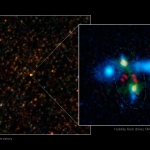
The image at right shows a close-up of the colliding galaxies in red and green. The red data show dust-enshrouded regions of star formation. The green data show gas in the merging galaxies. The blue spots are visible-light observations of galaxies located much closer to us. Credit: JPL-Caltech/UC Irvine/Keck Observatory/STScI/NRAO/SAO/ESA/NASACapturing the creation of this type of large, short-lived star body is extremely rare – the equivalent of discovering a missing link between winged dinosaurs and early birds, said the scientists, who relied primarily on data from Keck Observatory’s NIRC2 fitted with the laser guide star adaptive optics (LGSAO) system. The new mega-galaxy, dubbed HXMM01, is the brightest, most luminous and most gas-rich submillimeter-bright galaxy merger known.
HXMM01 is fading away as fast as it forms, a victim of its own cataclysmic birth. As the two parent galaxies smashed together, they gobbled up huge amounts of hydrogen, emptying that corner of the universe of the star-making gas.
“These galaxies entered a feeding frenzy that would quickly exhaust the food supply in the following hundreds of million years and lead to the new galaxy’s slow starvation for the rest of its life,” said lead author Hai Fu, a UC Irvine postdoctoral scholar.
The discovery solves a riddle in understanding how giant elliptical galaxies developed quickly in the early universe and why they stopped producing stars soon after. Other astronomers have theorized that giant black holes in the heart of the galaxies blew strong winds that expelled the gas. But cosmologist Asantha Cooray, the UC Irvine team’s leader, said that they and colleagues across the globe found definitive proof that cosmic mergers and the resulting highly efficient consumption of gas for stars are causing the quick burnout.
Bad news today, the Kepler Spacecraft has suffered a mechanical failure. As feared, one more of the reaction wheels that keep the spacecraft stabilized has failed. Of the set of four reaction wheels two have now failed, at least three are required to continue the mission.
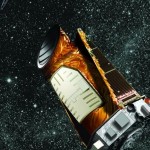
Artist’s rendition of the Kepler Spacecraft in orbit around the Sun peering at a distant solar system, press release image from the NASA Kepler websiteKeck and Kepler have been a potent team in finding and confirming hundreds of exoplanets. Kepler detects alien world through the transit technique, the very slight dimming of a star as a planet passes in front. Data from an instrument such as Keck’s HIRES spectrograph is required to confirm the find through the use of radial velocity data. Using the technique Kepler has discovered 130 extrasolar planets that are now confirmed. An amazing 2,700 possible planets are awaiting confirmation. Besides the discovery of exoplanets the Kepler data set has been a bonanza to astronomers looking for other phenomena. Magnitude data on more than 100,000 stars with unprecedented precision has allowed the discovery and study of a widerange of stellarphenomena.
Engineers will continue to see if the reaction wheel can be nursed back to some level of function in an effort to salvage the mission. The prognosis is not good, it is likely the Kepler mission has ended. In any case it will take astronomers years to learn what the massive haul of Kepler data can teach us and to work through the backlog of candidate planets. In a few years the spectacular success of Kepler will be followed up by TESS, the Transiting Exoplanet Survey Satellite, due for launch in 2017.
The Antennae Galaxies, NGC4038 & 4039 as imaged by MOSFIRE, image credit Keck ObservatoryJoin the W. M. Keck Observatory for an evening of astronomy presented at the Kahilu Theater.
MOSFIRE is the newest and the most advanced astronomical instrument available today. Dr. Ian McLean from UCLA will describe some of the technical challenges developing and commissioning this multi-year, multi-million dollar instrument. He will also share early science results ranging from the discovery of ultra-cool, nearby substellar mass objects, to the detection of oxygen in young galaxies only 2 billion years after the Big Bang.
Wednesday, May 22, 2013
Show starts at 7 p.m.
Free and Open to the Public