
Happy Fourth of July
When you want to see the stars, find someplace dark


Today the Earth is furthest from the Sun, a point called apehelion. We will be about 152,098,232km (94,509,459miles) from the Sun. Compare this to the 147,098,290km (91,402,639miles) we were at perihelion on Jan 4th, a difference of about 5,411,169km (3,362,344miles) occurs throughout one orbit.
It may seem odd that we are actually at the furthest for the middle of northern summer, you just have to remember that proximity to the Sun is not the cause of the seasons. The seasons are caused by the axial tilt of the Earth, creating short and long days throughout the year, with a resulting change in the angle and intensity of the sunlight.
| 2012 Solstices and Equinoxes | ||||
|---|---|---|---|---|
| UT | HST | |||
| Perihelion | Jan 5 | 03:59UT | Jan 4 | 17:59HST |
| Spring Equinox | Mar 20 | 05:14UT | Mar 19 | 19:14HST |
| Summer Solstice | Jun 20 | 23:09UT | Jun 20 | 13:09HST |
| Apehelion | Jul 4 | 23:59UT | Jul 4 | 13:59HST |
| Fall Equinox | Sep 22 | 14:49UT | Sep 22 | 04:49HST |
| Winter Solstice | Dec 21 | 11:12UT | Dec 21 | 01:12HST |
| Source: USNO Data Services Website and the NASA Sky Calendar | ||||
W. M. Keck Observatory Position Announcement…
The W.M. Keck Observatory operates two of the world’s largest and most scientifically productive optical/infrared telescopes located on the summit of Mauna Kea on the Big Island of Hawaii. A highly capable and motivated staff operates, maintains and develops the complex telescope systems and infrastructure on the summit. We seek an Infrastructure Technician-Electrician to join this high-caliber team.

Commitment to WMKO’s core values, working well with others, and the ability to handle multiple tasks and priorities within a fast paced environment are all essential. For a full listing of duties and qualifications for this position, please go to: www.keckobservatory.org/about/employment
W. M. Keck Observatory Position Announcement…
The W. M. Keck Observatory (WMKO) has an immediate opening for a software engineer to support scientific programming needs for the Keck Observatory Archive (KOA). The successful candidate will work with the Keck Archive Scientist and other members of the KOA team and software group on all aspects of KOA software development: defining requirements, developing algorithms, writing applications, testing and implementing software, preparing documentation, and supporting software and users. Special attention will be paid to applicants with strong skills and experience in astronomical data reduction, especially spectroscopy.

Minimum qualifications for this position include a Bachelor’s degree in computer or physical sciences, or engineering, and at least 5 years of programming experience. Required are a good knowledge of database design, a high level of competency in SQL, PHP, C and C++ or JAVA programming; good knowledge of IDL, IRAF, Matlab or Python; experience in a Unix environment, experience developing web enabled database applications, good communication skills, good applied mathematical/statistical skills and the ability to work as part of a team. Desirable skills include an advanced degree, knowledge of astronomical data archive, familiarity with FITS data format, astronomical CCD image data, and astronomical data manipulation software.
This position requires you to submit your resume on-line at: http://keckobservatory.iapplicants.com/ViewJob-324999.html with your cover letter that states why you are uniquely qualified for the position.
Additional information about WMKO and this position may be found on our web site at www.keckobservatory.org
A close relative of seahorses, pipefish are usually found sheltering in crevices or small caves. They are not uncommon sights for anyone who makes a habit of investigating the nooks and crannies of the reef…

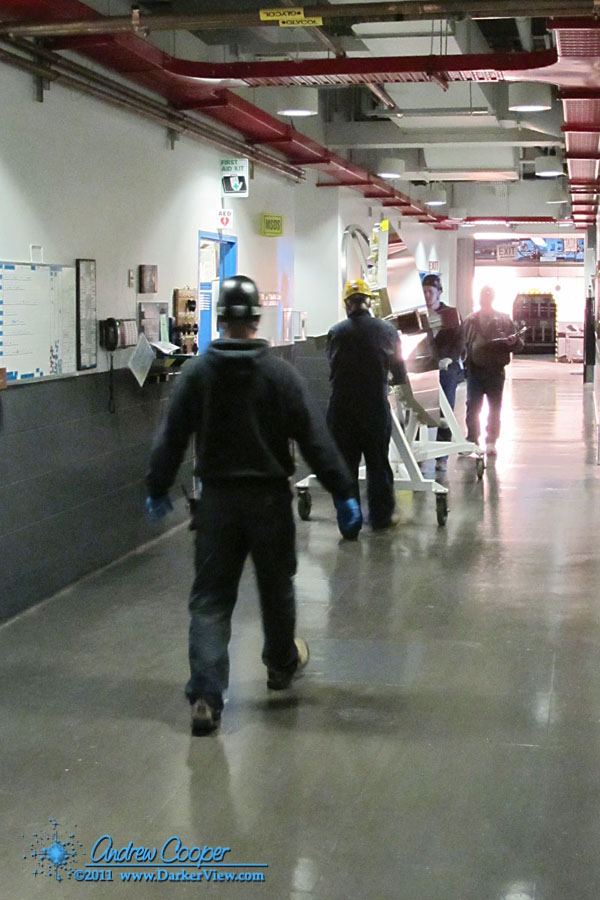
The radio call goes out… “Mirror in the hall, mirror in the hall!” Everyone gets out of the way as a mirror segment is rolled down the central hallway. It is being moved to the coating facility where it will be cleaned, stripped and re-coated with a layer of fresh aluminum.

Today Mercury reaches maximum elongation, the furthest point it will reach from the Sun in the sky and the highest it will be above the sunset this apparition. The planet is easily visible as a bright, starlike object about 15° above the setting Sun as the sky grows dark. Over the next couple weeks Mercury will slide back into the sunset, heading for inferior conjunction on Jul 28.