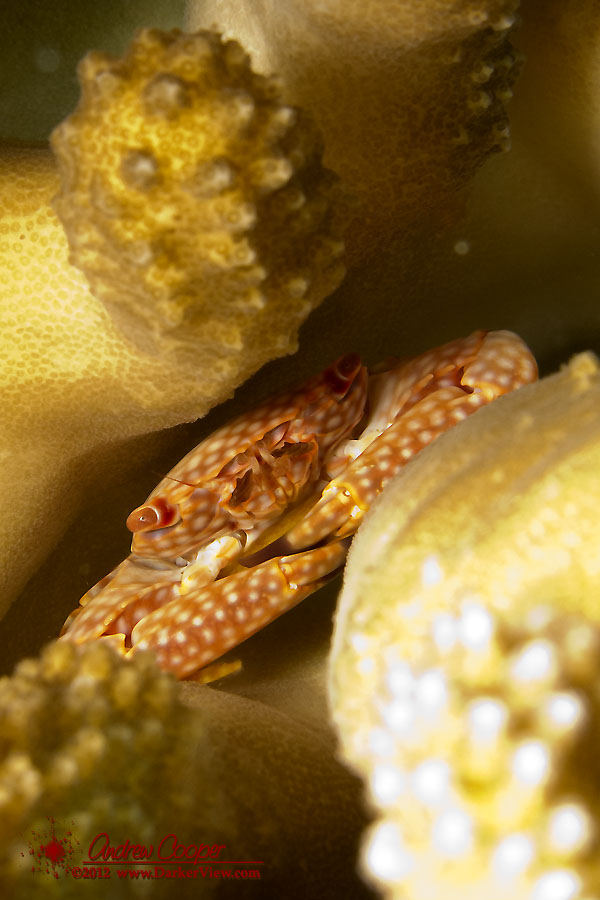
Guard Crab
When you want to see the stars, find someplace dark

A pretty crescent Moon will join Venus in the evening sky tonight. The pair will be a little less than 6° apart with a 13% illuminated Moon. It should make a lovely pairing high in the dusk.
The morning routine was predictable… Moments after the first notes from the alarm clock there would be a familiar thump at the foot of the bed. That would be followed by whiskers in the face. Time to get up and start the day, which included feeding the cat.
Not this morning, nor tomorrow, nor anytime soon…
Today I buried a cat that had been part of my life for 16 years.
No more expectant eyes standing on the corner of the bed, demanding a skritch while I was attempting to dress for the day. Inevitably sitting atop of whatever clean shirt I had put there moments before. Gone is the purr from beside me while I attempt to get to sleep. I remember an escape artist that defeated my ever more elaborate barriers to keep a litter of kittens safely in a linoleum floored kitchen. I remember hot days of Tucson sun, lying in the shade of the old tangerine tree. I remember hours of yowling as we drove to San Diego, the first leg of the move to Hawai’i.
I picked her from the litter, the little grey furball. Named for the star Epsilon Canis Majoris, Adhara, sometimes spelled Adara. This star was once the brightest star in the Earth’s sky, though it has faded as it has drifted away from Earth over the eons.
Now, all we have in an empty house and freshly turned earth beneath an adenium in the front yard.

This evening will see a razor thin Moon just above the planet Jupiter, low in the sunset. The planet will be about 5° below a 3% illuminated Moon. The Moon itself will be only 19° from the Sun at sunset, about 18:42HST. It should be a dramatic scene with the pair immersed in the colors of sunset.

So often I talk to visitors who come from places where they might see a mere handful of stars. To live in or worse, to grow up in a major metropolitan area, is to lose the beauty that is our night sky. To lose the view of our universe is to reduce that vast universe to just our everyday world. You lose the imagination and sense of wonder that can change everything.
Maybe I am weird, I make a point to get out and spend nights under a dark sky. With a telescope I pass the night looking into the vastness of space. With that experience comes a broader understanding of the scale of our universe and our place within it. To see the galaxies, to know what they are, to gain a glimmer of understanding, it changes your view of who and what we are.
To me this is precious.
Light pollution may be an issue few understand. It has many consequences… Vast amounts of wasted energy and money, impacts on our health and the health of our natural environment. There are many reasons to minimize the impact of artificial lighting. Of these reasons, it is the loss of the starry night sky that can sever our connection to the universe.
This week is International Dark Skies Week. Take a moment to look up at the night sky and understand what you may have have lost.
The Magnificent Night Sky: How to Protect It from Keck Observatory on Vimeo.
Mercury and Uranus will meet up in the dawn over the next few days. The pair is separated by about 3° this morning. Tomorrow morning the separation will have diminished to about 2°19′. Close approach will be on the morning of April 22nd at almost exactly 2°. On the 23rd the separation will have increased to 2°14′. Both planets will be well up, about 17° elevation at sunrise.
While Mercury is easy to pick out with the unaided eye. Uranus will require at least a pair of binoculars to see at 5.9 magnitude. The close approach will aid in finding the outer planet. Check your charts, there are a couple 6th magnitude stars just as close to Mercury to confuse for the dimmer planet.
Yes, it is three in the afternoon and I am just waking up. That was the plan.
A night spent under dark Mauna Kea skies with a telescope. It has been much too long since I had a good night out with the ‘scope, it was time. A few items conspired to make it happen… Good weather, a note from the HR department that I was at maximum on accumulated vacation time, use it or lose it! Additionally, my friend and co-worker, Olivier Martin, was looking for a night of observing as well.
With a couple days of approved vacation I headed for the mountain.
A partly cloudy sky greeted us on arrival, high and heavy cirrus hid much of the blue. The forecast was for this to clear off during the first part of the night, not yet time to panic. Not wanting to deal with the crowd at the Mauna Kea VIS we hid out in a spot I found on one of the nearby back roads, a place where we would not be disturbed by any visitors through the night, a place that is completely dark.

Today Mercury reaches maximum elongation, the furthest point it will reach from the Sun in the sky and the highest it will be above the sunrise for this morning apparition. The planet is easily visible as a bright, starlike object about 15° above the rising Sun as the twilight begins. Over the next couple weeks Mercury will slide back into the sunrise, heading for superior conjunction on May 27.