I have been posting a lot of photos from others lately. Not something I do a lot of, I prefer to use my own shots. But when I get shots like this…

When you want to see the stars, find someplace dark

I have been posting a lot of photos from others lately. Not something I do a lot of, I prefer to use my own shots. But when I get shots like this…
That rock just moved, I am sure of it! Did it? Olivier was gesturing emphatically at a pile of coral rubble. I looked… I looked again, there must be something there. There was…

A light snowfall delayed our arrival at the summit this morning. It was really only a few inches, but as usual it drifted into all the wrong places. Thus ice and drifts on the road meant we were waiting for the snowplows to break through.
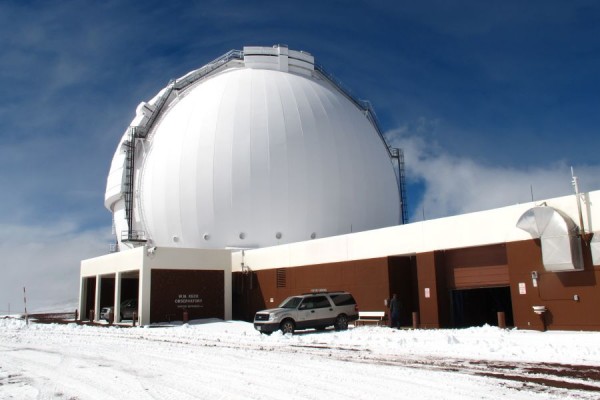
Waiting was no problem, the Sun was out, creating a very pretty mountain. Olivier and I walked up to Keck from below Subaru as the snowplow cleared the last bit of road. We both had cameras in hand, enjoying the scenery. Not a lot of snow, but a fair amount of ice on any exposed surface. A few days before Christmas it all seemed appropriate.
After a quick job in the AO bench we needed to wait for some adhesive to cure. I ended up joining in with the snow shovel crew, clearing our doors and walkways of small drifts. Shoveling snow is not easy at nearly 14,000ft. Breathing hard, but having fun…
There are some devices that folks still try to repair if possible, camera gear seems to be at the top of the list. I suppose this should not be a surprise, the gear is expensive, and seems to get damaged from hard use. Particularly on this island, where cameras see a wide range of harsh conditions, from tropical heat to salt water.
A month back I repaired a Pentax waterproof camera for a co-worker. Salt water had penetrated around the shutter button and corroded the switch. The camera, rated to 10m (30ft), had probably experienced pressures even higher. Her teenage boys can easily exceed that depth while free diving the island reefs. It was necessary to completely disassemble the camera to get at the button. Well over an hour of tiny screws and gaskets to replace a $1.35 switch.
There have been other items this year… A classic chrome stand microphone that required a little rewiring to work with a modern computer. A pair of very nice computer monitors now found on my desk. A toy RC aircraft with broken motor leads. I do appear to have gained a reputation for fixing this stuff.
Last week it was an underwater video camera case brought to me. None of the external controls were working, no way to hit record once in the water. The repair turned out to be fairly simple, a broken conductor in the LANC cable used to control the camera. A bit of scrounging around in my spare parts to build a replacement cable was all that was required to put everything right. Most repairs are that sort of simple, just the effects of wear and tear taking their toll.
After the repair J sent me a link to his YouTube channel and I spent a lunch watching video. Well edited, nicely crafted videos of the local paddling sport community. Canoe races and special events covered with a personal touch, with respect for the people and traditions. I was very happy to see I had done a bit to help someone who was producing such excellent material.
The repairs serve me as well. Each time I take apart an unfamiliar device I learn, I refresh my skills, I experience the simple joy of using those skills. Each device is a challenge, to successfully disassemble the gear, find the fault, and put it all back together properly. On occasion I fail in that challenge, either I do not have the skill, or the repair is impractical, or the device too badly damaged. There is often little real risk, if it is broken the attempt to save something useful from the trash is an easy choice, the only thing lost is the effort. The reward is seeing the gear returned to useful service and knowing you prevented that little bit of waste.
I wonder what will come my way next time?
An example of J’s VideosI did attempt to see comet C/2011 W3 Lovejoy in the daylight. I actually tried several times. Once on the morning of the 15th and a couple more times on the morning of the 16th after I heard that the comet had survived perihelion passage. Neither time did I see the comet with an unaided eye.
On the 15th I was not surprised I could not see it. I was in Waimea where there was a lot of low altitude haze and a lot of glare around the Sun. On the 16th I had a much better chance using the clean high altitude air of the summit of Mauna Kea. But still, no comet seen even though it should be just over four degrees from the Sun. This is about the same separation that had allowed me to see comet McNaught in early 2007.
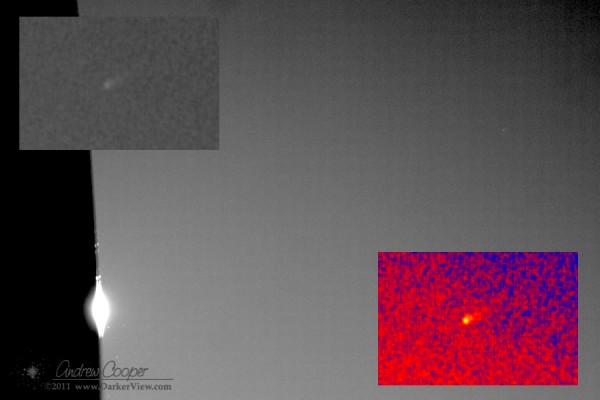
Just to be certain I set the camera on a tripod, placed it just inside the shadow of the Keck 1 dome, and blazed away. Examining the photos on the camera display likewise revealed no trace of the comet, but there were some interesting spots of light.
It was not until I sat down and really analyzed the raw frames that I found something. Using some astronomy software, I calculated the position of the comet when the shots were taken and the field of view of the camera. And lo! There it was, a small spot with a trace of tail. It showed up best in the green channel, and not at all in the blue thanks to Rayleigh scattering in our atmosphere. Stacking nine of ten frames and processing the heck out of the frames does allow you to clearly see the comet…
the Kona Coast is riddled with caves, old lava tubes, wave carved openings in ancient sea cliffs, or simple small openings in the coral. The caves are high on many diver’s priority lists when exploring the reef. In these caves you find many species that hide during the light of day, lobsters and night active fish. The larger caves offer a sheltered environment, safe from the pounding winter surf. The walls are covered with colorful sponges and the nudibranchs that feed on them.
If there is a cave, you will probably note my fins disappearing into it.

Will Comet C/2011 W3 Lovejoy be visible in the daytime? This is the morning to find out. Look about 2° below the rising Sun once it is well up in the clear sky for a small white object. Two degrees is four times the Sun’s width in the sky.

I have seen one other daytime comet in my life, C2006/P1 McNaught back in January of 2007. That time the comet was about 5° from the Sun, over twice as far away from the glare. The photo at the right should give an idea of what to look for today. Remember to shield your eyes from the Sun’s glare by positioning yourself to put the Sun behind some object like a wall or streetlight. There is no guarantee that Lovejoy will be at all visible, but it is worth taking a look this morning.
The annual Geminid meteor shower has become one of the most reliable annual meteor showers. First observed over 150 years ago this is a interesting meteor shower. The parent body for the Geminids is not a comet, but rather the asteroid 3200 Phaethon. It is somewhat of a mystery how this mostly rocky body gives rise to the debris stream needed to generate a meteor shower.
The evening of Dec 14th into the morning of Dec 15th is favored, starting around 8pm as Gemini rises in the east.
While the 2011 Geminids are expected to just as numerous as usual, viewing will be hampered by a bright Moon in the sky. Certainly the brighter fireballs will be easily visible, but the dim meteors will be lost to the moonlight. If you do wish to try your luck, view between midnight and dawn on the night of the 14th and into the morning of December 15th. It may be possible to see some meteors after the radiant rises, about 8pm, and before moonrise around 10pm on the evening of the 14th.
Watching meteors requires no more equipment than your eyes and a dark sky, and can be enjoyable for just about anyone. Set the alarm clock, this one should be worth the early morning wake-up.
Plans for a summit run and some lunar eclipse photography. A midnight alarm clock and departure for the summit was the strategy. I planned to shoot time lapse of the eclipse setting over the Keck telescopes. But the best laid plans sometimes hit a snag…
I had noticed some minor power loss and roughness in the engine heading into work. Some condensation in the system? Perhaps just some bad gas? It was on the way home that the trouble became truly clear. A rhythmic stutter accompanied by a more severe power loss. As I limped home listening to the engine I realized that at least one cylinder of the six was not firing. A faint smell of gas when I got out of the vehicle just seemed to confirm the hypothesis.
That evening I spent a bit poking at the engine, inspecting for a loose connection or some other easy cause. I removed and cleaned the mass air sensor, a known trouble spot. Checked the air intake and ignition system. Removed battery power to allow the electronic engine controls a full reset to default settings. Still, when I started it up there was that rhythmic stutter.

Instead I simply set the alarm clock for a bit before totality and watched the eclipse from my front lanai. I made no attempt at photography, I do have quite a few decent eclipse photos. Instead I simply watched as the Moon ghosted through a thin layer of clouds. It was quite pretty, a bright Orion and Gemini were visible through an opening for a while. Much of mid totality was lost to the clouds, but it opened up again at the end allowing a nice view of the first touch of direct sunlight on the Moon.
As for the vehicle? I still was not certain what was the issue. This could be the result of something truly serious considering the engine has well over 180,000 miles on it. Plans for a replacement vehicle are under consideration, but I love this old truck. The first new vehicle I had ever owned, a veteran of hot dusty Arizona mining roads, of icy mountain passes, of rocky Hawaiian coastlines carrying scuba gear in the back. How many times has this vehicle waited through the night, telescope setup beside it, while I explored the sky from some remote and dark campsite? A trusted steed that has carried me to so many great places and always gotten me home.
The maintenance manual has a list of a dozen things that can cause misfires. May as well start with the easy (and cheap) stuff. I drove Deb’s car into Waimea to run a few errands and pick up a set of ignition cables and spark plugs.

That would be almost two hours later, two hours of cursing the engine designers who would obviously not ever have to replace the plugs on this engine. Who puts a hard fuel line right in line with the spark plugs? I go back to the toolbox for the 3/8″ universal joint and spend a few minutes figuring out what combination of extensions will get me through which gap in the hoses and lines. Really? Is cylinder three’s plug under there? I will have to do it entirely by feel.
Finally! All plugs in place, cables neatly routed around the block, tools picked up from around the engine compartment, I have a chance to turn her over. A quick crank and she starts, idling with a smooth purr that is simply music to my ears. My old friend will be with me for a little longer.
This was the last total lunar eclipse for the next three years. I did watch it, remembering other total lunar eclipses across the years. An eclipse seen from among a stand of saguaro cacti in the Arizona desert, another eclipse watched from the Mauna Kea VIS just a couple years ago. A copper moon high over the broken walls and ruins of a 12th century priory. This eclipse will mark yet another memory, to be recalled when I again sit under a blood red Moon in the middle of the night.
These sea cucumbers are well known to divers and can be found in the local guide books. There is no scientific name, the species has never been properly described. An odd state of affairs for a relatively common critter. As for the name? I could come up with a few other common names that seem to describe the appearance. However, naming a species after a pile of doo-doo is not generally acceptable.
