One of the tasks I have helped with on the K1 AO Laser is aligning the Launch Telescope Assembly (LTA). This is not so much an electrical engineer’s task, but a mechanical one. So how did I end up with the task? Simple, I was present the first time it was done. Since the mechanical engineer who was first responsible has now left the observatory, I get the job by default. Just the way things work around here.
The launch telescope is a small telescope, about 0.5 meter in aperture, that projects the laser into the sky. Mounted behind the secondary mirror of the Keck 1 telescope, it must be precisely aimed to exactly the same spot in the sky the main telescope is aimed.
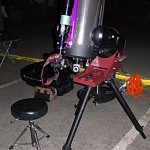
Adjusting the mounting of the K1 Launch TelescopeThe procedure is not all that difficult. Mount two dial indicators in place, restrain the motion by using wooden wedges or a really big c-clamp, loosen the bolts, make the adjustment, tighten the bolts. No problem, right? The challenge is to move the large assembly just a few thousandths of an inch and have it stay exactly where you want it while re-tightening the bolts.
In practice this adjustment is about one to two hours crouched in the secondary assembly of the Keck 1 telescope. Each time the bolts are tightened the assembly moves about 10-15 thousandths of an inch. Thus I have to guess how much to offset the measurement so it ends up correct when the bolts are tight. It takes anywhere from three to five repetitions to get right sometimes.
This is where I curse the mechanical engineer who dreamed up the mounting for the launch telescope. I look at the dial indicators, shift my stance against the cold steel to stop the cramping, loosen the bolts and try again.
The last adjustment was a mere 0.004″ (four one-thousandths of an inch) to move the pointing about 30 arc-seconds on the sky. I am now only about 10 arc-seconds from the optical axis. Keep in mind that a single arc-second is 1/60th of an arc-minute, which is in turn 1/60th of a degree. Ten arc-seconds is pretty good, but we want closer. Here I go one more time…
Deb spotted this one. I come over the coral head to find her gesticulating at a very large antler coral (Pocillopora eydouxi). These coral are always worth checking out, so many things live amongst the branches. These denizens are fascinating, and frustratingly hard to photograph deep in the branches.
This particular coral had a number of residents… A couple guard crabs and several fish, including this fellow…
Spotted Coral Blenny (Exallias brevis) at 15′ depth, Honokohau
Two years since I last left this rock, time for a vacation! We were off island for over three weeks, visiting family in Oregon, a little shopping for things we can not shop for on-island, and some time experiencing the mainland in general. Then it was off to Alaska for a couple weeks of fishing with family and friends.
As usual we were using one of the boats from the Nordic Tugs Charters of Juneau fleet, but new this year was that the boat in question is my father’s, an all new 42′ Nordic Tug named the Nordic Quest. A very comfortable boat, we were hardly roughing it while we explored the waters around Juneau and Icy Strait.
The Nordic Quest underway near Tenakee, AKMuch of the trip was spent fishing. Two weeks of trolling for salmon or dropping lines to the bottom for halibut. We caught more than a few, filling freezers with fish, and collecting a few fish stories. As usual Deb loved the fishing and was often found on the back deck with a pole. She caught some great fish including her first King Salmon. We did quite well catching salmon, not so well on halibut. I did have one big halibut on the line, briefly, until it broke a heavy steel leader!
One successful fishing story was going for crab. I dropped pots several times, and was rewarded with a rich haul of Dungeness Crab. We ate well! In my experience, Dungies are the best eating crab in the world! After many years of exploring the area we have learned a few good spots to drop the pots. There was one particularly memorable warm and sunny afternoon cooking crab on the back deck. We clustered at the back rail, cracking shell and savoring the succulent meat, laughing and throwing the shells overboard. We didn’t eat it all, extra crab was cracked for a dinner of crab cakes and crab salad. Not a bad day.
There was also a gorgeous day spent fishing on the open Pacific at the mouth of Cross Sound. A place where the sea can so easily provide miserable conditions was instead nearly flat, with hardly a cloud in the sky. We trolled for salmon around Yakobi Rock, landing silvers as fast as we could put the lines in the water.
We visited several places I had never been… The fishing settlement of Pelican is an interesting place. Built around a fish packing plant in the 1940’s the town features a long boardwalk along which the town is built. A cute cafe operates at the center of town along with a post office and city hall. The town is struggling after the closing of the fish packing plant, but folks were optimistic that the town will survive.
Steller sea lions Eumetopias jubatus fishing off of Point Adolphus, Icy Strait, AKHoonah is an Tlingit Indian settlement on Icy Strait. Here is a bit of real Alaska, a fishing town, off the beaten track, making a living from timber and salmon. This is changing even here as the town has recently become a stop for one of the cruise lines.
Near Hoonah is Point Adolphus, at this headland the bounty of the sea is concentrated. Abundant herring can be found here, so thick we can see the clouds of fish in the sonar. Salmon feed here before turning inland towards the streams and rivers to spawn. Sharing this rich habitat can be found dozens of Humpback Whales, Sea Lions, Eagles and more. The result is simply spectacular. Each time past the point we stop and drift for a while as whales move past and sea lions fish for salmon all around us. Four times we passed the point over the two weeks, resulting in hundreds of photos, and a view of nature usually associated with BBC documentaries.
Another stop was one of our favorites… Tenakee, a small village of a few dozen homes along the shore and a general store. We stop here for the hot springs, water coming right out of the rock at just the right temperature for a soak. A trail leads from town through the forest to a small river. A wonderful walk that allows exploration of the landscape underneath the carpet of trees seen from out on the water. A trail walked with some care, there are grizzlies here! This is the place I came face to face with a very big bear once upon a time.
Andrew Cooper fishing for Salmon in Icy Strait, photo by Deborah CooperWe spent a morning cruising up Tenakee inlet on a mission to find and watch bears. A very successful mission, we saw nine grizzlies in a couple bays. The bears are gathering near the stream in anticipation of the salmon’s arrival at the spawning ground. The fish are an essential part of the bear’s diet, the annual runs providing the food and fat that will see the bears through a long winter. Most of the bears we saw distantly, but one mother and cub allowed us to get quite close. She was eating grass just above a rocky shoreline, with deep water permitting us to bring the boat in very close to shore. We idled just a few yards away as she ate grass and occasionally looked up at the bank of cameras aimed at her and her cub.
A nice trip, measured in new memories, over two thousand photographs, and a cooler filled with fourty pounds of frozen salmon, halibut and crab. Yes, a direct flight from Juneau, via Seattle and into Kona allowed us to bring a full cooler back with everything inside still well frozen. As for the photographs? I will not bore my audience will too many, just a few selected frames to liven up the pages here on Darker View.
No, not produced by me. But a bit of video Keck & NSF commissioned to use in public venues. I have seen it a number of times, but recently stumbled over a copy posted to Vimeo. Just had to share…
Keck Observatory with soundtrack by Big Empty Field
The day ends late during an Alaskan summer, there are only a few hours of darkness each night. Sunset and sunrise last a long time, hours of low light in which the world becomes rich with color. Keep a camera handy at all times, you never know what you will see, what spectacular vista will greet the eye, or when an opportunity for a photo will present. Sun setting over Saginaw Channel, near Juneau, Alaska
There are reasons why I avoid sushi. I have cut apart too many deep sea fish, I have seen what is to be found on and in those fish. I really want those things to be well and truly dead before I consume them. Cook it!